

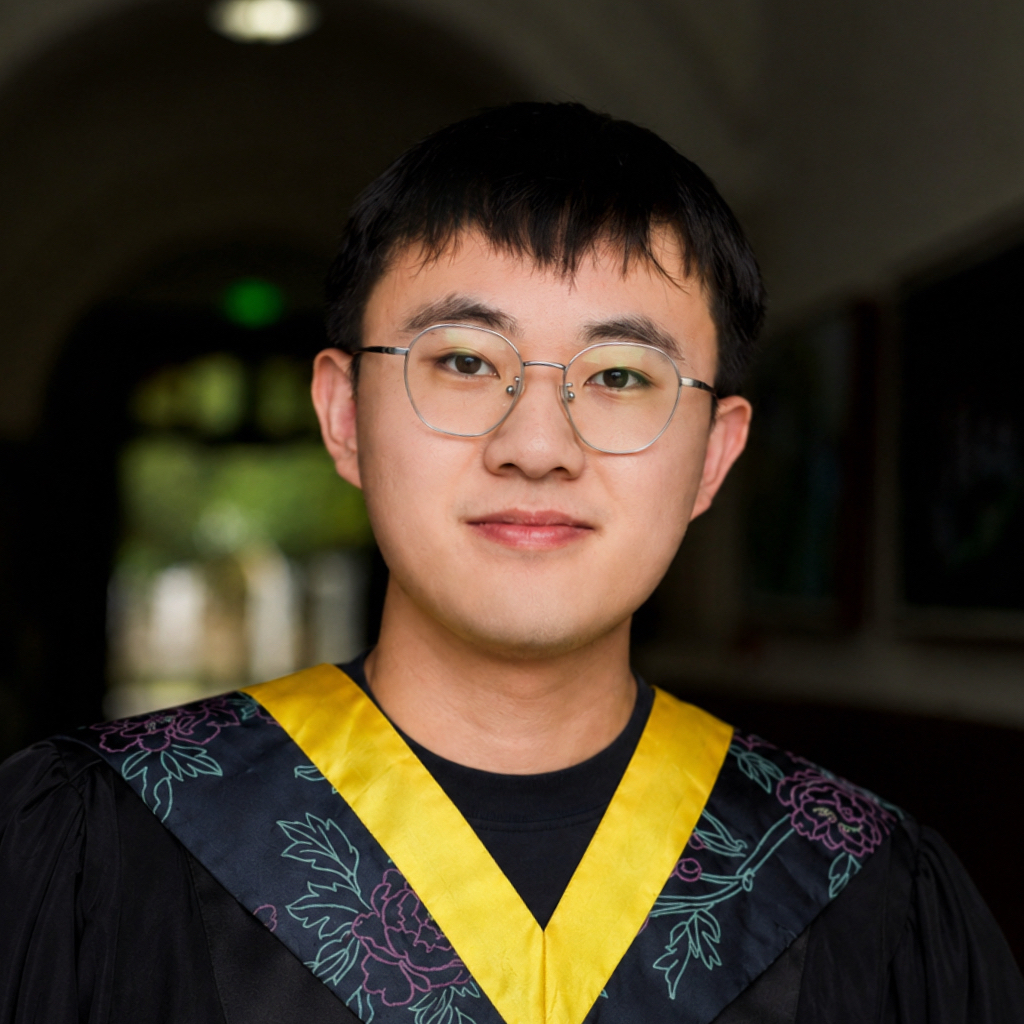
 Zhen Huang
· 2 previous affiliations
- Fudan UniversitySince 2025
- PhD student · 2025–2030
- Current
- Soochow University2021–2025
- Undergrad student · 2021–2025
6 other authors named Zhen Huang: Zhen Huang (National University of Defense Technology · 150 papers), Zhen Huang (University of Science and Technology of China · 32 papers), Zhen Huang (22 papers), Zhen Huang (2 papers), Zhen Huang (1 paper), and 1 more
Research Overview
Zhen Huang focuses on the reasoning capabilities of large language models, emphasizing data-efficient training and rigorous evaluation methodologies. His work explores how structured thought processes and reinforcement learning can elicit complex problem-solving skills from minimal data. Recently, he has expanded into benchmarking autonomous agents on multi-disciplinary cognitive tasks and open-ended scientific research.
Research Trajectory
In 2024, Huang introduced OlympicArena: Benchmarking Multi-discipline Cognitive Reasoning for Superintelligent AI, a comprehensive benchmark designed to assess the cognitive reasoning capabilities of AI models across challenging, multi-disciplinary problems. This work highlighted the limitations of state-of-the-art models in complex reasoning and multimodal integration, contributing to the broader area of Shifting from Static Benchmarks to Dynamic Evaluation and the research direction of Process Based Evaluation of Large Language Model Reasoning.
Building on these evaluation frameworks, his research in 2025 shifted toward optimizing how models acquire reasoning skills, particularly focusing on extreme data efficiency. With collaborators, he developed LIMO: Less is More for Reasoning, a method demonstrating that mathematical reasoning can be elicited using a highly curated dataset of just 800 examples. By utilizing cognitive templates to unlock pre-existing domain knowledge, this work challenged the long-held belief that massive training datasets are essential for reasoning. This advanced the area of Data Efficient Reasoning through Structured Thought Processes, as well as the direction of Rationale First Automated Evaluation. He further pushed the boundaries of data efficiency in reinforcement learning for language models with One Sample to Rule Them All: Extreme Data Efficiency in RL Scaling. This research introduced a "polymath learning" framework, showing that a single, strategically selected mathematical reasoning sample could produce significant multidisciplinary performance improvements, challenging fundamental assumptions about data requirements in reinforcement learning.
Moving into 2026, Huang's collaborative efforts expanded to the application and evaluation of autonomous agents in complex, long-horizon domains. He participated in the development of daVinci-Dev: Agent-native Mid-training for Software Engineering, a project that bridges static code knowledge and dynamic problem-solving. By training models on reconstructed GitHub pull requests and real-world execution traces, the method achieved strong results on the SWE-Bench Verified leaderboard while requiring significantly less data than prior approaches. This work intersects with research directions such as Multi-turn Iterative Code Generation and Refinement and Hardware Accelerated Simulation for Reinforcement Learning. Alongside this, he contributed to InnovatorBench: Evaluating Agents’ Ability to Conduct Innovative AI Research. This benchmark and platform evaluate whether AI agents can execute end-to-end scientific discovery. By pairing complex research tasks with a realistic environment supporting multi-machine execution, the study revealed that while frontier models show promise, they continue to struggle with the logistical patience and robust algorithm design required for real-world research.
Current Directions
The most recent papers in the evidence address the transition from static language modeling to dynamic, agentic problem-solving. Recent work investigates how autonomous agents can be trained and evaluated for long-horizon tasks, such as software engineering and end-to-end scientific research. A continuing theme is the emphasis on data efficiency—whether through agent-native mid-training on execution traces or eliciting complex reasoning via minimal, high-quality reinforcement learning samples. These directions collectively aim to bridge the gap between theoretical reasoning capabilities and practical, multi-step execution in open-ended environments.
Profile updated
Loading new papers…
Other researchers whose papers cluster into the same research directions — a proxy for overlapping technical interests and shared intellectual neighborhoods.
See something wrong? Report a mistake