

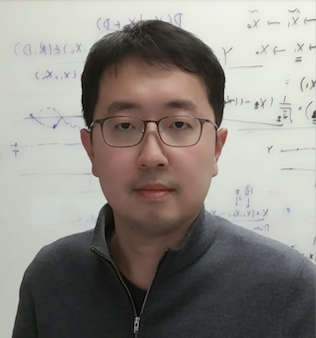
 Zeyu Zheng
· 1 previous affiliation
- International Computer Science InstituteSince 2018
- Associate Professor · Since 2018
2 other authors named Zeyu Zheng: Zeyu Zheng (Google (United Kingdom) · 17 papers), Zeyu Zheng (Carnegie Mellon University · 1 paper)
Research Overview
Zeyu Zheng focuses on operations research, simulation optimization, and the theoretical foundations of machine learning, particularly multi-armed bandits and Markov chains. His trajectory spans from discrete submodular optimization and dynamic planning to the integration of large language models and diffusion models into complex decision-making systems. Currently, he investigates generative artificial intelligence, multimodal learning, and advanced statistical inference for black-box optimization.
Research Trajectory
Early work addressed the area of Learning with Non-Stationary Reward Distributions. In Dynamic Planning and Learning under Recovering Rewards, he and his collaborators introduced a multi-armed bandit framework where rewards recover over time, developing an online learning algorithm that achieves sublinear regret even with unknown recovery rates. This work contributed to the broader direction of Periodic Policies for Recovering and Non-Stationary Rewards and the related field of Coordinating Periodic Actions via Harmonic Intervals. Concurrently, he explored stochastic submodular minimization, developing polynomial-time algorithms for stochastic $L^\natural$-convex minimization in Stochastic $L^\natural$-convex Function Minimization, utilizing a novel truncation operation to reduce computational complexity.
Expanding on discrete optimization, his research advanced the area of Continuous Relaxation of Submodular Functions. With Gradient-Based Algorithms for Convex Discrete Optimization via Simulation, he presented gradient-based methods for high-dimensional discrete optimization problems evaluated through simulation, achieving theoretical guarantees on solution quality with simulation costs that scale polynomially. Returning to bandit problems, he analyzed the theoretical limits of policy design in Stochastic Multi-armed Bandits: Optimal Trade-off among Optimality, Consistency, and Tail Risk, characterizing the interplay between worst-case optimality, instance-dependent consistency, and light-tailed risk. He further extended bandit frameworks to clinical trial applications in Stochastic Multi-Armed Bandits with Strongly Reward-Dependent Delays, formalizing a setting where the delay in observing a response is intrinsically tied to the reward itself, rather than being external noise.
In 2024, his focus broadened to include the integration of foundation models into traditional statistical frameworks. In Large Language Model Enhanced Machine Learning Estimators for Classification, he investigated how pre-trained language models can be integrated into classical supervised machine learning estimators to improve prediction performance, particularly under distribution shifts. This interest in generative artificial intelligence expanded into visual and multimodal domains. He developed methods for coupled image generation in Controllable Coupled Image Generation via Diffusion Models, utilizing time-varying attention control to generate multiple images with identical backgrounds but different foreground entities. Similarly, in Efficient Fine-Grained Guidance for Diffusion Model Based Symbolic Music Generation, he introduced a hard control projection step into the denoising process of diffusion models, enabling harmonically precise and interactive symbolic music creation.
Alongside generative models, he continued to advance foundational applied probability, specifically in the research direction of State Space Truncation for Infinite Markov Chains. In A Regeneration-based a Posteriori Error Bound for a Markov Chain Stationary Distribution Truncation Algorithm, he established a rigorous a posteriori error bound using regenerative properties and Lyapunov functions to quantify the error introduced when truncating infinite state spaces. He deepened this analysis in Approximation of Markov Chain Expectations and the Key Role of Stationary Distribution Convergence, demonstrating that for discrete state spaces, the convergence of stationary distributions guarantees the convergence of other critical metrics, such as hitting times and discounted rewards.
His work also critically evaluated the necessity of complex architectures in certain domains. In Are Time Series Foundation Models Ready for Zero-Shot Forecasting?, he and his collaborators demonstrated that a simpler principal component analysis and linear regression model could competitively match state-of-the-art time series foundation models for zero-shot forecasting tasks. Bridging his expertise in simulation optimization and large language models, he introduced SOCRATES: Simulation Optimization with Correlated Replicas and Adaptive Trajectory Evaluations. This framework leverages language models to build digital replicas of complex systems, using them as testbeds to intelligently compose and refine simulation optimization strategies. Furthermore, in Black-box Optimization with Simultaneous Statistical Inference for Optimal Performance, he addressed the challenge of optimizing complex, mathematically opaque systems by developing methods for simultaneous statistical inference during the optimization process.
Current Directions
The most recent papers in the evidence indicate a strong focus on the efficiency and architecture of foundation models for autonomous agents and multimodal learning. Recent work investigates lifelong memory systems for large language model agents, participating in the development of frameworks based on semantic lossless compression to manage historical experiences without excessive token costs, as seen in SimpleMem: Efficient Lifelong Memory for LLM Agents. Additionally, he contributes to the design of generative pretrained visual encoders. In OpenVision 2: A Family of Generative Pretrained Visual Encoders for Multimodal Learning, this involves exploring how simplified architectures and purely generative training signals can match the performance of more complex multimodal models while significantly reducing training time and memory consumption.
Profile updated
Loading new papers…
Other researchers whose papers cluster into the same research directions — a proxy for overlapping technical interests and shared intellectual neighborhoods.
See something wrong? Report a mistake