

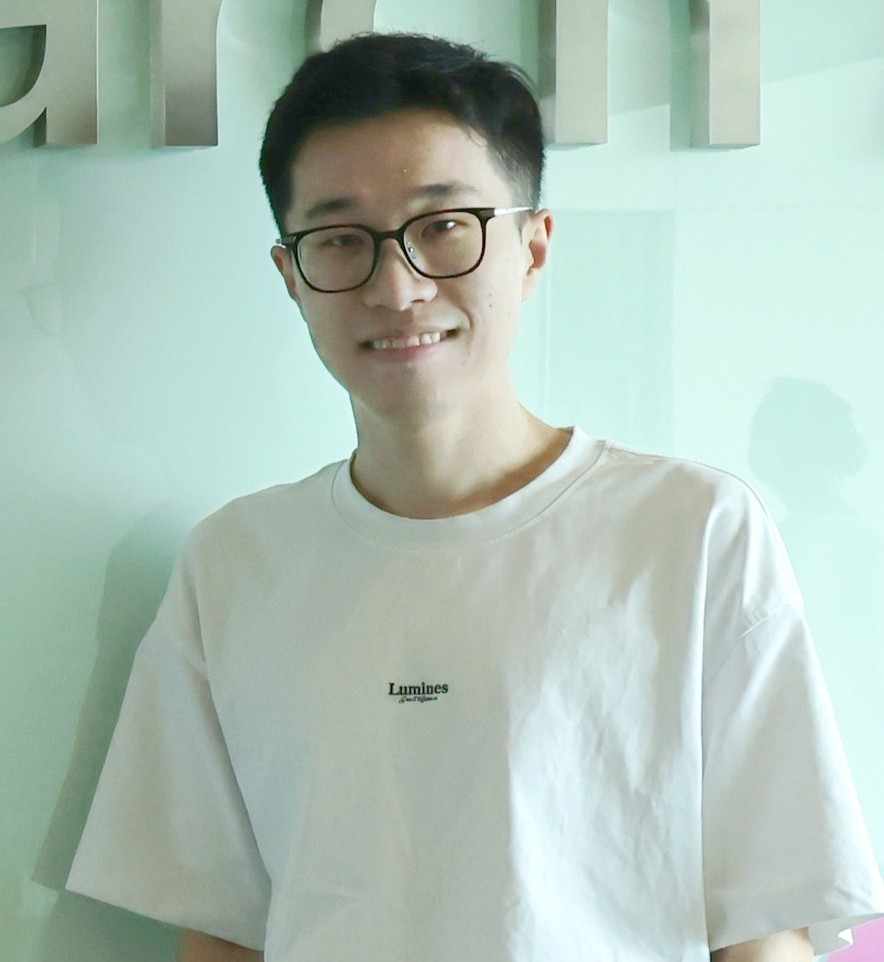
 Zeyu Qin
· 5 previous affiliations
- Moonshot AI (China)Since 2025
- Agent Research at Kimi · Since 2025
- Current
- Doctor of Philosophy - PhD, Machine Learning · 2022–2026
- Microsoft (United States)2024–2025
- Research Intern · 2024–2025
- Alibaba Group (China)2022–2023
- Research Intern · 2022–2023
- Tencent AI Lab2021–2022
- Research Intern · 2021–2022
Research Overview
Zeyu Qin focuses on adversarial machine learning, large language model safety, and reasoning distillation. His early work investigated the robustness of deep neural networks against black-box attacks and backdoor vulnerabilities in federated learning. More recently, his research centers on scalable oversight and reasoning, developing methods to safely align large language models and distill complex reasoning trajectories into smaller, highly capable systems.
Research Trajectory
Qin's early research addressed the vulnerabilities of deep neural networks to adversarial attacks. He developed Random Noise Defense Against Query-Based Black-Box Attacks, a lightweight defense mechanism that injects Gaussian noise into queries to disrupt the gradient estimation techniques used by attackers. Building on this understanding of adversarial dynamics, he subsequently introduced Boosting the Transferability of Adversarial Attacks with Reverse Adversarial Perturbation, a method designed to prevent adversarial examples from overfitting to surrogate models, thereby improving their transferability against unknown target architectures.
Expanding his focus to distributed systems and model sanitization, Qin investigated how personalized federated learning architectures interact with training data poisoning. In Revisiting Personalized Federated Learning: Robustness Against Backdoor Attacks, he demonstrated that partial model-sharing methods inherently resist backdoor attacks, and he introduced a lightweight tuning defense to purge backdoors by re-initializing the final layer. This work contributed to the broader research direction of Adversarial Machine Unlearning. He continued to examine the persistence of neural backdoors in Uncovering, Explaining, and Mitigating the Superficial Safety of Backdoor Defense, collaborating to show that many purified models retain hidden vulnerabilities that can be easily reactivated, challenging standard evaluations of AI security.
As large language models became central to AI research, Qin's work shifted toward their safety alignment and evaluation. He explored the area of Co-evolving Adversarial Alignment for Large Language Models and the related direction of Deep Safety Alignment through Introspective Reasoning in Safety Reasoning with Guidelines. This framework trains models to explicitly reason through safety implications using structured guidelines, improving generalization against complex, out-of-distribution jailbreaks. This aligns with his contributions to the direction of Deliberative Safety Alignment for Large Reasoning Models. To further evaluate these safety measures, he collaborated on Quality-Diversity Red-Teaming: Automated Generation of High-Quality and Diverse Attackers for Large Language Models, addressing the limitations of simplistic diversity metrics in automated red-teaming by generating more comprehensive adversarial attack strategies.
Concurrently, Qin has made significant contributions to data scaling and reasoning distillation. He investigated the saturation limits of synthetic data scaling in Scaling Laws of Synthetic Data for Language Model, introducing a framework that transforms pre-training corpora into high-quality synthetic datasets that adhere to predictable scaling laws. To improve the diversity of reasoning chains generated by LLMs, he developed Reasoning Path Divergence: A New Metric and Curation Strategy to Unlock LLM Diverse Thinking, demonstrating that curating diverse step-by-step solutions significantly enhances test-time scaling on complex tasks.
His recent work heavily emphasizes transferring these capabilities to smaller models, contributing to the research direction of Bridging the Mimicry Gap in Reasoning Distillation. He proposed Merge-of-Thought Distillation to improve how smaller student models mimic the long chain-of-thought explanations of massive oracle models. Addressing the "imitation shock" often observed during this process, he participated in the development of Training-Trajectory-Aware Token Selection, a method that masks dominant anchor tokens in early training to accelerate the adaptation of student models.
Most recently, Qin has explored the fundamental representation of concepts within LLMs. He collaborated on Concept Concentration for Faithful Representation Intervention, which identifies a "faithfulness gap" where harmful and benign concepts are non-linearly entangled, and proposes a data-refactoring method to linearize the representation space for robust concept erasure. Additionally, he contributed to the design of specialized pedagogical agents in ClinTutor-R1: Advancing Scalable and Robust One-to-Many Alignment in Clinical Socratic Education, a vision-language system that tracks individual and group progress to maintain instructional quality across growing student cohorts.
Current Directions
The most recent papers in the evidence indicate a strong focus on reasoning distillation and the fundamental representation of safety concepts in large language models. Current work investigates how to efficiently transfer complex, multi-step reasoning capabilities from massive oracle models to smaller, specialized architectures without suffering from performance degradation during early training. This includes developing novel token selection strategies and distillation frameworks that preserve the diversity of reasoning paths. Additionally, recent research addresses the non-linear entanglement of harmful and benign concepts within model representations, exploring structured interventions that allow for the precise erasure of unsafe knowledge while maintaining the model's general intelligence and reasoning capacity. Finally, these alignment and reasoning techniques are being applied to domain-specific challenges, such as scaling pedagogical agents for complex, multi-user educational environments.
Profile updated
Loading new papers…
Other researchers whose papers cluster into the same research directions — a proxy for overlapping technical interests and shared intellectual neighborhoods.
See something wrong? Report a mistake