

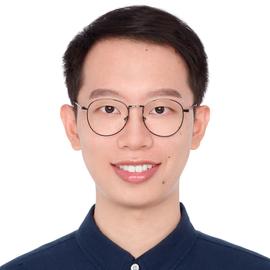
 Yuxin Wen
· 2 previous affiliations
- Tencent (China)Since 2022
- Researcher · Since 2022
- South China University of Technology2013–2022
- PhD student · 2017–2022
- Undergrad student · 2013–2017
1 other author named Yuxin Wen: Yuxin Wen (OpenAI (United States) · 38 papers)
Research Overview
Yuxin Wen focuses on 3D shape modeling, adversarial robustness, and neural network regularization. His research explores how geometric priors and implicit surface representations can improve the reconstruction of 3D objects from raw point clouds. Recent work investigates test-time optimization techniques to enhance the generalization of deep generative models on unseen 3D data.
Research Trajectory
Yuxin Wen's early research investigated the vulnerabilities of machine learning models, particularly in the 3D domain. In 2019, he introduced geometry-aware objectives in Geometry-aware Generation of Adversarial and Cooperative Point Clouds. This work addressed the generation of adversarial examples for 3D point clouds, mitigating the issue of noticeable point outliers that are easily removed by standard defense mechanisms. He continued to explore model fragility in Towards Understanding the Regularization of Adversarial Robustness on Neural Networks, examining the theoretical and practical implications of regularization techniques used to defend neural networks against adversarial attacks.
Expanding on network stability, he participated in the development of Orthogonal Deep Neural Networks. By demonstrating that deep neural networks exhibit local isometry on real-world data, this research proposed singular value bounding algorithms to maintain equal singular values in weight matrices, thereby improving generalization and robustness in image classification.
In 2021, his focus shifted toward advanced techniques for 3D shape modeling and reconstruction. He contributed to the research direction of Surface Reconstruction from Unoriented Point Clouds through his work on Sign-Agnostic Implicit Learning of Surface Self-Similarities for Shape Modeling and Reconstruction From Raw Point Clouds. This approach utilized the universal phenomenon of repeating local surface patches to build data-driven models capable of handling incomplete or noisy scans, intersecting with the broader area of Overcoming the 3D Supervision Bottleneck.
To address the challenge of scaling learned 3D representations to unseen data, he developed new frameworks that bridge learning-based and optimization-based methods. In Deep Optimized Priors for 3D Shape Modeling and Reconstruction, he proposed optimizing pre-trained priors and latent codes directly on the input at test time. This methodology advanced the area of Geometric Out-of-Distribution Generalization in 3D Reconstruction and contributed significantly to the research directions of Test-Time Weight Adaptation for Generative Reconstruction and Weight Proximity Regularization for Stable Model Adaptation.
Current Directions
The most recent papers in the evidence, dating to 2021, address the generalization of 3D generative models and the reconstruction of complex shapes from raw point clouds. This work emphasizes test-time optimization and the use of implicit neural representations to overcome the limitations of sparse 3D training datasets. By dynamically adapting learned priors to unseen geometric structures, these efforts aim to create more robust and flexible pipelines for 3D modeling and reconstruction.
Profile updated
Loading new papers…
Other researchers whose papers cluster into the same research directions — a proxy for overlapping technical interests and shared intellectual neighborhoods.
See something wrong? Report a mistake