

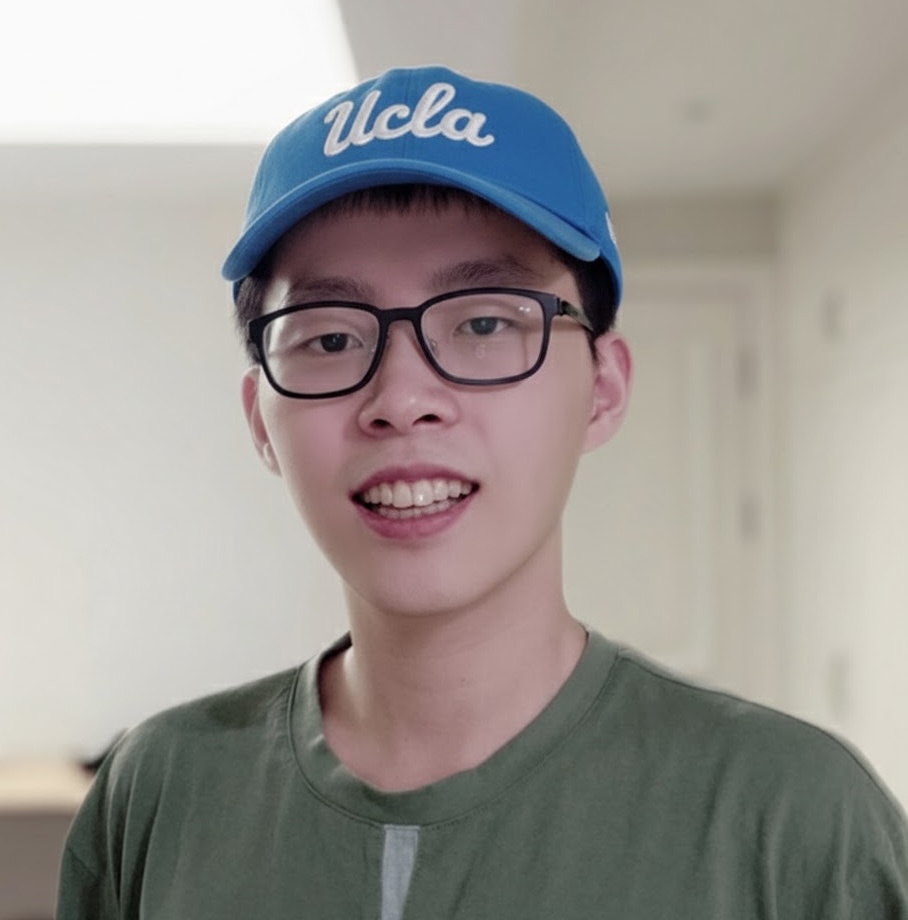
 Yunuo Chen
· 2 previous affiliations
- Current
- Discover2021–2026
- PhD student · 2021–2026
1 other author named Yunuo Chen: Yunuo Chen (Microsoft (United States) · Shanghai Jiao Tong University · 17 papers)
Research Overview
Yunuo Chen focuses on computer graphics, computer vision, and differentiable physics simulation. His research bridges the gap between visual generation and physical reality, developing methods that ensure 3D assets, animations, and generated videos adhere to physical laws. Currently, he investigates the integration of physical constraints into diffusion models and robotic simulation frameworks.
Research Trajectory
Yunuo Chen’s early research established a foundation in computational mathematics and physics simulation, focusing on the mechanics of complex materials and fluid dynamics. In 2020, he contributed to AnisoMPM: animating anisotropic damage mechanics, exploring the simulation of structural degradation in anisotropic materials. He continued to advance simulation methodologies with An Efficient B-Spline Lagrangian/Eulerian Method for Compressible Flow, Shock Waves, and Fracturing Solids (2022), which addressed the computational challenges of modeling high-energy physical phenomena. That same year, he also worked on A unified newton barrier method for multibody dynamics, further refining the mathematical approaches used to simulate interacting physical bodies.
Concurrently, he explored the application of mathematical optimization and data-driven frameworks to logistics and supply chain management. This work culminated in Research on Enterprise Raw Material Ordering and Transportation Based on Index Analysis and Entropy Method (2022), which utilized neural networks and linear programming to optimize supplier selection and minimize storage costs. This interdisciplinary application touched on the research direction of Information Entropy for Objective Indicator Weighting and the broader area of Stochastic Optimization for Robust Real World Logistics, as well as work in Balancing Waste and Service in Perishable Supply Chains. Returning to core graphics, he subsequently investigated the structural modeling of complex geometries in Multi-Layer Thick Shells (2023).
Beginning in 2024, his trajectory shifted toward the intersection of generative artificial intelligence and differentiable physics. He introduced Atlas3D: Physically Constrained Self-Supporting Text-to-3D for Simulation and Fabrication (2024), a framework that integrates a differentiable rigid-body simulator directly into the optimization loop. This approach ensures that 3D models generated from text prompts are not only visually coherent but also physically stable and self-supporting in both virtual and real-world environments.
In 2025, this focus on physically grounded generation expanded across several domains, including virtual garments, character animation, and video synthesis. He contributed to Dress-1-to-3: Single Image to Simulation-Ready 3D Outfit with Diffusion Prior and Differentiable Physics, advancing the area of Multi-Layered Virtual Try-On and Garment Modeling by reconstructing detailed, physically plausible garments from single images. He also developed AnimaMimic: Imitating 3D Animation from Video Priors, which distills motion priors from 2D video diffusion models to animate static 3D meshes while respecting physical laws and maintaining temporal coherence.
His recent work also addresses the physical shortcomings of modern video generation models. He led Towards Physical Understanding in Video Generation: A 3D Point Regularization Approach (2025), which teaches video diffusion models 3D geometry by jointly generating RGB pixels and 3D point trajectories. By applying physical regularization, the framework prevents unnatural morphing in complex scenarios, contributing to the domain of Scaling 3D Representations Beyond the Memory Wall.
Beyond visual media, he has applied differentiable simulation to robotics and digital art. He participated in the creation of GRIP: A General Robotic Incremental Potential Contact Simulation Dataset for Unified Deformable-Rigid Coupled Grasping (2025), leveraging a parallelized simulator to model complex contact physics for grasp prediction. Additionally, he collaborated on Birth of a Painting: Differentiable Brushstroke Reconstruction (2025), simulating the iterative paint-smudge loop and utilizing techniques in the area of Composite Loss Functions for Perceptual Image Restoration to reconstruct human painting processes across various artistic styles.
Continuing this line of work into garment modeling, Chen contributed to DressWild: Feed-Forward Pose-Agnostic Garment Sewing Pattern Generation from In-the-Wild Images (2026), a feed-forward pipeline that predicts physics-consistent 2D sewing patterns and 3D garments directly from single in-the-wild images via vision–language models and transformer-based feature fusion.
Current Directions
Recent work investigates the critical intersection of generative AI and physical simulation, with a particular focus on embedding physical understanding into diffusion models. The most recent papers in the evidence address the limitations of purely visual generative models by enforcing 3D geometry and physical regularization, ensuring that generated videos and 3D assets behave naturally without morphing or collapsing. Additionally, current research explores the use of differentiable physics to bridge the gap between static visual priors and dynamic, simulation-ready assets. This spans a wide range of applications, from virtual garment modeling and physically plausible character animation to the development of high-fidelity simulation environments for complex robotic grasping.
Profile updated
Loading new papers…
Other researchers whose papers cluster into the same research directions — a proxy for overlapping technical interests and shared intellectual neighborhoods.
See something wrong? Report a mistake