

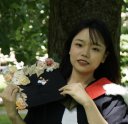
 Yunong Liu
· 4 previous affiliations
- Luma AISince 2025
- Researcher · Since 2025
- Stanford UniversityCurrent
- Current
- MS student · 2023–2025
- University of Edinburgh2019–2023
- Undergrad student · 2019–2023
- The University of Texas at Austin2021–2022
- Undergrad student · 2021–2022
Research Overview
Yunong Liu focuses on computer vision and generative AI, with an emphasis on video understanding, spatial intelligence, and controllable visual synthesis. His work spans the 4D grounding of complex procedural tasks in video to the extraction of motion representations from generative models. He is currently a Research Engineer at Luma AI, where he investigates agentic systems and reinforcement learning for generative alignment.
Research Trajectory
Yunong Liu’s research investigates how computational models can understand and generate complex spatial and temporal phenomena in visual data. During his graduate studies at Stanford University, he explored the intersection of 3D spatial reasoning and video understanding. A major focus of this period involved the research direction of Bridging the 4D Data Gap for Spatial Intelligence. In this context, he developed a novel framework for understanding complex procedural tasks over time. In IKEA Manuals at Work: 4D Grounding of Assembly Instructions on Internet Videos, he introduced the IKEA Video Manuals dataset, which provides dense spatio-temporal alignments between 3D furniture models, instructional manuals, and internet assembly videos. This work addresses the challenge of grounding multi-modal assembly instructions in 4D space, contributing to broader efforts in the area of Pose Estimation via Geometric Correspondence and Solvers and the research direction of Resolving Geometric Symmetry Ambiguity in 3D Pose Estimation.
Following this work on spatial grounding, Liu’s research expanded into the analysis of motion and flow within generative video models. Participating in a collaborative effort to probe the internal representations of these models, he contributed to Taming generative video models for zero-shot optical flow extraction. This project introduced KL-tracing, a zero-shot statistical method that extracts high-quality optical flow from frozen generative video models without requiring fine-tuning. By injecting perturbations and measuring the Kullback–Leibler divergence of the model's predictions, the approach successfully tracks motion through complex occlusions and dynamic scenes. This methodology advances work in the broader area of Handling Brightness Constancy Violations in Motion Estimation, demonstrating how generative priors can be repurposed for fundamental vision tasks.
Current Directions
The most recent papers in Liu's evidence investigate the latent capabilities of generative video models, particularly how their internal representations can be harnessed for zero-shot physical understanding. Moving forward, his broader research themes emphasize the intersection of reinforcement learning and generative modeling, focusing on how reward signals can shape generation quality, controllability, and alignment with human intent. He is also exploring agentic AI systems that leverage tool-calling for complex multi-step reasoning, alongside mechanisms for fine-grained, user-guided visual synthesis and editable media.
Profile updated
Loading new papers…
Other researchers whose papers cluster into the same research directions — a proxy for overlapping technical interests and shared intellectual neighborhoods.
See something wrong? Report a mistake