

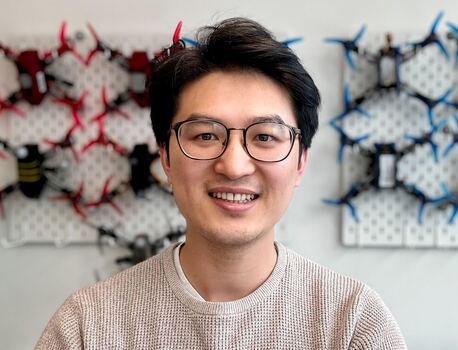
 Yunlong Song
· 8 previous affiliations
- Genesis AISince 2025
- Member of Technical Staff · Since 2025
- Skild AI2025
- Research Scientist · 2025
- University of Zurich2019–2024
- PhD student · 2019–2024
- ETH AI Center2021–2024
- Associate Researcher · 2021–2024
- Visiting Researcher · 2023–2024
- AGT International2017–2018
- Intern and Working Student · 2017–2018
- Technische Universität Darmstadt2015–2018
- Master's degree, Information and communication engineering · 2015–2018
- Shanghai University2010–2014
- Undergrad student · 2010–2014
Research Overview
Yunlong Song focuses on autonomous robotic control, differentiable simulation, and the intersection of reinforcement learning with optimal control. His work addresses the challenges of deploying highly agile robots in complex environments by bridging model-based planning and learning-centric policy training. Recent efforts emphasize robust scene transfer and dynamic locomotion for both aerial and legged systems.
Research Trajectory
The core of Yunlong Song’s research investigates the fundamental differences and potential synergies between reinforcement learning (RL) and optimal control (OC) in highly dynamic robotic applications. A central theme in his 2024 work is understanding how different optimization objectives impact a robot's agility and robustness in the physical world. In Learning Robot Control: From Reinforcement Learning to Differentiable Simulation, he provided theoretical and practical insights into this dichotomy. The work highlights that the primary advantage of RL in robotics stems from its ability to directly maximize task-level objectives—which are often non-differentiable—whereas traditional optimal control is constrained by the necessity for smooth, differentiable cost functions.
This theoretical foundation was empirically validated in the context of high-speed aerial navigation. In Reaching the Limit in Autonomous Racing: Optimal Control versus Reinforcement Learning, he demonstrated that RL controllers can consistently outperform traditional OC methods in autonomous drone racing. The findings suggest that RL's superiority in these edge-case scenarios relies on its capacity to handle real-world uncertainties rather than raw optimization prowess. This work directly advances the research area of Closing the Sim-to-Real Gap in Robotics and contributes to the broader domain of Dynamics Randomization for Robust Robotic Control.
Rather than treating learning and optimal control as mutually exclusive, subsequent work has focused on hybridizing the two paradigms. He introduced a novel control architecture in Policy Search for Model Predictive Control with Application to Agile Drone Flight, which utilizes policy search to automatically tune high-level decision variables for a Model Predictive Control (MPC) system. By learning from experience to inform model-based optimal control, the framework enables robust, real-time navigation through dynamic environments, such as flying through fast-moving gates. This approach exemplifies the research direction of Hierarchical Decoupling of Strategic Planning and Motor Execution.
Beyond control algorithms, deploying agile robots in the real world requires robust perception. With collaborators, he explored visual representation learning to address the poor sample efficiency and limited generalization of end-to-end policy learning. In Contrastive Learning for Enhancing Robust Scene Transfer in Vision-based Agile Flight, the research team developed an adaptive multipair contrastive learning strategy. This method generates visual embeddings that allow control policies to operate effectively in unseen environments, facilitating zero-shot scene transfer for mobile robotics.
Expanding his focus from aerial platforms to legged systems, he has also investigated the utility of differentiable simulation for complex motor control. In Learning Quadruped Locomotion Using Differentiable Simulation, he addressed the complex optimization landscape caused by the discontinuous dynamics of robotic foot contacts. To overcome the limitations that previously restricted differentiable simulation to purely simulated environments, he proposed a framework that decouples the whole-body simulation into separate continuous domains. This alignment allows for the computation of low-variance first-order gradients, promising faster convergence and more stable training for quadruped locomotion.
Current Directions
The most recent papers in the evidence, all published in 2024, indicate a sustained focus on hybridizing learning-based and model-based control paradigms for highly dynamic robotic systems. Current work investigates how differentiable simulation can be adapted to handle the discontinuous dynamics inherent in legged locomotion, moving beyond traditional simulation constraints to enable stable, low-variance gradient computation for physical robots. Concurrently, ongoing research addresses the perceptual challenges of agile flight, exploring contrastive learning strategies to achieve zero-shot visual scene transfer. Across these domains, the overarching objective remains the development of control policies that maintain real-world robustness while pushing the physical limits of autonomous robotic agility.
Profile updated
Loading new papers…
Other researchers whose papers cluster into the same research directions — a proxy for overlapping technical interests and shared intellectual neighborhoods.
See something wrong? Report a mistake