

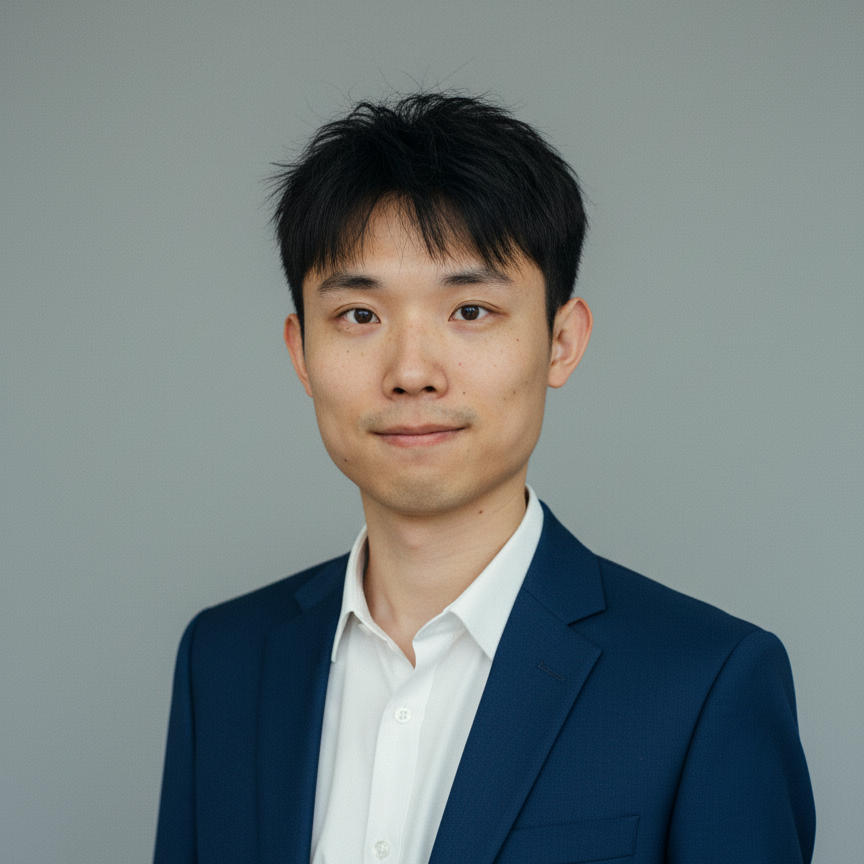
 Yunkang Cao
· 2 previous affiliations
- Hunan UniversitySince 2025
- Assistant Professor · Since 2025
- PhD student · 2020–2025
Research Overview
Yunkang Cao focuses on industrial anomaly detection, multimodal representation learning, and efficient visual reasoning. His early work developed knowledge distillation and feature mapping techniques for identifying defects in manufacturing images and 3D point clouds. More recently, his research investigates the application of vision-language models to zero-shot anomaly detection and explores novel token compression strategies for genomic modeling.
Research Trajectory
Cao's early research primarily addressed the challenges of automatic visual inspection in manufacturing, specifically focusing on identifying defects of varying sizes and shapes. In 2022, he developed methods to improve the performance and efficiency of these systems. He introduced techniques for Informative knowledge distillation for image anomaly segmentation, establishing a foundation for using teacher-student network architectures in defect identification. Recognizing that fully unsupervised methods often struggle with minute defects, he subsequently proposed Semi-supervised Knowledge Distillation for Tiny Defect Detection. This approach extended knowledge distillation into a semi-supervised paradigm, simultaneously leveraging abundant normal data and a limited set of abnormal examples to better distinguish subtle anomalies in industrial products. During this period, he also contributed to Position Encoding Enhanced Feature Mapping for Image Anomaly Detection, which mapped pairs of pre-trained features embedded with positional encodings to localize anomalies.
In 2023, Cao expanded his focus from 2D imagery to 3D spatial data, contributing to the research direction of In-Domain Representation Learning for Industrial Anomaly Detection. He developed Complementary Pseudo Multimodal Feature for Point Cloud Anomaly Detection, a method that integrates local 3D geometric information with global semantic features extracted from 2D neural networks. By projecting point clouds into multi-view images, this work bridged modalities, intersecting with broader areas such as Geometric Alignment for Multi-Modal Spatial Reasoning and Overcoming the Multi-View Bottleneck in 3D Perception. This multimodal approach also touched upon the area of Non-Parametric Feature Retrieval for Anomaly Detection and the research direction of Active Viewpoint Selection for Efficient 3D Perception.
Current Directions
The most recent papers in the evidence indicate a shift toward leveraging foundation models and novel representation strategies for complex reasoning tasks. In the domain of industrial inspection, recent work investigates the use of Vision-Language Models (VLMs) to generalize defect detection to unseen categories. Cao participated in Towards VLM-based Hybrid Explainable Prompt Enhancement for Zero-Shot Industrial Anomaly Detection, which addresses the limitations of standard zero-shot methods by providing models with detailed, explainable prompt templates that better describe specific industrial anomalies.
Concurrently, his research has expanded into highly efficient sequence modeling. He contributed to Rethinking Genomic Modeling Through Optical Character Recognition, which introduces a framework that treats 1D DNA sequences as 2D documents. By applying OCR techniques to rendered genomic data, this approach significantly reduces token counts and improves parameter efficiency on long-range tasks. This methodology aligns with the broader research direction of Visual Token Compression for Efficient Multimodal Reasoning, demonstrating an ongoing interest in optimizing how complex data structures are encoded and processed by deep learning architectures.
Profile updated
Loading new papers…
Other researchers whose papers cluster into the same research directions — a proxy for overlapping technical interests and shared intellectual neighborhoods.
See something wrong? Report a mistake