

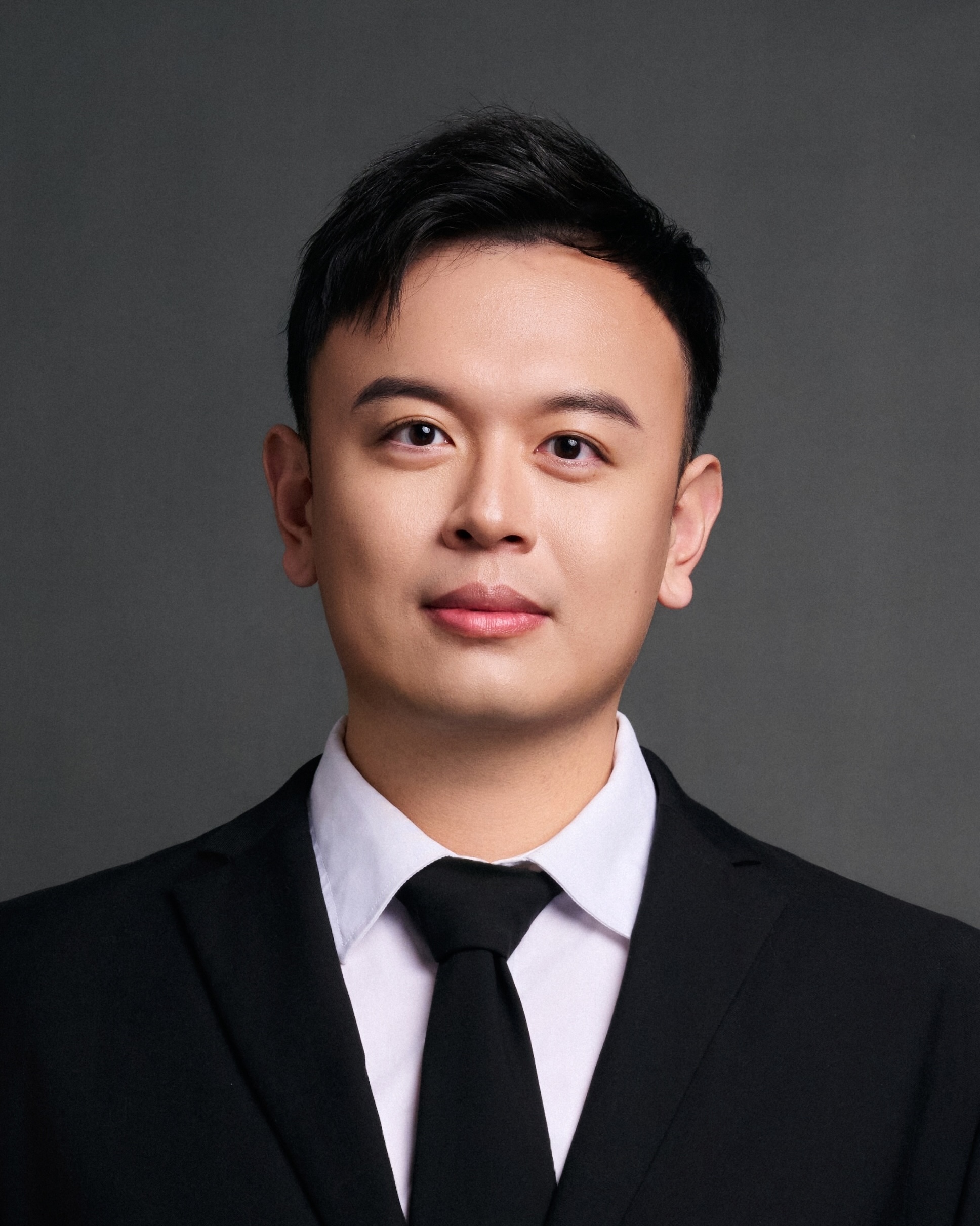
 Yunfan Liu
· 3 previous affiliations
- Associate Professor · Since 2026
- Current
- Postdoc · 2023–2025
- PhD student · 2019–2023
- University of Michigan2015–2017
- MS student · 2015–2017
- Tsinghua University2011–2015
- Undergrad student · 2011–2015
1 other author named Yunfan Liu: Yunfan Liu (Mayun University · Zhejiang University · 14 papers)
Research Overview
Yunfan Liu focuses on computer vision and generative modeling, with specific emphasis on facial attribute manipulation, visual state space models, and discrete diffusion. His trajectory spans from early contributions in facial landmark detection and generative adversarial networks to recent architectural innovations in scalable vision backbones and language modeling. Currently, his work addresses efficiency and spatial reasoning in foundational vision and diffusion models.
Research Trajectory
His early research addressed fundamental computer vision tasks, particularly in facial analysis and scene understanding. He introduced a method combining optical flow with stacked sparse autoencoders for Facial expression recognition and generation using sparse autoencoder, aiming to reduce the influence of personal appearance differences in video sequences. Later, his lab developed an approach that merged data-driven fully convolutional networks with model-driven point distribution models to improve accuracy in Combining Data-Driven and Model-Driven Methods for Robust Facial Landmark Detection. During this period, he also collaborated on foundational benchmarks and architectures for semantic scene understanding, participating in the development of the HICO-DET benchmark and the HO-RCNN architecture in Learning to Detect Human-Object Interactions.
A major phase of his work focused on facial attribute manipulation using Generative Adversarial Networks (GANs), with a particular emphasis on face aging. He developed an attribute-aware model utilizing wavelet packet transforms to preserve identity and demographic features during synthesis in Attribute-Aware Face Aging With Wavelet-Based Generative Adversarial Networks.. He further contributed to conditional GAN frameworks designed to simultaneously handle age progression and regression in Age Progression and Regression with Spatial Attention Modules. To resolve persistent issues with unnatural semantic shifts and low-level image distortions in aging synthesis, he introduced an attentive model that embedded facial attribute vectors as conditional information in AGAN: An Attribute-Aware Attentive Generative Adversarial Network for Face Aging.
Expanding beyond aging, he explored broader facial editing techniques and the underlying mechanics of generative latent spaces. He collaborated on frameworks for controllable geometric changes to high-level semantic components in Reference Guided Face Component Editing. He later synthesized the field's progress in a comprehensive survey, GAN-Based Facial Attribute Manipulation. Addressing the challenge of spatially entangled modifications in latent spaces, he proposed manipulating latent codes within the style space of pre-trained models to achieve localized editing in Towards Spatially Disentangled Manipulation of Face Images With Pre-Trained StyleGANs. This focus on disentanglement extended to video and animation, where he utilized 3D morphable models to separate identity from driving expressions for One-shot Face Reenactment with Dense Correspondence Estimation.
In recent years, his research group has shifted toward foundational architectural design for vision and generative models. To adapt Vision Transformers for rotation-sensitive scenarios, his team developed a divide-and-conquer approach for predicting bounding box parameters in Spatial Transform Decoupling for Oriented Object Detection. A notable architectural advancement came with VMamba: Visual State Space Model, where his lab adapted the Mamba state-space model for computer vision. By introducing a 2D Selective Scan mechanism, this work achieved global receptive fields with linear time complexity, addressing critical efficiency gaps in high-resolution image processing. Most recently, his group has advanced discrete diffusion models with Balancing Understanding and Generation in Discrete Diffusion Models, introducing a mixed diffusion language modeling approach that optimizes both zero-shot reasoning and fast generation.
Current Directions
The most recent papers in the evidence indicate a focus on foundational architectures for both computer vision and generative modeling. Recent work investigates the adaptation of state-space models to visual tasks, aiming to achieve global receptive fields with linear time complexity to better scale high-resolution image processing. Additionally, his group is exploring improvements to discrete diffusion models, developing mixed approaches that balance the demands of zero-shot reasoning with efficient, few-step generation.
Profile updated
| Paper | Venue | Year |
|---|---|---|
| vHeat: Building Vision Models upon Heat ConductionGitHubMzeroMiko/ | arXiv | 2024 |
| VMamba: Visual State Space ModelGitHubMzeroMiko/ | NeurIPS | 2024 |
Loading new papers…
Other researchers whose papers cluster into the same research directions — a proxy for overlapping technical interests and shared intellectual neighborhoods.
See something wrong? Report a mistake