

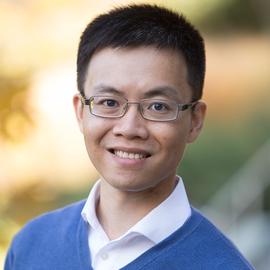
 Yudong Chen
· 2 previous affiliations
- University of Wisconsin–MadisonSince 2021
- Associate Professor · Since 2021
- Current
- Cornell Tech2015–2022
- Associate Professor · 2021–2022
- Assistant Professor · 2015–2021
3 other authors named Yudong Chen: Yudong Chen (The University of Queensland · 42 papers), Yudong Chen (University of Warwick · 4 papers), Yudong Chen (1 paper)
Research Overview
Yudong Chen focuses on the theoretical foundations of machine learning, reinforcement learning, and high-dimensional statistics. His research addresses the challenges of extracting structure from high-dimensional data and developing provably efficient algorithms for complex decision-making problems. By bridging optimization theory and statistical inference, he investigates the performance guarantees of non-convex and nonsmooth learning problems, stochastic approximation, and the sample complexity of reinforcement learning. His work often explores the boundaries between what is statistically possible and what is computationally feasible in large-scale systems.
Research Trajectory
The early stages of Chen’s research were primarily concerned with the recovery of structured signals from incomplete or corrupted observations, a central problem in high-dimensional statistics. Between 2011 and 2015, he developed foundational results for low-rank matrix recovery and sparse regression. This period was characterized by an emphasis on convex optimization techniques, such as nuclear norm minimization and $\ell_1$-regularization, to solve problems involving missing data and gross errors. His work during this time contributed to the understanding of Beyond the Rank One Assumption in Spiked Models, identifying the critical thresholds of signal-to-noise ratios required for successful recovery. He also investigated Statistical-to-Computational Gaps in High-Dimensional Inference, exploring regimes where a signal may be statistically identifiable but remains computationally intractable for polynomial-time algorithms.
As the field moved toward more complex models, Chen’s focus shifted toward non-convex optimization and latent variable models. Around 2015, he began applying convex relaxation frameworks to combinatorial problems like bi-clustering, providing some of the first theoretical guarantees for exact recovery in noisy settings. This interest in non-convexity evolved into a deeper study of iterative algorithms, such as the Expectation-Maximization (EM) algorithm. His research provided global convergence analysis for EM in the context of mixture models, moving beyond local optima to characterize the conditions under which these widely used heuristics reach a global solution.
In the late 2010s and early 2020s, Chen’s work increasingly centered on the theoretical underpinnings of reinforcement learning (RL). He transitioned from static estimation problems to dynamic, multi-agent environments, focusing on Minimax Optimal Sample Complexity in Reinforcement Learning. This research trajectory involves developing algorithms for Markov games and restless bandits that achieve the mathematical lower bounds of efficiency. His recent work integrates high-dimensional statistical tools, such as Deterministic Equivalents for Large Wireless Systems, to predict the behavior of learning algorithms in regimes where the number of features and observations are both large.
Representative Work
In Low-rank matrix recovery from errors and erasures, Chen established a unified performance guarantee for recovering low-rank matrices from observations that are simultaneously sparse and corrupted. This work was significant for its ability to handle both random and deterministic patterns of errors and erasures, providing a more robust theoretical framework than previous models that assumed purely random noise. By utilizing convex optimization, the paper demonstrated that exact recovery is possible even when a constant fraction of the entries are arbitrarily corrupted, provided the matrix satisfies certain incoherence conditions.
Chen addressed the limitations of standard sparse regression models in Noisy and Missing Data Regression: Distribution-Oblivious Support Recovery. While traditional methods often assume perfectly known covariates, this research focused on the more realistic scenario where covariates are missing or subject to additive noise. The paper introduced a distribution-oblivious approach to support recovery, ensuring that the underlying sparse structure could be identified without precise knowledge of the noise distribution, a critical requirement for high-dimensional applications in bioinformatics and social sciences.
The work in A Convex Optimization Framework for Bi-Clustering applied the principles of matrix completion to the problem of identifying sub-matrices of high value within a larger dataset. By relaxing the Maximum Likelihood Estimator into a nuclear norm minimization problem, Chen provided theoretical guarantees for the exact recovery of hidden cluster structures. This approach replaced heuristic "black-box" methods with a principled optimization framework, allowing for a rigorous analysis of the conditions under which bi-clustering is statistically possible.
Transitioning into reinforcement learning, Chen co-authored Learning Zero-Sum Simultaneous-Move Markov Games Using Function Approximation and Correlated Equilibrium. This research developed provably efficient algorithms for two-player games where agents move simultaneously. By incorporating linear function approximation, the work addressed the "curse of dimensionality" in large state spaces. The authors proposed an optimistic variant of least-squares minimax value iteration, providing regret bounds for online settings and duality gap guarantees for offline settings, thereby extending the reach of RL theory to competitive multi-agent environments.
In Leave-One-Out Approach for Matrix Completion: Primal and Dual Analysis, Chen refined the analysis of iterative stochastic procedures. The paper introduced a powerful leave-one-out technique to obtain fine-grained, entrywise bounds for non-convex algorithms like Projected Gradient Descent and convex methods like nuclear norm minimization. This analysis is particularly valuable for understanding the behavior of algorithms in the presence of probabilistic dependencies, providing a more precise characterization of how errors propagate through iterative updates in matrix completion tasks.
Chen’s recent work in Exact Tensor Completion Beyond Isotropy and Invertibility extends the study of low-rank structures to higher-order tensors. This research challenges the traditional requirement that the transforms used in tensor completion must be orthogonal or invertible. By operating directly in the transform domain, the work establishes theoretical guarantees for exact completion under arbitrary linear transforms. This contribution explains why certain "slim" transforms outperform square counterparts in practice, offering a theoretical basis for more flexible and efficient tensor recovery methods in multi-dimensional signal processing.
Current Directions
Chen’s current research continues to push the boundaries of efficiency and transferability in machine learning. A significant focus is on Subspace Projections for Efficient Reinforcement Learning Exploration, where he investigates how agents can ignore irrelevant state variables to accelerate the discovery of optimal policies. This work is closely linked to his interest in Feature Subspace Alignment in Transfer Learning, which examines how representations learned on source tasks can be effectively mapped to target tasks by aligning their underlying geometric structures.
Another active area of investigation involves the restless bandit problem, specifically under the average-reward criterion. Chen has worked on breaking the "uniform global attractor" assumption, a traditionally difficult-to-verify condition required for asymptotic optimality. By developing simulation-based frameworks like "Follow-the-Virtual-Advice," he aims to create policies that remain efficient as the number of arms in the bandit problem grows large.
Additionally, Chen is exploring the scaling laws of kernel-based methods. His work on Towards a Unified Quadrature Framework for Large-Scale Kernel Machines utilizes numerical integration and deterministic interpolatory rules to approximate kernels more efficiently than standard Monte Carlo methods. This research seeks to maintain high approximation accuracy while significantly reducing the computational nodes required, facilitating the application of kernel machines to massive datasets. These diverse threads are unified by a consistent commitment to providing rigorous mathematical foundations for the next generation of learning and optimization algorithms.
Profile updated
Loading new papers…
Other researchers whose papers cluster into the same research directions — a proxy for overlapping technical interests and shared intellectual neighborhoods.
See something wrong? Report a mistake