

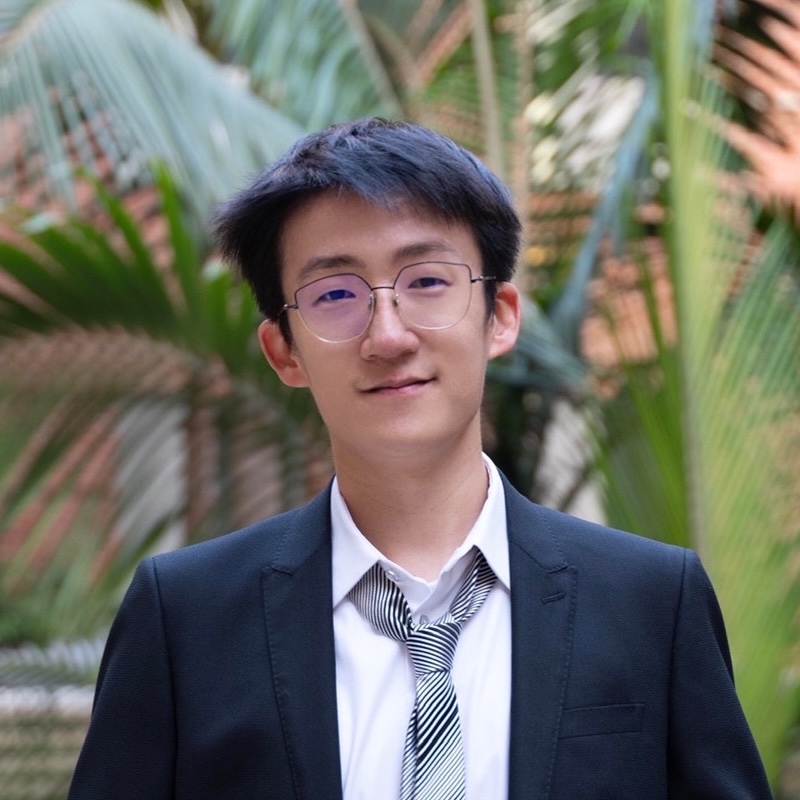
 Yu Zhou
7 previous affiliations
- Research Scientist Intern · 2025
- Research Intern · 2024
- Doctor of Philosophy - PhD, Computer Science · 2024
- Research Intern · 2023
- Bachelor of Science - BS, Mathematics · 2019–2023
- Discover2024
- PhD student · 2024
- Illinois Computer Science2022–2023
- Research Intern · 2022–2023
- Tsinghua University2021–2022
- Research Intern · 2021–2022
- Research Intern · 2022
17 other authors named Yu Zhou: Yu ZHOU (Nankai University · 371 papers), Yu Zhou (Shenzhen University · 233 papers), Yu Zhou (Huazhong University of Science and Technology · 99 papers), Yu Zhou (Hong Kong Polytechnic University · 62 papers), Yu Zhou (Institute of Automation · 31 papers), and 12 more
Research Overview
Yu Zhou focuses on multimodal vision-language modeling and embodied learning. His research trajectory spans from grounding textual instructions in procedural videos to developing frameworks for egocentric perception and embodied decision-making. Most recently, his work investigates the evaluation of embodied cognition and the use of synthetic data to improve generalization in autonomous agents.
Research Trajectory
Zhou’s early work explored how models understand complex, real-world procedures and events by grounding language in visual and physical contexts. In 2023, he introduced Non-Sequential Graph Script Induction via Multimedia Grounding, developing a method to convert rigid, linear textual instructions into flexible graph scripts by grounding them in procedural videos. This approach allowed models to account for optional and interchangeable steps, improving their ability to predict and complete complex tasks. Concurrently, he explored how agents perceive environments from a first-person view. In Localizing Active Objects from Egocentric Vision with Symbolic World Knowledge, he utilized large language models to extract pre-conditions, post-conditions, and physical descriptions from task instructions. This symbolic world knowledge significantly improved the ability of AI agents to track active objects in egocentric video, advancing the research direction of Modeling Actions as Transformations between Physical States and contributing to the area of Bridging the Egocentric Exocentric Perspective Gap. Around this time, he also participated in data mining research, contributing to Iterative Strict Density-Based Clustering for News Stream, which proposed a method for fine-grained topic detection in rapidly evolving textual data.
Moving into 2024, his focus expanded to the systematic evaluation and training of autonomous systems. With collaborators, he developed Embodied Agent Interface: Benchmarking LLMs for Embodied Decision Making. This work introduced a generalized framework to assess the capabilities and failure modes of language models in embodied environments, moving beyond simple success rates to pinpoint specific missing abilities in decision-making. This project intersected with the broader area of Formal Task Specification Using Temporal Logic.
In 2025, Zhou investigated how synthetic data and diverse simulated environments can address knowledge gaps in multimodal models. He introduced Contrastive Visual Data Augmentation, a pipeline that leverages text-to-image models to generate targeted synthetic training data. By extracting distinguishing features between confusing concepts, the method significantly improved the accuracy of large multimodal models on rare or newly discovered visual concepts. He also contributed to the development of a framework that uses language models to simulate user interface states, detailed in LLMs as Scalable, General-Purpose Simulators For Evolving Digital Agent Training. This approach provided a massive synthetic training ground for digital agents, advancing work in the areas of Generalization via Synthetic Diversity and Visual Perception for Autonomous Computer Agents.
Alongside these core embodied and synthetic data projects, Zhou explored the robustness of multimodal models across different domains. He led the creation of DialectGen: Benchmarking and Improving Dialect Robustness in Multimodal Generation, which evaluated the performance degradation of generative models when processing regional English dialects, highlighting significant vulnerabilities in state-of-the-art systems. Additionally, he participated in medical imaging research, contributing to TemMed-Bench: Evaluating Temporal Medical Image Reasoning in Vision-Language Models. This benchmark tested models on tracking patient changes over time, demonstrating that augmenting models with multi-modal retrieval improves diagnostic accuracy and aligning with the direction of Temporal Reasoning for Tracking Disease Progression.
In 2026, Zhou continued to probe the limits of physical reasoning in artificial intelligence. He collaborated on ENACT: Evaluating Embodied Cognition with World Modeling of Egocentric Interaction, a benchmark designed to test whether vision-language models possess embodied cognition. By framing physical reasoning as a sequence-reordering task, the work revealed a substantial performance gap between human and AI sensorimotor understanding, particularly as interaction sequences grow longer.
Current Directions
The most recent papers in the evidence address the evaluation and enhancement of embodied cognition in multimodal models. Recent work investigates how vision-language models understand physical interactions and sensorimotor dynamics, framing physical reasoning through complex sequence-reordering tasks to expose biases and limitations in AI world modeling. Concurrently, this research explores the use of scalable simulation and synthetic data generation to train robust digital agents, aiming to overcome the limitations of pre-trained knowledge gaps and improve generalization across diverse, real-world environments.
Profile updated
Loading new papers…
Other researchers whose papers cluster into the same research directions — a proxy for overlapping technical interests and shared intellectual neighborhoods.
See something wrong? Report a mistake