

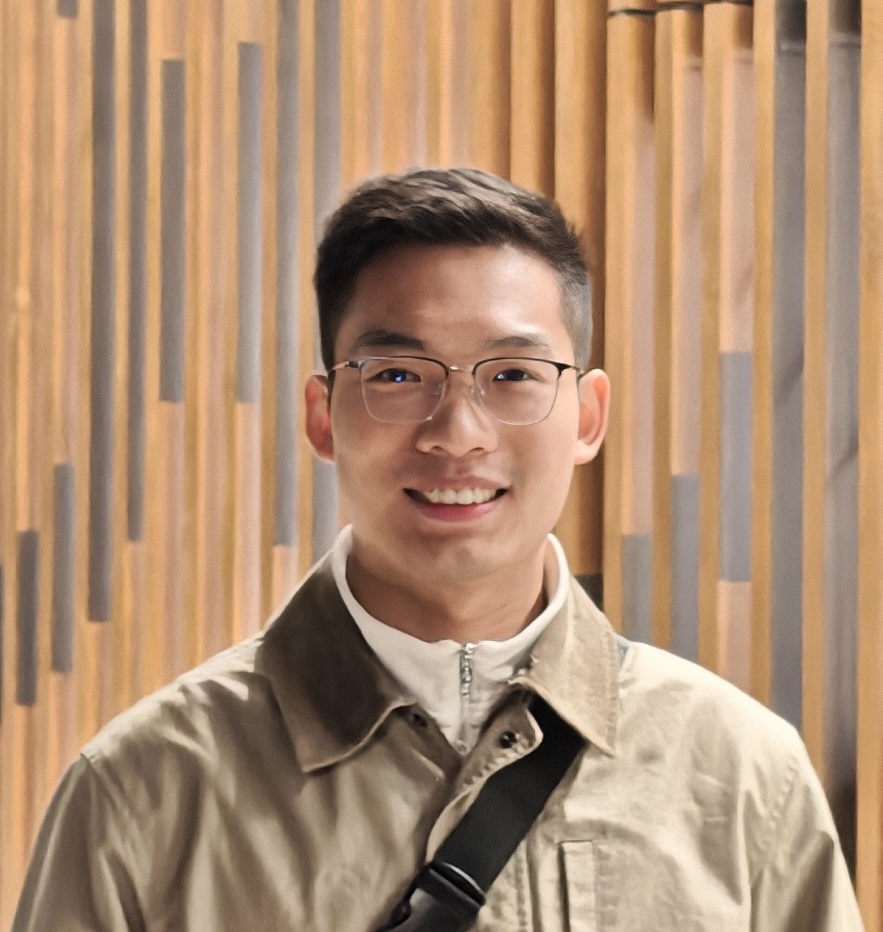
 Yu Yang
· 2 previous affiliations
- Zhejiang UniversitySince 2021
- PhD student · Since 2021
- National University of Singapore2025–2026
- PhD student · 2025–2026
14 other authors named Yu Yang: Yu Yang (City University of Hong Kong · 123 papers), Yu Yang (Education University of Hong Kong · 34 papers), Yu Yang (OpenAI (United States) · 31 papers), Yu Yang (Beijing University of Post and Telecommunication · 18 papers), Yu Yang (Duke University · 11 papers), and 9 more
Research Overview
Yu Yang focuses on 3D computer vision, generative world models, and autonomous driving perception. His early work addressed temporal action proposals and LiDAR-based scene understanding for outdoor environments. Recently, his research has shifted toward developing controllable 4D scene generation frameworks and evaluating the physical consistency of generative world models for autonomous vehicles.
Research Trajectory
Yu Yang’s early research addressed video analysis, specifically focusing on temporal action proposal in untrimmed videos. He introduced Exploiting semantic-level affinities with a mask-guided network for temporal action proposal in videos, which tackled the challenge of modeling representative temporal relations in long video sequences by learning semantic-level affinities rather than relying solely on local or global dependencies.
Following this work, his focus expanded into 3D scene understanding and LiDAR processing for outdoor environments. He contributed to PANet: LiDAR Panoptic Segmentation with Sparse Instance Proposal and Aggregation, which advanced methods for segmenting both foreground objects and background elements in point clouds. In parallel, he co-authored SSC-RS: Elevate LiDAR Semantic Scene Completion with Representation Separation and BEV Fusion, a framework that separates semantic and geometric representations into distinct branches before fusing them in a Bird's-Eye View (BEV) space to improve semantic scene completion.
In 2024, this focus on scene completion extended to camera-based methodologies. With collaborators, he developed Camera-Based 3D Semantic Scene Completion With Sparse Guidance Network. This one-stage framework utilizes a dense-sparse-dense approach to efficiently propagate semantic information from sparse seed voxels to the entire 3D scene, advancing the research direction of Error Propagation in Monocular Depth Priors. Returning to LiDAR segmentation the following year, he developed DQFormer: Toward Unified LiDAR Panoptic Segmentation With Decoupled Queries for Large-Scale Outdoor Scenes. This unified framework employs a decoupled query workflow specifically designed to address the distinct spatial distributions of foreground objects and background elements in large-scale outdoor environments.
Around this time, his trajectory shifted significantly toward generative AI and the development of world models for autonomous driving. His work on Driving in the Occupancy World: Vision-Centric 4D Occupancy Forecasting and Planning via World Models for Autonomous Driving established a vision-centric approach to predicting dynamic 3D environments and planning vehicle trajectories. He further refined this approach in Vision-Centric 4D Occupancy Forecasting and Planning via Implicit Residual World Models. This research improves autonomous driving simulation by shifting away from full-scene reconstruction; instead, the model focuses its capacity on predicting future changes, or residuals, effectively separating dynamic foreground elements from redundant static backgrounds. This methodology intersects with the broader area of Temporal Consistency for Generative Video Diffusion.
Expanding into large-scale scene generation, he introduced X-Scene: Large-Scale Driving Scene Generation with High Fidelity and Flexible Controllability. This framework is designed to build expansive, high-fidelity 3D driving environments from simple text prompts or layouts. By combining large language model-driven scene planning with a geometry-first diffusion pipeline and spatial outpainting, the system creates spatially consistent, city-scale worlds that can be rendered into 3D Gaussian Splatting for realistic simulation, contributing to the research direction of Controllable Generative World Models for Autonomous Driving. He also participated in related generative efforts, such as Learning to Generate 4D LiDAR Sequences, which explores the generation of realistic and temporally coherent 4D LiDAR data from natural language descriptions by leveraging explicit scene graphs and multi-stage diffusion.
To synthesize this rapidly evolving field, he co-authored 3D and 4D World Modeling: A Survey, providing a unified taxonomy and standardized definitions for approaches using video, occupancy grids, and LiDAR to model dynamic environments. Beyond autonomous driving, Yang has also participated in research on agentic systems and vision-language reasoning, such as O2-Searcher: A Searching-based Agent Model for Open-Domain Open-Ended Question Answering, an RL agent for question answering that decouples internal reasoning from dynamic search, and Evidence-RL: Towards Evidence-intensive Visual Reasoning, which uses counterfactual evidence disentanglement in post-training to ground VLM responses in concrete visual evidence.
Yang's recent agentic and generative work also spans 3D and video synthesis. As lead author, Yang developed SPIRAL: Self-Evolving Action-Conditioned Video Generation via Reflective Planning Agents, a closed-loop framework employing planning, memory, and reflection agents to achieve long-horizon temporal coherence and self-evolution through reinforcement learning. Additionally, Yang contributed to HoloCode: A Code-Centric Multi-Agent Framework for Image-to-3D Scene Generation, which coordinates layout, modeling, and refinement agents to generate executable Blender code and assemble structurally plausible 3D scenes from single images.
Current Directions
The most recent papers in the evidence address the evaluation and benchmarking of generative world models for autonomous driving. With collaborators, he has investigated the research direction of Aligning Video Generation Models with Physical Laws, moving beyond visual fidelity to assess how realistically these models behave in simulated environments. This includes participation in WorldLens: Full-Spectrum Evaluations of Driving World Models in Real World, which introduces a comprehensive benchmark spanning 4D reconstruction and closed-loop control to measure physical plausibility. Related work, such as Is Your Driving World Model an All-Around Player?, further examines the functional reliability and geometric grounding of these systems, highlighting the ongoing challenge of developing world models that are both photorealistic and physically accurate for safe autonomous driving.
Profile updated
Loading new papers…
Other researchers whose papers cluster into the same research directions — a proxy for overlapping technical interests and shared intellectual neighborhoods.
See something wrong? Report a mistake