

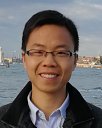
 Yongtao Wang
· 3 previous affiliations
- Peking UniversitySince 2011
- Associate Professor · Since 2016
- Assistant Professor · 2011–2016
- Postdoc · 2010
- PhD student · 2004–2009
- Undergrad student · 2000–2004
1 other author named Yongtao Wang: Yongtao Wang (2 papers)
Research Overview
Yongtao Wang focuses on computer vision, autonomous driving perception, and efficient deep learning architectures. His trajectory spans early work in image processing and object detection to advanced multimodal sensor fusion and neural architecture search. Recently, his research emphasizes robust 3D perception, trajectory prediction, and the reinforcement fine-tuning of vision-language-action models for embodied intelligence.
Research Trajectory
Early in his career, his research centered on classical computer vision and image processing. He developed a topological clustering algorithm for Large Disparity Motion Layer Extraction via Topological Clustering (2011), establishing robust affine transformation models to segment scenes into distinct motion layers. He also collaborated on the Infrared Patch-Image Model for Small Target Detection in a Single Image (2013), formulating target detection as a low-rank and sparse matrix recovery problem based on the non-local self-correlation properties of infrared backgrounds.
As deep learning architectures became central to computer vision, his work addressed scale variation and feature extraction in object detection. He participated in designing M2Det: A Single-Shot Object Detector Based on Multi-Level Feature Pyramid Network (2019) to construct more effective feature pyramids outside of traditional classification backbones. Building on this, he co-developed CBNet: A Novel Composite Backbone Network Architecture for Object Detection (2020), which iteratively feeds high-level features between adjacent backbones to improve detection performance. During this period, his collaborative work included Differentiable Automatic Data Augmentation (2020), which reformulated policy search as a differentiable optimization problem. This work contributed directly to the research direction of Efficient Automated Data Augmentation Policy Search, achieving significantly faster search times than prior discrete methods.
By 2022, his focus had expanded significantly into 3D perception and autonomous driving. He contributed to BEVFusion: A Simple and Robust LiDAR-Camera Fusion Framework (2022), a multimodal architecture demonstrating that camera streams could operate independently of LiDAR inputs, ensuring robustness during sensor malfunctions. Concurrently, he introduced BEV-MAE: Bird's Eye View Masked Autoencoders for Outdoor Point Cloud Pre-training (2022), advancing self-supervised pre-training by masking point clouds in the bird's eye view rather than 3D space and adding a point density prediction task. He also explored optimization strategies in Training Protocol Matters: Towards Accurate Scene Text Recognition via Training Protocol Searching (2022), utilizing evolutionary algorithms to prove that hyperparameter and data strategy recipes are as critical as architectural design for model performance.
Continuing into 2023 and 2024, his research explored unsupervised learning and AI security. His lab addressed the broader area of Hierarchical Feature Fusion across Network Depths with Foreground Guidance and Multi-Layer Feature Fusion for Unsupervised Object Discovery with Transformers (2023), refining object localization by enhancing pre-trained Transformer features rather than solely focusing on the localization head. Shifting to generative AI security, he guided the development of DUAW: Data-free Universal Adversarial Watermark against Stable Diffusion Customization (2024), an imperceptible watermark designed to corrupt the variational autoencoders of generative models and protect copyrighted artwork from unauthorized mimicry.
His most recent trajectory integrates large language models, efficient network design, and advanced autonomous systems. He collaborated on CoLLM-NAS: Collaborative Large Language Models for Efficient Knowledge-Guided Neural Architecture Search (2025), a "two-brain" framework that replaces blind search algorithms with LLM-guided reasoning to discover valid architectures rapidly. To address efficiency in 3D perception, he led the development of PTQAT: A Hybrid Parameter-Efficient Quantization Algorithm for 3D Perception Tasks (2025), which selectively fine-tunes layers most sensitive to error propagation to bridge the gap between post-training quantization and quantization-aware training.
In the domain of autonomous driving, he co-authored KnowVal: A Knowledge-Augmented and Value-Guided Autonomous Driving System (2025) to embed common sense and ethical norms into end-to-end driving models. His team further refined sensor fusion with InsFusion: Rethink Instance-level LiDAR-Camera Fusion for 3D Object Detection (2025), which extracts object queries directly from raw camera and LiDAR features to minimize cumulative noise. For trajectory prediction, his group introduced HeLoFusion: An Efficient and Scalable Encoder for Modeling Heterogeneous and Multi-Scale Interactions in Trajectory Prediction (2025), utilizing localized, multi-scale graphs to capture social interactions efficiently. Finally, expanding into embodied intelligence, he oversaw RFTF: Reinforcement Fine-tuning for Vision-language-action Models with Temporal Feedback (2026), addressing the limitations of sparse rewards in training vision-language-action models to follow human instructions in physical environments.
Current Directions
Recent work investigates the intersection of embodied intelligence, advanced autonomous driving, and efficient model design. In the domain of embodied AI, his most recent papers address the reinforcement fine-tuning of Vision-Language-Action (VLA) models, seeking to overcome the limitations of sparse rewards by incorporating fine-grained temporal feedback for complex physical tasks.
In autonomous driving, his current research emphasizes both robust perception and value-guided decision-making. This includes developing systems that embed common sense and ethical norms into end-to-end driving models, as well as refining 3D object detection through instance-level LiDAR-camera fusion that minimizes cumulative noise. He is also actively exploring scalable trajectory prediction by modeling heterogeneous, multi-scale social interactions among agents using localized graph structures.
Finally, his recent methodological work focuses on optimizing deep learning architectures for deployment. This involves leveraging collaborative Large Language Models to guide neural architecture search, significantly accelerating the discovery of valid architectures, and designing hybrid quantization frameworks that mitigate error propagation in 3D perception tasks while drastically reducing trainable parameters.
Profile updated
Loading new papers…
Other researchers whose papers cluster into the same research directions — a proxy for overlapping technical interests and shared intellectual neighborhoods.
See something wrong? Report a mistake