

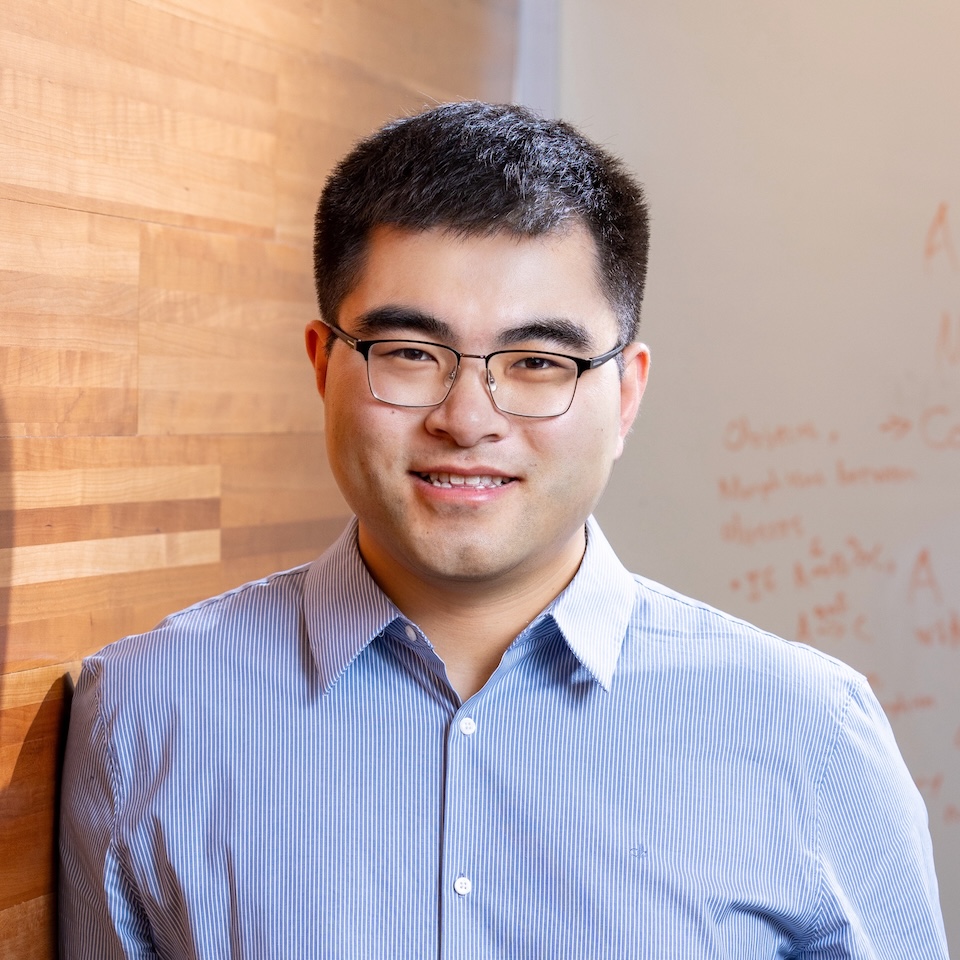
 Yizhong Wang
· 5 previous affiliations
- ByteDance (China)Since 2025
- Researcher · Since 2025
- The University of Texas at AustinSince 2026
- Assistant Professor · Since 2026
- Current
- University of Washington2019–2025
- PhD student · 2019–2025
- Peking University2016–2019
- MS student · 2016–2019
- Shanghai Jiao Tong University2012–2016
- Undergrad student · 2012–2016
Research Overview
Yizhong Wang focuses on instruction tuning, synthetic data generation, and the evaluation of large language models. His early work explored natural language parsing and reading comprehension before shifting toward scalable alignment techniques and parameter-efficient adaptation. Recently, he investigates algorithms for long-horizon agency, human-AI feedback routing, and robust evaluation methodologies for frontier models.
Research Trajectory
Currently a Research Scientist at ByteDance Seed and an incoming Assistant Professor at the University of Texas at Austin, his research trajectory began with foundational problems in natural language processing. In 2017, he proposed a pipelined approach for rhetorical structure theory in A Two-Stage Parsing Method for Text-Level Discourse Analysis, separating the parsing of naked discourse trees from relation labeling to mitigate data sparsity. He subsequently participated in the creation of DROP: A Reading Comprehension Benchmark Requiring Discrete Reasoning Over Paragraphs, contributing to the broader area of Discrete Reasoning for Numerical Machine Reading Comprehension.
By 2022, his focus shifted significantly toward instruction tuning and zero-shot generalization. He introduced Super-NaturalInstructions: Generalization via Declarative Instructions on 1600+ NLP Tasks, a large-scale benchmark demonstrating that training on diverse, structured instructions yields substantial performance gains on unseen tasks. This work highlighted the importance of the research direction of Task Diversity for Cross-Task Generalization. Building on this, he developed Self-Instruct: Aligning Language Models with Self-Generated Instructions, a framework that enables language models to generate their own synthetic training data, drastically reducing the need for human annotation while maintaining high instruction-following capabilities. He also systematically evaluated the utility of various open-source datasets and models in How Far Can Camels Go? Exploring the State of Instruction Tuning on Open Resources.
In 2023, he explored methods to make instruction tuning more efficient and versatile. In HINT: Hypernetwork Instruction Tuning for Efficient Zero- and Few-Shot Generalisation, he utilized hypernetworks to transform task instructions into lightweight modules, advancing work in the areas of Factorized Hypernetworks for Adaptive Parameterization and Parameter Synthesis for Dynamic Model Adaptation. He also collaborated on extending instruction tuning to text representations in One Embedder, Any Task: Instruction-Finetuned Text Embeddings, contributing to the research direction of Instruction Conditioned Embeddings for Task Aware Retrieval. Concurrently, he participated in designing adaptive retrieval mechanisms to improve factual accuracy in Self-RAG: Self-reflective Retrieval Augmented Generation.
His more recent work addresses the complexities of model evaluation, alignment, and context scaling. In 2024, he investigated the predictability of model behavior in Third-Party Language Model Performance Prediction from Instruction, finding that forecasting performance based solely on task instructions remains highly challenging. To optimize alignment processes, he introduced a routing framework in Hybrid Preferences: Learning to Route Instances for Human vs. AI Feedback, which balances the cost of human annotation with the scalability of synthetic feedback. He also tackled systematic biases in automated evaluation through HREF: Human Response-Guided Evaluation of Instruction Following in Language Models, demonstrating that using human references as a gold standard significantly improves reliability. Furthermore, he developed techniques to simulate long-range dependencies without expensive long-form data in Long Context Alignment with Short Instructions and Synthesized Positions.
Moving into 2025 and 2026, his research emphasizes fine-grained diagnostics and the robustness of automated systems. He proposed EvalTree: Profiling Language Model Weaknesses via Hierarchical Capability Trees to generate human-readable weakness profiles that guide targeted model remediation. He also collaborated on identifying critical vulnerabilities in LLM-as-a-judge paradigms in When Rubrics Backfire: Systematic Preference Drift in LLM Judges. Most recently, he participated in evaluating the capacity of multi-modal models to navigate complex web environments in TurkingBench: A Challenge Benchmark for Web Agents.
Current Directions
The most recent papers in the evidence address the robust evaluation and diagnostic profiling of language models, alongside the development of capable web agents. Recent work investigates how to move beyond aggregate benchmark scores by building hierarchical capability trees to diagnose specific model weaknesses and guide targeted data collection. Additionally, he explores the adversarial vulnerabilities of automated evaluators, demonstrating how minor rubric changes can cause systematic preference drift in LLM judges. His current research also extends to multi-modal models, evaluating their ability to navigate complex, web-based crowdsourcing environments and execute long-horizon tasks.
Profile updated
Loading new papers…
Other researchers whose papers cluster into the same research directions — a proxy for overlapping technical interests and shared intellectual neighborhoods.
See something wrong? Report a mistake