

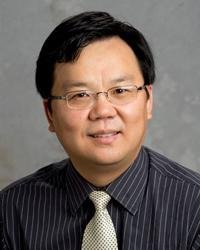
 Yingjie Victor Chen
· 3 previous affiliations
- Purdue University West LafayetteSince 2010
- Full Professor · Since 2023
- Associate Professor · 2018–2023
- Assistant Professor · 2012–2018
- Visiting Scholar · 2010–2012
- Simon Fraser University2002–2011
- PhD student · 2007–2011
- MS student · 2002–2007
- Tsinghua University1987–1992
- B.Eng, Engineering · 1987–1992
Research Overview
Yingjie Victor Chen focuses on human-computer interaction, information visualization, and the integration of artificial intelligence within computer graphics. His trajectory spans early foundational systems in visual analytics to recent advancements in virtual reality and deep learning for 3D generation. Currently, he investigates spatiotemporal modeling, neural representations for dynamic scenes, and multi-modal machine learning.
Research Trajectory
Chen’s early research concentrated on visual analytics and interactive systems designed to manage complex, high-dimensional datasets. In 2006, he explored multimedia data structures with NEAR: Visualizing Information Relations in a Multimedia Repository. This interest in interactive data exploration expanded into award-winning contributions to the IEEE VAST Challenges. He developed systems for analyzing complex narratives, as seen in Model based interactive analysis of interwoven, imprecise narratives: VAST 2010 mini challenge 1 award: Outstanding interaction model. Recognizing the growing need for flexible, on-the-go analysis, he introduced MobileAnalymator: Animating data changes on mobile devices in 2011, an internet-based visual analytic system utilizing spatial and temporal autocorrelations for tablet environments.
Continuing to scale these visual analytics approaches, Chen and his collaborators designed SemanticPrism: A multi-aspect view of large high-dimensional data: VAST 2012 Mini Challenge 1 award: Outstanding integrated analysis and visualization, which employed semantic zooming across geo-temporal, time series, and pixel perspectives to analyze logs from millions of computers. He later applied these principles to crisis informatics in Real-time identification and monitoring of abnormal events based on microblog and emergency call data using SMART (2014), extending a social media analytics toolkit to monitor topic evolution and geolocation patterns during emergencies. Alongside building specific systems, he also formalized the underlying analytical processes, proposing frameworks to capture user interactions in Employing a Parametric Model for Analytic Provenance.
In the following years, Chen’s work increasingly integrated deep learning techniques into computer graphics, particularly focusing on robust representations for pose estimation. He contributed to the research direction of Continuous Rotation Representations for Deep Learning and the broader area of Orthogonal Projections for Robust 3D Rotation Estimation. This shift is evident in A Vector-based Representation to Enhance Head Pose Estimation (2021), where he proposed using the three vectors of a rotation matrix to overcome the discontinuity issues inherent in Euler angles and quaternions. He refined this approach in Towards Unbiased Label Distribution Learning for Facial Pose Estimation Using Anisotropic Spherical Gaussian (2022), mapping rotation matrix vectors to a unit sphere to eliminate biased expectations in label distribution learning.
Concurrently, Chen applied deep learning to cultural heritage and continued advancing visualization and virtual reality (VR) interfaces. He led research on Traditional African Dances Preservation Using Deep Learning Techniques (2022), developing frameworks to identify and model fast, complex dance movements from video. Returning to visual analytics, he addressed visual clutter in temporal ranking data with Colorslope: a balanced visualization of overview and details on ranks over time (2023), a hybrid technique combining slope graphs and temporal heatmaps. In the VR domain, he sought to reduce cognitive load during complex tasks, introducing ManiLoco: A VR-Based Locomotion Method for Concurrent Object Manipulation (2023) to enable hands-free navigation while users interact with virtual objects.
Chen’s recent work demonstrates a synthesis of multi-modal machine learning, advanced 3D/4D generation, and rigorous evaluation of interactive systems. In 2024, he explored synthetic pretraining for environmental analysis in M2fNet: Multi-Modal Forest Monitoring Network on Large-Scale Virtual Dataset, utilizing synthetically generated virtual forests to improve tree detection accuracy. He also continued to innovate in data visualization, developing node-link techniques to interpret distortion errors in Mesoscopic structure graphs for interpreting uncertainty in non-linear embeddings. His commitment to the usability of spatial computing systems was further reflected in Understanding Pitfalls and Opportunities of Applying Heuristic Evaluation Methods to VR Training Systems: An Empirical Study. In the realm of video analysis, he addressed the high cost of pixel-wise annotation by exploring simulated dense labels and explicit motion clues in Label-Efficient Video Object Segmentation With Motion Clues.
By 2025, Chen’s research expanded into cutting-edge generative models and large language model (LLM) architectures. He participated in the development of SplatFlow: Self-Supervised Dynamic Gaussian Splatting in Neural Motion Flow Field for Autonomous Driving, a framework for reconstructing complex dynamic scenes without manual 3D bounding boxes. He also contributed to model alignment research with Probabilistic Token Alignment for Large Language Model Fusion, framing cross-vocabulary alignment as an optimal transport problem to fuse heterogeneous LLMs. Furthermore, he addressed temporal consistency in generative animation with Tracking-Guided 4D Generation: Foundation-Tracker Motion Priors for 3D Model Animation, injecting explicit tracking priors into multi-view video diffusion models and 4D Gaussian Splatting reconstructors.
Current Directions
Recent work investigates the intersection of generative artificial intelligence, dynamic scene reconstruction, and multi-modal model alignment. The most recent papers in the evidence address the challenges of spatiotemporal modeling, specifically leveraging 4D Gaussian Splatting and neural motion flow fields to generate and animate high-fidelity 3D assets from sparse inputs. Additionally, current research explores probabilistic frameworks for fusing large language models, moving beyond rigid token mapping to optimize knowledge sharing across heterogeneous architectures. Across these domains, the overarching theme remains the development of robust, self-supervised, and label-efficient methods to bridge complex data representations with human-centric applications.
Profile updated
Loading new papers…
Other researchers whose papers cluster into the same research directions — a proxy for overlapping technical interests and shared intellectual neighborhoods.
See something wrong? Report a mistake