

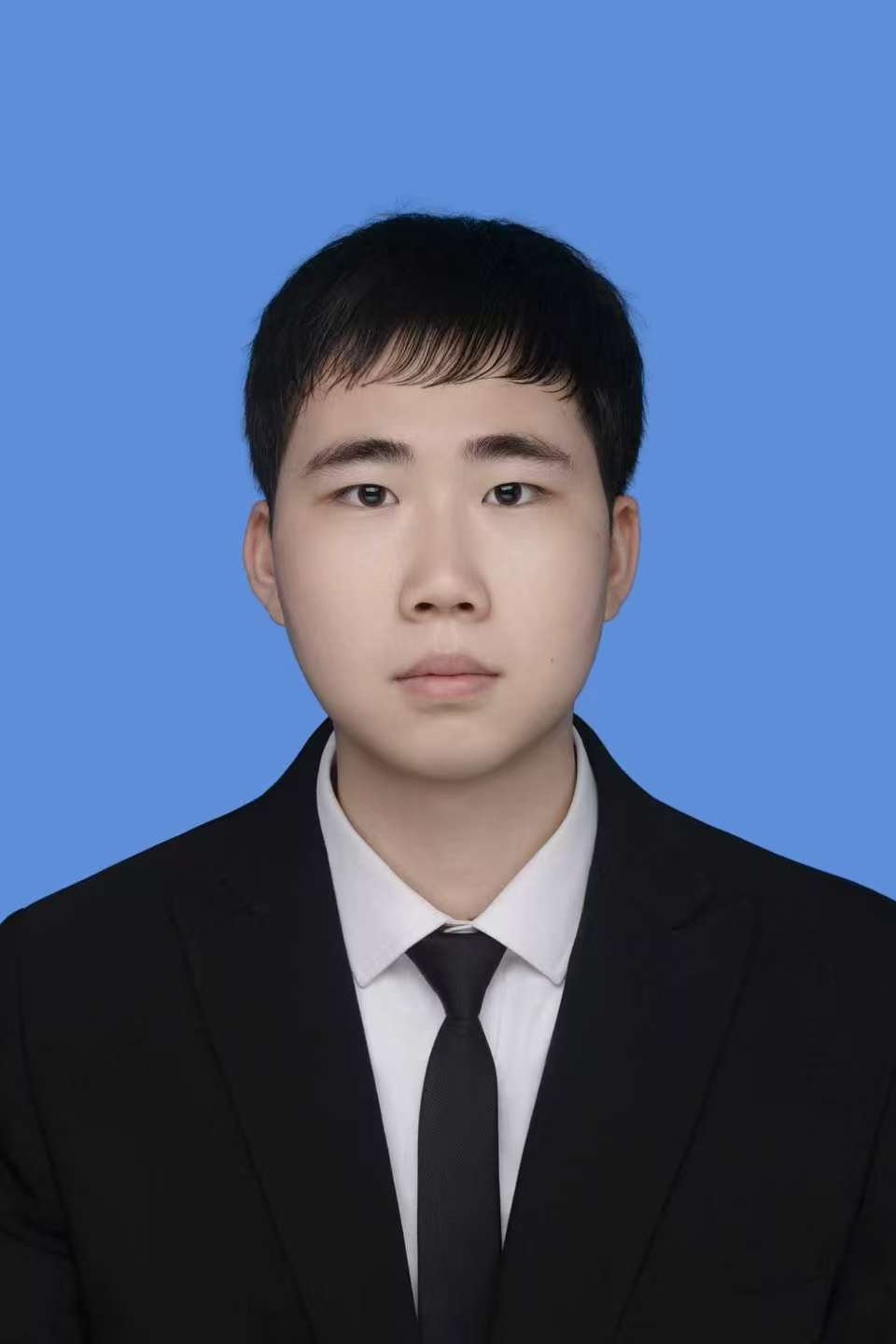
 Yihao Hu
· 5 previous affiliations
- Ant Group (China)Since 2026
- Intern · Since 2026
- Westlake UniversityCurrent
- Current
- Mayun UniversitySince 2026
- PhD student · 2026–2031
- Meituan (China)2025–2026
- Intern · 2025–2026
- hainan2022–2026
- Undergrad student · 2022–2026
2 other authors named Yihao Hu: Yihao Hu (Southeast University · 6 papers), Yihao Hu (University of Notre Dame · 1 paper)
Research Overview
Yihao Hu focuses on multimodal large language models, visual multi-agent systems, and audio-visual reasoning. His work explores how structured representations and reinforcement learning can improve the reasoning capabilities of AI systems across complex visual and temporal contexts. Recently, his research addresses the coordination bottlenecks in multi-agent environments and the temporal grounding of video reasoning.
Research Trajectory
In 2025, Hu contributed to research investigating how symbolic representations can enhance the training data used for multimodal large language models. With collaborators, he explored the research direction of Structural Metrics for Reasoning Complexity in Language Models through the development of the SCOPE (Scalable COunterfactual Program Evolution) framework. Detailed in Counterfactual Evolution of Multimodal Datasets via Visual Programming, this work utilizes visual programming to systematically evolve multimodal datasets. By representing reasoning paths as executable Python code, the framework enables proactive interventions—such as expanding reasoning steps or altering visual contexts—to generate more complex and verifiable training examples. This approach, which also touches upon the broader area of Complexity Based Reasoning Subsumption, facilitates a curriculum-based training strategy that improves the reasoning and visual dialogue capabilities of multimodal models.
Building on his work with complex visual systems, Hu's research expanded in 2026 to address challenges in collaborative AI environments, specifically focusing on the research area of The Multi Agent Coordination Bottleneck. He participated in the development of a framework designed to overcome the "scaling wall" observed in Visual Multi-Agent Systems (VMAS), where increasing the number of agents or interaction turns typically degrades performance and inflates computational costs. In Dual Latent Memory for Visual Multi-agent System, the research team introduced $L^2$-VMAS, a system that replaces lossy, text-based communication between agents with a dual latent memory architecture. By decoupling perception from cognitive processing, this method improves system accuracy while significantly reducing token consumption. This contribution aligns with broader efforts in the research direction of Selective Communication for Scalable Multi-Agent Systems and the area of Uncertainty Driven Triggers for Efficient Multi Agent Communication.
Also in 2026, Hu contributed to advancements in multimodal reinforcement learning, specifically targeting the research direction of Grounding Video Reasoning in Temporal Evidence. In OmniVideo-R1: Reinforcing Audio-visual Reasoning with Query Intention and Modality Attention, he and his co-authors presented a two-stage reinforcement learning framework designed to enhance the audio-visual reasoning capabilities of large language models. The OmniVideo-R1 system trains models to explicitly ground their responses in specific temporal segments of a video, rewarding the effective synthesis of audio and visual cues to solve complex reasoning benchmarks.
Current Directions
The most recent work in the evidence indicates an ongoing focus on scaling and refining multimodal reasoning systems. Current directions involve optimizing how AI agents process and communicate complex sensory data, particularly in multi-agent configurations where traditional text-based exchanges become inefficient. Additionally, recent efforts emphasize the use of reinforcement learning to enforce precise temporal grounding in video analysis, ensuring that multimodal models synthesize audio and visual information accurately across time. Together, these themes reflect a broader interest in building more efficient, verifiable, and context-aware architectures for advanced visual and temporal reasoning.
Profile updated
Loading new papers…
Other researchers whose papers cluster into the same research directions — a proxy for overlapping technical interests and shared intellectual neighborhoods.
See something wrong? Report a mistake