

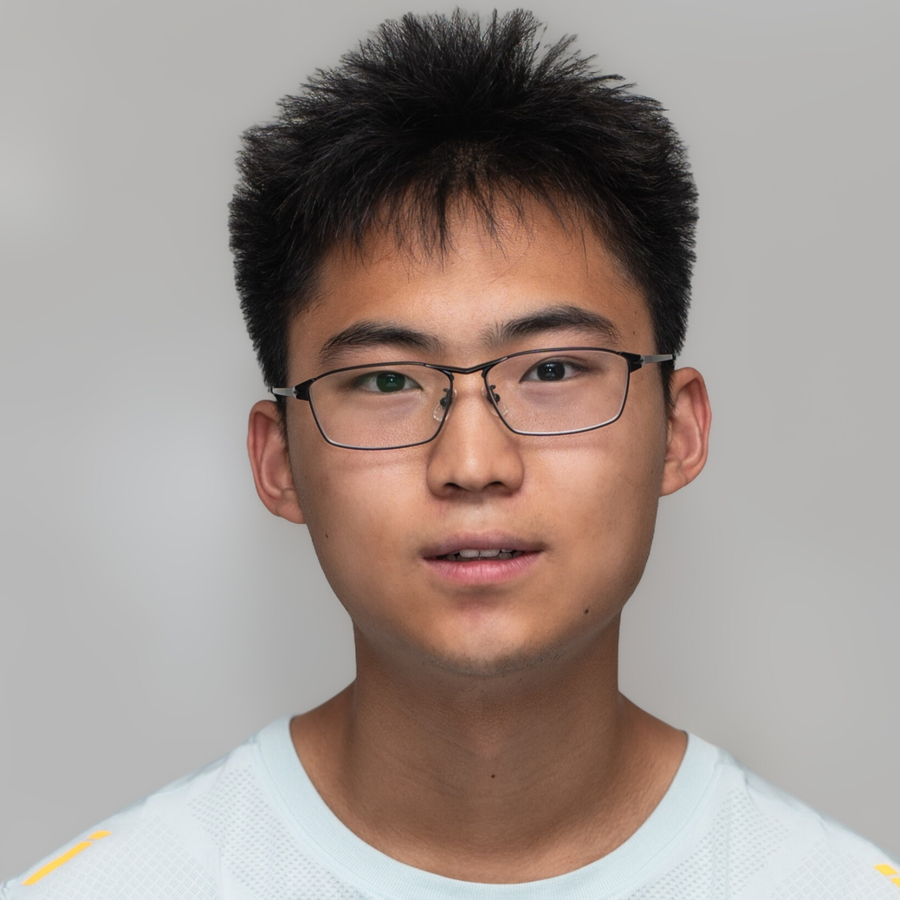
 Yifei Wang
· 2 previous affiliations
- Rice UniversitySince 2025
- PhD student · Since 2025
- Peking University2021–2025
- Undergrad student · 2021–2025
10 other authors named Yifei Wang: Yifei Wang (Amazon (United States) · MTS at Amazon AGI SF Lab · 118 papers), Yifei Wang (5 papers), Yifei Wang (Biogen (United States) · 3 papers), Yifei Wang (Qiyuan Laboratory · 2 papers), Yifei Wang (Georgia Institute of Technology · 2 papers), and 5 more
Research Overview
Yifei Wang focuses on generative modeling, specifically addressing the theoretical and practical challenges of training and sampling diffusion models. His work spans from developing expectation-maximization frameworks for learning from corrupted data to unifying one-step diffusion distillation methods. Currently, he investigates advanced divergence minimization techniques to accelerate generative sampling while preserving high generation quality.
Research Trajectory
In 2024, Wang contributed to research addressing the stringent data requirements of high-quality diffusion models, which typically rely on massive datasets of pristine images. With collaborators, he developed An Expectation-Maximization Algorithm for Training Clean Diffusion Models from Corrupted Observations. This work introduced EMDiffusion, an expectation-maximization framework designed to iteratively reconstruct clean images from corrupted observations and subsequently retrain the model on those reconstructions. This approach advanced the research direction of Learning Clean Distributions from Corrupted Observations and contributed to the broader area of Restoring Images with Unknown Complex Degradations. By enabling effective training for tasks like inpainting, denoising, and deblurring with minimal clean data, the research also intersected with the area of Periodic Reinitialization for Robust Iterative Learning.
Building on his foundational work in generative modeling, Wang subsequently focused on the theoretical unification and acceleration of diffusion sampling. He introduced Uni-Instruct: One-step Diffusion Model through Unified Diffusion Divergence Instruction, a comprehensive framework that consolidates over ten disparate one-step diffusion distillation methods—including Diff-Instruct, DMD, and SIM—under a single theoretical umbrella. By leveraging a novel diffusion expansion of the $f$-divergence family, this research derived a tractable training objective that achieves high generation quality, even outperforming the multi-step teacher models from which they were distilled. This contribution significantly advanced the research direction of Unified Generative Modeling through Variational Divergence Minimization and the area of Preserving Diversity in Fast Generative Distillation.
Current Directions
The most recent papers in the evidence indicate a strong focus on optimizing the efficiency and theoretical foundations of generative models. Wang's current work investigates unified theoretical frameworks for diffusion distillation, aiming to reduce the computational overhead of multi-step sampling without sacrificing output quality. By exploring advanced divergence minimization techniques, this research seeks to establish more robust and tractable objectives for fast generative distillation, ultimately making high-quality generative modeling more accessible and computationally efficient.
Profile updated
Loading new papers…
Other researchers whose papers cluster into the same research directions — a proxy for overlapping technical interests and shared intellectual neighborhoods.
See something wrong? Report a mistake