

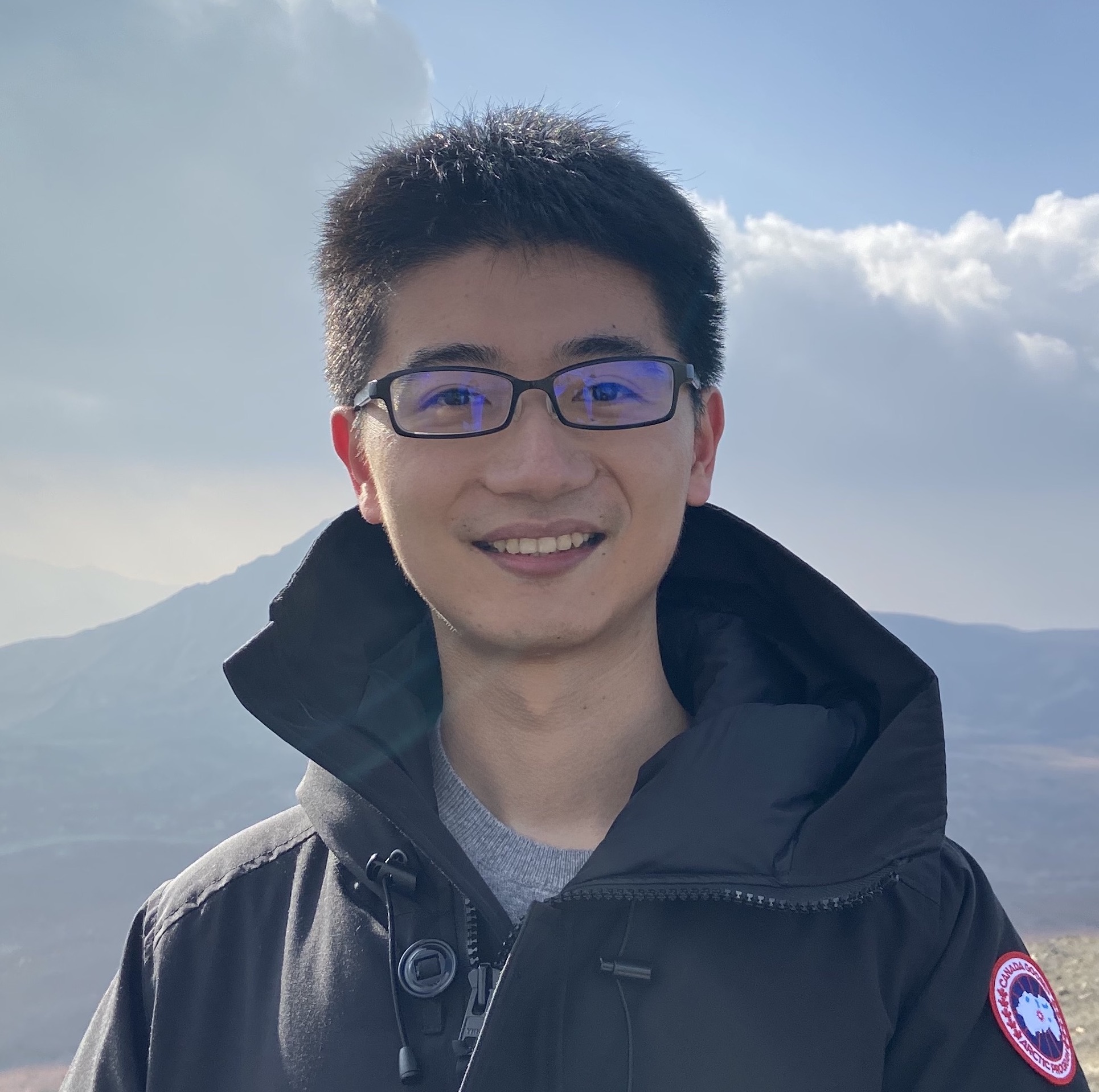
 Yifei Huang
· 2 previous affiliations
- The University of TokyoSince 2015
- Postdoc · Since 2021
- Current
- PhD student · 2018–2021
- MS student · 2015–2018
- Shanghai Jiao Tong University2011–2015
- Undergrad student · 2011–2015
2 other authors named Yifei Huang: Yifei Huang (Qualcomm (United States) · 42 papers), Yifei Huang (Beihang University · 1 paper)
Research Overview
Yifei Huang focuses on video understanding, egocentric vision, and gaze-guided interaction systems for embodied AI. His early work explored how human selective attention and gaze can inform computational models of action recognition and segmentation. More recently, his research addresses long-form video comprehension, cross-view alignment between first- and third-person perspectives, and efficient spatiotemporal reasoning using state space models.
Research Trajectory
Huang’s research began with a focus on first-person (egocentric) vision and the role of human attention in understanding actions. In 2017, he investigated Temporal Localization and Spatial Segmentation of Joint Attention in Multiple First-Person Videos. This interest in temporal dynamics naturally extended to broader video understanding challenges. He developed methods to improve action segmentation when observations are limited, introducing a graph-based temporal reasoning module in Improving Action Segmentation via Graph-Based Temporal Reasoning to model relations across multiple action segments.
Recognizing that human gaze provides cost-efficient physiological cues, he explored how selective attention mechanisms could aid learning from sparse data. This led to Leveraging Human Selective Attention for Medical Image Analysis with Limited Training Data, which simulated underlying attentional patterns to encode task-relevant visual clues.
Continuing the theme of learning with limited labels, Huang proposed novel frameworks for few-shot action recognition. He introduced the concept of summarizing videos into global and focused prototypes in Compound Prototype Matching for Few-Shot Action Recognition. This work was later expanded in the journal article Matching Compound Prototypes for Few-Shot Action Recognition, which applied tailored matching strategies—such as bipartite matching for temporal alignment—to handle variations in action speed and duration.
Around the same time, Huang contributed to model interpretability and robustness. In Spatio-Temporal Perturbations for Video Attribution, he and his collaborators introduced a model-agnostic method that enforces spatiotemporal smoothness to identify which parts of a video drive a neural network's predictions. He also addressed the challenge of localizing events without precise timestamp labels. Weakly Supervised Temporal Sentence Grounding with Uncertainty-Guided Self-training presented a self-training framework using a Bayesian teacher network to estimate uncertainty, improving the accuracy of finding specific moments based on text descriptions. In Memory-and-Anticipation Transformer for Online Action Understanding, his work advanced online video processing by creating a circular dependency between past actions and future intentions, allowing anticipated states to refine current memory representations.
A major theme in Huang’s recent trajectory is bridging the gap between first-person and third-person perspectives, contributing significantly to the area of View Invariant Representation Learning through Cross View Alignment. To support this, he introduced EgoExoLearn: A Dataset for Bridging Asynchronous Ego- and Exo-centric View of Procedural Activities in Real World, a large-scale dataset designed to help AI agents master asynchronous learning by watching a third-person demonstration and executing it from a first-person perspective. This line of inquiry naturally extended to evaluating Multimodal Large Language Models (MLLMs). In EgoExoBench: A Benchmark for First- and Third-person View Video Understanding in MLLMs, he and his collaborators revealed an "intelligence gap" in current models' ability to align semantics and associate spatial viewpoints across different perspectives.
Simultaneously, Huang has focused on the challenges of long-form video comprehension. In LvBench: A Benchmark for Long-form Video Understanding with Versatile Multi-modal Question Answering, he addressed the complexities of intricate narratives and diverse multimodal information, contributing to the research direction of Overcoming Temporal Reasoning Decay in Long Video Understanding. He also continued to refine temporal grounding techniques. In VideoTG-R1: Boosting Video Temporal Grounding via Curriculum Reinforcement Learning on Reflected Boundary Annotations, he proposed a framework that cleans up messy training labels and uses a curriculum to significantly boost performance with a fraction of the training data and computational budget.
Most recently, Huang has investigated alternative architectures for video understanding. In Video Mamba Suite: State Space Model as a Versatile Alternative for Video Understanding, he provided a comprehensive evaluation of State Space Models (SSMs), demonstrating their potential to match or exceed Transformer performance while offering significant efficiency gains for long videos. This work advances the broader areas of Spatiotemporal Reasoning for Multimodal Video Understanding and Efficient Spatiotemporal Reasoning with Selective State Space Models.
Current Directions
The most recent papers in the evidence indicate a strong focus on scaling video understanding to longer durations and more complex, multi-perspective reasoning tasks. Huang is actively investigating the capabilities and limitations of Multimodal Large Language Models (MLLMs) when processing extended narratives and bridging the gap between egocentric and exocentric viewpoints. Additionally, his recent work explores the architectural foundations of video processing, specifically evaluating how State Space Models (SSMs) like Mamba can provide more efficient spatiotemporal reasoning for long-form video compared to traditional Transformer-based approaches.
Profile updated
Loading new papers…
Other researchers whose papers cluster into the same research directions — a proxy for overlapping technical interests and shared intellectual neighborhoods.
See something wrong? Report a mistake