

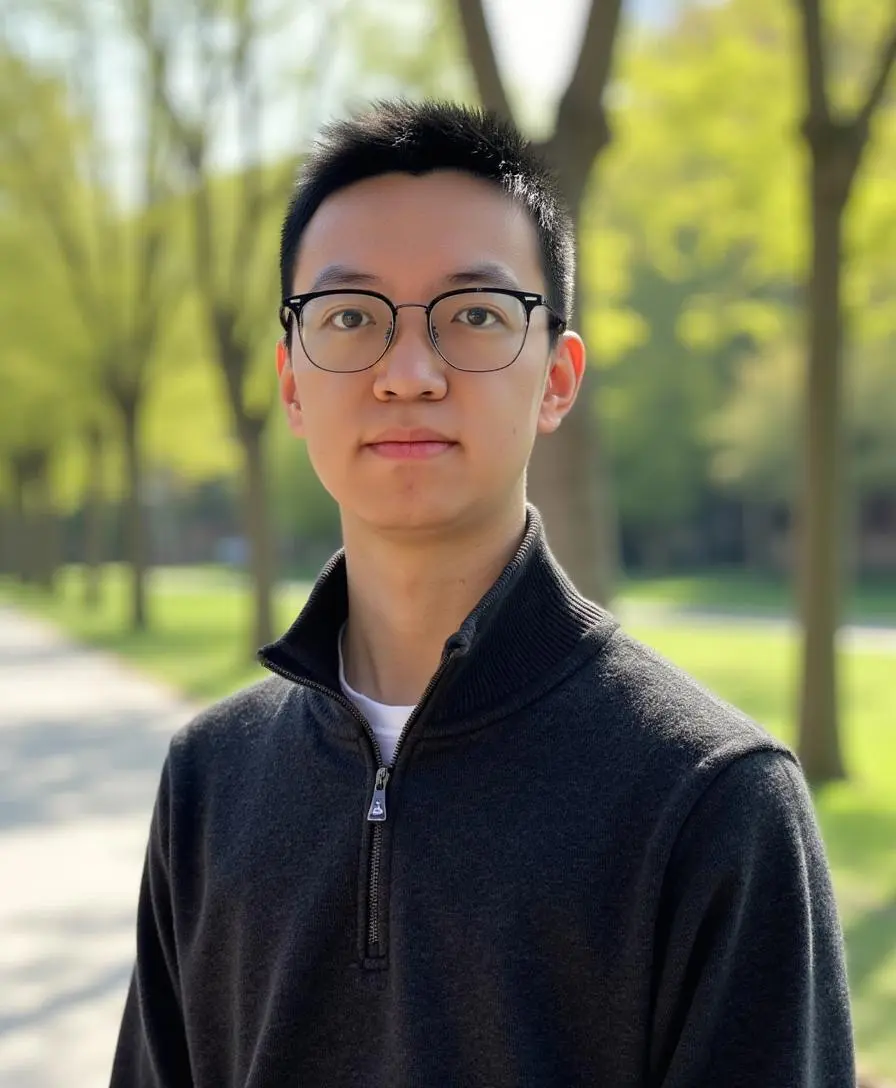
 Yibo Wen
· 1 previous affiliation
- Northwestern UniversitySince 2024
- PhD student · 2024–2029
- Current
Research Overview
Yibo Wen focuses on computational molecular design, structure-based drug discovery, and the development of virtual cell models. His trajectory spans early work in efficient neural graphics encodings to recent advances in AI-driven antibody and drug optimization using preference learning and reinforcement learning. Currently, he investigates genomic foundation models and the biological contextualization of virtual cells.
Research Trajectory
Yibo Wen’s research trajectory began with foundational work in computer graphics and neural representations before transitioning into computational biology and AI-driven drug discovery. His early research addressed computational bottlenecks in neural graphics primitives. In Efficient Encoding of Graphics Primitives with Simplex-based Structures, he introduced a simplex-based encoding method that scales linearly with dimensionality, offering a more efficient alternative to exponentially scaling grid-based encodings. This work contributed to the area of Isotropic Discretization for Grid Based Optimization, significantly reducing training and rendering times for tasks like gigapixel image fitting without sacrificing visual quality.
Shifting his focus toward molecular design and structural biology, his subsequent research applied advanced machine learning paradigms to the generation and optimization of biological molecules. He developed AlignAb, detailed in Pareto-Optimal Energy Alignment for Designing Nature-Like Antibodies, which is a three-stage framework designed to generate stable, high-affinity, and structurally realistic antibody candidates. By extending direct preference optimization for multi-objective alignment, this research advanced the broader area of Multimodal Integration for Scalable Protein Design and contributed to the research direction Iterative Self-Preference Optimization for Language Models, ensuring candidates maintain physical rationality, aligning with work in Physical Realism in Generative Protein Design.
To further improve the sample efficiency of drug discovery pipelines, he proposed a reinforcement learning approach in POLO: Preference-Guided Multi-Turn Reinforcement Learning for Lead Optimization. This system treats lead optimization as a multi-turn dialogue, combining trajectory-level reinforcement with turn-level preference ranking to extract dense learning signals from intermediate steps. This method directly addresses challenges in the research direction Credit Assignment for Sparse and Delayed Rewards, achieving high success rates on single- and multi-property tasks with strict evaluation budgets. Concurrently, he collaborated on a comprehensive taxonomy of the field in A Survey of Large Language Models for Text-Guided Molecular Discovery: from Molecule Generation to Optimization, mapping out learning paradigms for de novo generation and property optimization within the area of Bridging the Synthesizability Gap in Molecular Generation.
Most recently, his trajectory has expanded to encompass genomic foundation models and the conceptual development of virtual cells. He contributed to the engineering of standardized biological machine learning infrastructure in Genome-Factory: A Library for Tuning, Deploying, and Interpreting Genomic Foundation Models. This integrated Python library unifies the lifecycle of genomic models, providing tools for fine-tuning, deployment, and mechanistic interpretability to bridge the gap between machine learning and bench biology. Alongside this infrastructural work, he participated in formulating broader biological modeling strategies in Position: Virtual Cells Need Context, Not Just Scale. This paper argues that the primary failure mode of current computational cellular models is a lack of adequate coverage over diverse biological contexts, suggesting that simply scaling model capacity is insufficient for predicting cellular responses to perturbations.
Current Directions
The most recent papers in the evidence address the development and contextualization of large-scale biological models, specifically focusing on genomic foundation models and virtual cells. Recent work investigates the necessary infrastructure for deploying and interpreting genomic models, aiming to create standardized pipelines that support tasks ranging from data acquisition to mechanistic interpretability. Additionally, current theoretical directions emphasize the importance of biological context over pure model scale. This involves exploring how computational models of cellular responses can be improved by integrating diverse biological contexts rather than relying solely on increased model capacity and expressivity.
Profile updated
Loading new papers…
Other researchers whose papers cluster into the same research directions — a proxy for overlapping technical interests and shared intellectual neighborhoods.
See something wrong? Report a mistake