

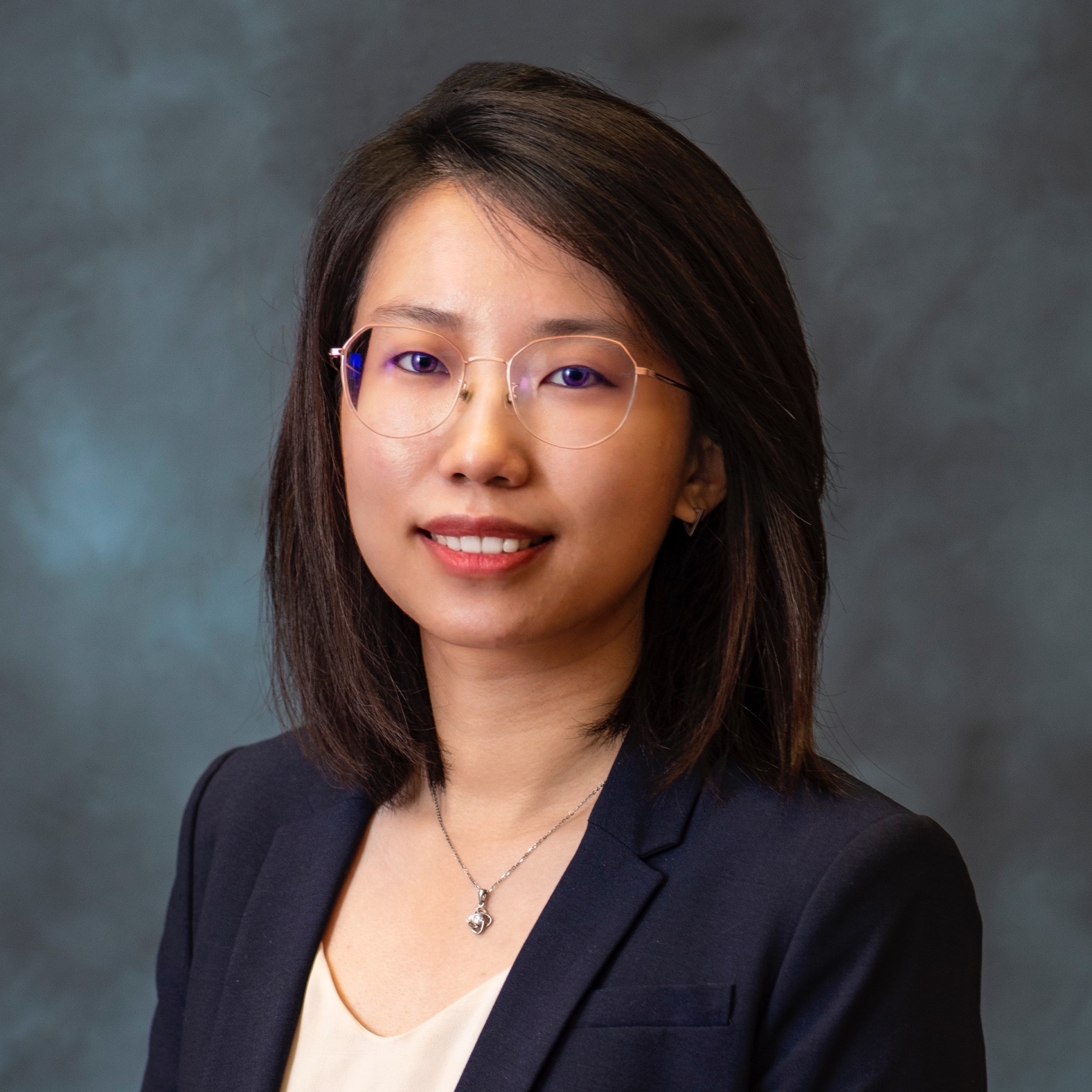
 Yeping Hu
· 3 previous affiliations
- Lawrence Livermore National LaboratorySince 2021
- Researcher · Since 2022
- Postdoc · 2021–2022
- PhD student · 2016–2021
- Undergrad student · 2012–2016
Research Overview
Yeping Hu focuses on probabilistic motion forecasting, interaction-aware decision making for autonomous systems, and graph-based surrogate models for physical simulations. Early research emphasized predicting multi-modal vehicle trajectories and improving domain generalization in dynamic traffic environments. More recently, this work has expanded into developing scalable, hierarchical graph neural networks to accelerate complex mesh-based physics simulations.
Research Trajectory
Yeping Hu’s early research primarily addressed the challenges of autonomous driving, with a specific focus on predicting the behavior of traffic participants in dynamic environments. This work contributed to the research direction of Trajectory-Conditioned World Models for Interactive Driving, moving away from treating vehicles as isolated entities and instead modeling their coupled interactions. In 2018, Hu led work on Probabilistic Prediction of Vehicle Semantic Intention and Motion, which proposed a method to adapt intention prediction to various traffic scenarios by directly predicting possible goal locations alongside classified intentions.
As the prediction horizons required for safe autonomous navigation grew longer, Hu’s focus shifted toward managing uncertainty and multi-modality in agent behavior. This aligned with the broader area of Interpretable Motion Forecasting for Autonomous Systems. In the first-author paper Multi-modal Probabilistic Prediction of Interactive Behavior via an Interpretable Model (2019), Hu addressed the highly coupled nature of vehicle state transitions, developing models to capture multi-modal distributions over future sequences. This research engaged with themes such as Multiple Hypothesis Prediction for Multimodal Regression, emphasizing the need for systems that can output several plausible future trajectories rather than a single deterministic prediction.
Between 2020 and 2022, Hu’s trajectory evolved to tackle the critical problem of domain generalization—ensuring that prediction models remain accurate when deployed in unseen or out-of-distribution traffic scenarios. In Scenario-Transferable Semantic Graph Reasoning for Interaction-Aware Probabilistic Prediction (2020), Hu introduced a framework that combined agent trajectories with vectorized high-definition maps to extract scenario-invariant features, improving the transferability of behavior prediction across different driving circumstances. Building on this need for robustness, Hu led the development of Causal-based Time Series Domain Generalization for Vehicle Intention Prediction (2021), which utilized a structural causal model to formalize and mitigate domain shift in time-series prediction tasks.
Following this work on predictive robustness, Hu also participated in evaluating the environments used to test these autonomous systems. As a second author on Analyzing and Enhancing Closed-loop Stability in Reactive Simulation (2022), Hu contributed to identifying and mitigating the instability that often arises when data-driven reactive models are unrolled over multiple simulation steps.
Most recently, Hu’s research has demonstrated a distinct pivot from autonomous vehicle trajectories toward scientific computing and physics-informed machine learning. Operating as a senior researcher and principal investigator, Hu has focused on scaling graph neural networks (GNNs) for complex physical simulations. This is exemplified by the last-author paper M4GN: Mesh-based Multi-segment Hierarchical Graph Network for Dynamic Simulations (2025). This work addresses the computational bottlenecks and over-smoothing issues inherent in applying deep message-passing networks to large-scale meshes, proposing a hierarchical, segment-centric architecture to accelerate partial differential equation (PDE) simulations without sacrificing fine-scale accuracy.
Current Directions
The most recent papers in the evidence indicate a primary focus on the intersection of machine learning and scientific computing. Current work investigates the use of graph neural networks as fast, scalable surrogates for mesh-based physics modeling. A major open problem in this domain is balancing the computational efficiency gained through graph coarsening with the need to respect underlying mesh topologies, geometries, and physical discontinuities. To address this, recent efforts involve designing hierarchical network architectures and domain decomposition strategies that allow data-driven models to simulate large-scale, long-range dynamic physical systems efficiently.
Profile updated
Loading new papers…
Other researchers whose papers cluster into the same research directions — a proxy for overlapping technical interests and shared intellectual neighborhoods.
See something wrong? Report a mistake