

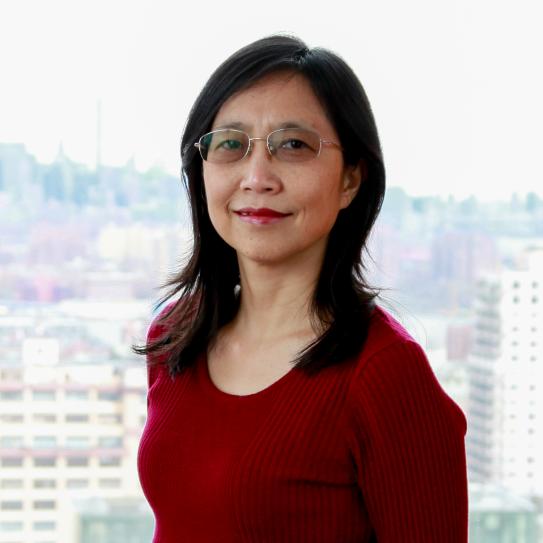
 Yao Wang
· 1 previous affiliation
- New York UniversitySince 1990
- Full Professor · Since 1990
8 other authors named Yao Wang: Yao Wang (Xi'an Jiaotong University · 371 papers), Yao Wang (Huawei Technologies (China) · 117 papers), Yao Wang (Xidian University · 73 papers), Yao Wang (3 papers), Yao Wang (2 papers), and 3 more
Research Overview
Yao Wang focuses on video coding, networked video applications, medical imaging, and computer vision. Her work encompasses the development of fundamental video processing algorithms, the optimization of video transport over heterogeneous networks, and the application of machine learning to 3D point clouds and medical diagnostics. Currently, her research emphasizes immersive media streaming, including 360-degree video and volumetric point clouds, alongside self-supervised learning techniques for medical image denoising and urban surveillance.
Research Trajectory
The evolution of Wang’s research reflects the broader shifts in digital media, moving from foundational video compression to complex networked delivery systems and, more recently, to high-dimensional 3D and medical data. In the early 1990s, her work was grounded in the core principles of video processing and communications, a period during which she authored a widely used textbook in the field. This foundational era established her expertise in motion estimation and standard video coding architectures.
By the mid-2010s, Wang’s focus shifted toward the challenges of video delivery in heterogeneous network environments. As peer-to-peer (P2P) networks and multi-party conferencing became prevalent, her research addressed the problem of user bandwidth diversity. She investigated trade-offs between layered video coding and partitioned simulcast to maximize quality under varying uplink and downlink constraints. During this period, she also explored content-aware video analysis, developing methods for detecting transitions and significant events in sports broadcasts, which bridged the gap between low-level signal processing and high-level semantic understanding.
In the late 2010s, the emergence of virtual reality (VR) and augmented reality (AR) prompted a transition into immersive media. Wang began addressing the extreme bandwidth requirements of 360-degree video. Her work introduced tiered streaming architectures and predictive modeling to manage the field-of-view (FoV) requirements of VR users. This research often utilized Robust Sparse Recovery Beyond the Restricted Isometry Property and other signal recovery techniques to handle the high-dimensional nature of spherical video data.
Since 2020, Wang has increasingly focused on 3D volumetric data and medical imaging. Her recent work in point cloud compression utilizes deep learning and hierarchical structures like octrees to improve coding efficiency for AR/VR applications. Simultaneously, she has applied her expertise in signal reconstruction to the medical domain, particularly in Low-Field MRI (LF-MRI). This work involves developing self-supervised denoising networks that operate without high-signal-to-noise ratio (SNR) references, aligning with broader trends in the Validating Medical Artificial Intelligence in Live Clinical Workflows.
Current Directions
Wang’s current research program is organized around three primary pillars: volumetric media compression, intelligent video surveillance, and advanced medical imaging. In the domain of volumetric media, she is developing end-to-end learned frameworks for point cloud geometry compression. These methods move beyond traditional handcrafted predictors, instead using differentiable surface representations and probabilistic models to achieve rate-distortion gains.
In urban science and surveillance, Wang applies unsupervised learning to extract behavioral patterns from large-scale video data. This work utilizes non-probabilistic topic models to classify traffic movements without the need for manual labeling, contributing to the field of Robust Motion Estimation via Dense All-Pixel Matching. Her approach treats motion vectors as "visual words," allowing for the discovery of complex interactions in urban environments.
Her medical imaging research continues to address the limitations of accessible diagnostic tools. By employing Structured Sparsity with Overlapping Groups and adaptive convolutional dictionary learning, she aims to enhance the image quality of LF-MRI. This work is critical for expanding the clinical utility of portable and low-cost imaging systems, particularly for lung and neurological applications.
Representative Work
Dealing With User Heterogeneity in P2P Multi-Party Video Conferencing: Layered Distribution Versus Partitioned Simulcast This research addresses the optimization of peer-to-peer multi-party video conferencing (P2P-MPVC) systems where participants possess diverse network capacities. Wang evaluates two primary strategies for managing this heterogeneity: layered video coding, which generates multiple quality layers, and partitioned simulcast, which involves sending different non-layered versions to distinct receiver groups. The study formulates the problem as a quality maximization task under uplink and downlink constraints, demonstrating that any multicast tree can be decomposed into a collection of two-hop trees. This work provided a theoretical framework for balancing complexity and quality in real-time networked video.
A Two-Tier System for On-Demand Streaming of 360 Degree Video Over Dynamic Networks Recognizing that streaming full 360-degree video is bandwidth-prohibitive, Wang proposed a two-tier delivery architecture. The base tier provides a low-quality version of the entire 360-degree span with a long prefetching buffer to ensure playback continuity despite network fluctuations. The enhancement tier delivers high-quality data specifically for the predicted field-of-view (FoV). This hybrid approach mitigates the risks of imperfect FoV prediction while significantly reducing the total bandwidth required for high-quality immersive experiences.
Flocking-based live streaming of 360-degree video In this work, Wang introduces the concept of "flocking" to live 360-degree video streaming. By assigning variable playback latencies to different users in a session, the system creates a "streaming flock" where low-latency users at the front act as leaders. Their viewing patterns are used to improve FoV prediction and edge server caching for the users following behind. This social-aware streaming mechanism optimizes resource allocation by leveraging the temporal correlation between users watching the same live event.
Learning to Predict on Octree for Scalable Point Cloud Geometry Coding This paper advances point cloud compression by replacing handcrafted probability estimation in the MPEG G-PCC standard with a denoising neural network. The model predicts the occupancy of octree leaf nodes by analyzing a "noisy" context cube that includes both decoded and uncoded voxels. Additionally, Wang proposes a convolution-based upsampling model to refine the point cloud at the decoder side. This integration of deep learning with traditional hierarchical data structures significantly improves rate-distortion performance for 3D geometry.
A New Method for Revealing Traffic Patterns in Video Surveillance using a Topic Model As the lead author of this study, Wang presents an unsupervised method for extracting traffic patterns from surveillance footage. The system employs dense optical flux to generate motion vectors, which are then processed as "visual words" using a non-probabilistic topic model called Group Thin Topic Coding (GS-TC). This approach allows for the automatic classification of complex behaviors, such as illegal turns or pedestrian crossings, without requiring pre-labeled training data or explicit object tracking.
SurfelSoup: Probabilistic G-SurfelTree for Learned Point Cloud Geometry Compression In this senior-authored work, Wang introduces SurfelSoup, an end-to-end learned framework for dense point cloud compression. The method utilizes "G-Surfels"—probabilistic and differentiable surface primitives that model local point occupancies using generalized Gaussian distributions. By employing an octree-like hierarchy (G-SurfelTree) with an adaptive decision module, the framework optimizes the granularity of surface representation. This approach avoids the redundancies of point-wise compression in smooth regions, resulting in more compact and visually coherent 3D reconstructions.
Profile updated
Loading new papers…
Other researchers whose papers cluster into the same research directions — a proxy for overlapping technical interests and shared intellectual neighborhoods.
See something wrong? Report a mistake