

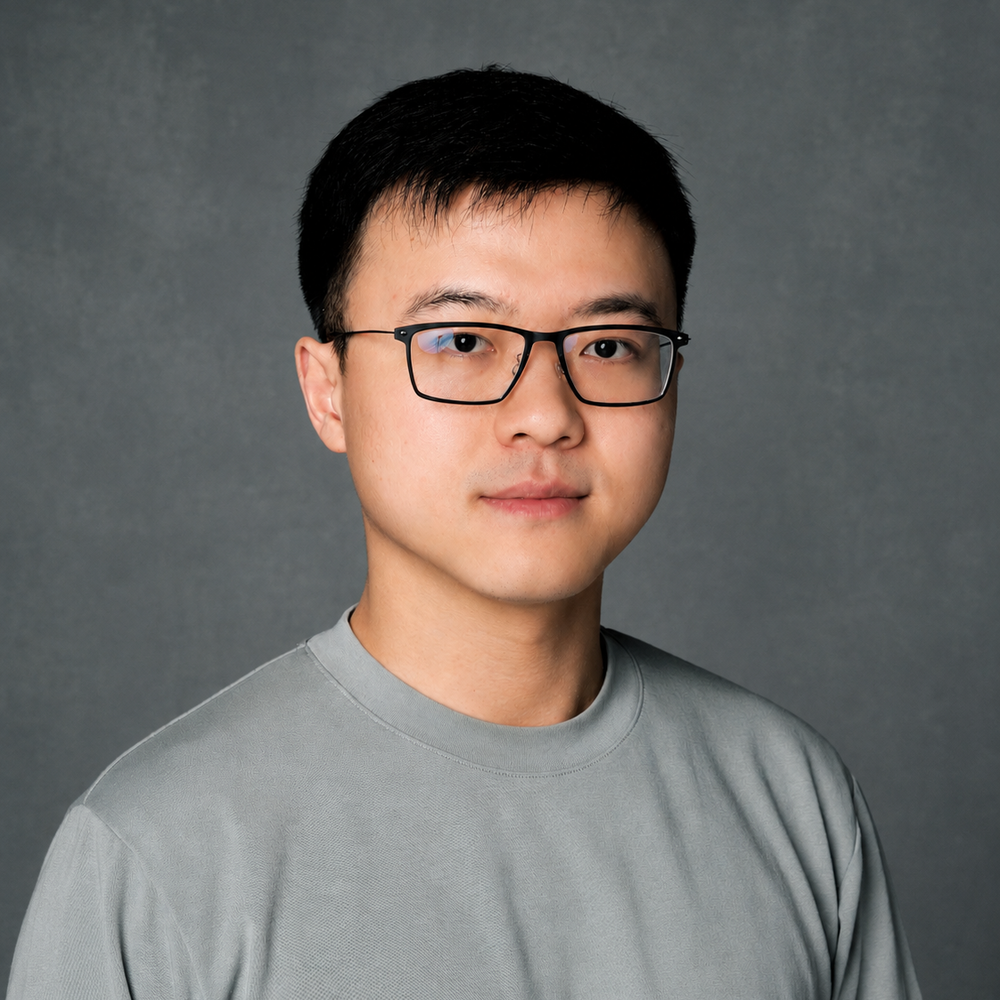
 Yang Yang
· 1 previous affiliation
- University of HelsinkiSince 2024
- PhD student · Since 2024
46 other authors named Yang Yang: Yang Yang (University of Electronic Science and Technology of China · 567 papers), Yang Yang (University of California, Santa Barbara · 211 papers), Yang Yang (Shanghai Jiao Tong University · 185 papers), Yang Yang (123 papers), Yang Yang (114 papers), and 41 more
Research Overview
Yang Yang focuses on probabilistic machine learning, amortized inference, and generative modeling. Early work explored structure learning for probabilistic circuits and multi-dimensional classification frameworks. More recently, the research emphasizes simulation-based inference and efficient autoregressive generation for transformer-based probabilistic models, developing methods to accelerate sampling and adapt priors at test time.
Research Trajectory
The earliest work in the available corpus centers on foundational probabilistic modeling and structure learning. In 2023, Yang led research on probabilistic circuits, a class of models known for tractable inference. As first author of Bayesian Structure Scores for Probabilistic Circuits, Yang developed rigorous Bayesian structure scores for deterministic probabilistic circuits. By marginalizing out parameters to compute structure likelihoods, this work provided a principled objective for structure learning that effectively protected against overfitting, distinguishing it from previous heuristic-based approaches. During this same period, Yang also co-authored Probabilistic Multi-Dimensional Classification, which addressed the challenge of predicting multiple class variables simultaneously. This research proposed a formal framework that decomposed the learning process into smaller, single-variable multi-class probabilistic classifiers connected via a directed acyclic graph, improving both scalability and uncertainty estimation.
By 2025 and 2026, the research trajectory shifted toward the computational efficiency of generative models and amortized inference. A major focus became overcoming the rigid constraints of pre-trained models in scientific applications. As first author, Yang introduced PriorGuide: Test-Time Prior Adaptation for Simulation-Based Inference. In simulation-based inference, amortized diffusion models are highly efficient at test time but are typically locked into the specific prior distribution used during training. PriorGuide resolved this by treating new, user-defined priors as a guidance term during the diffusion sampling process, allowing the model to adapt at test time without retraining and achieving substantial speedups over traditional methods.
Concurrently, Yang participated in collaborative efforts to optimize transformer architectures for probabilistic modeling. As a co-author on Efficient Autoregressive Inference for Transformer Probabilistic Models, Yang contributed to the design of a causal autoregressive buffer. This mechanism decoupled static context encoding from dynamic target dependencies, significantly reducing memory usage and accelerating joint probability estimation. This architectural improvement was also extended to other domains; in Efficient Autoregressive Inference for Tabular Foundation Models, the research team applied the causal buffer concept to tabular data, enabling efficient batched autoregressive generation and one-pass joint log-likelihoods without the need to re-encode augmented contexts at each step.
Current Directions
The most recent papers in the evidence indicate a strong ongoing focus on the computational bottlenecks of generative modeling and simulation-based inference. Recent work investigates test-time adaptation techniques that bypass the need for expensive model retraining, particularly in the context of diffusion-based amortized inference. By leveraging sampling guidance, this direction aims to make pre-trained scientific models more flexible when incorporating fresh expert knowledge or new hypotheses.
Additionally, current collaborative efforts address the efficiency of transformer-based probabilistic models. This involves developing memory-efficient autoregressive buffers that accelerate sampling and joint distribution estimation. These architectural optimizations are being applied across diverse data modalities, including tabular foundation models, to achieve the performance of expensive re-encoding techniques at a fraction of the computational cost.
Profile updated
| Paper | Venue | Year |
|---|---|---|
| Probabilistic Multi-Dimensional ClassificationGitHubyangyang-pro/ | UAI | 2023 |
Loading new papers…
Other researchers whose papers cluster into the same research directions — a proxy for overlapping technical interests and shared intellectual neighborhoods.
See something wrong? Report a mistake