

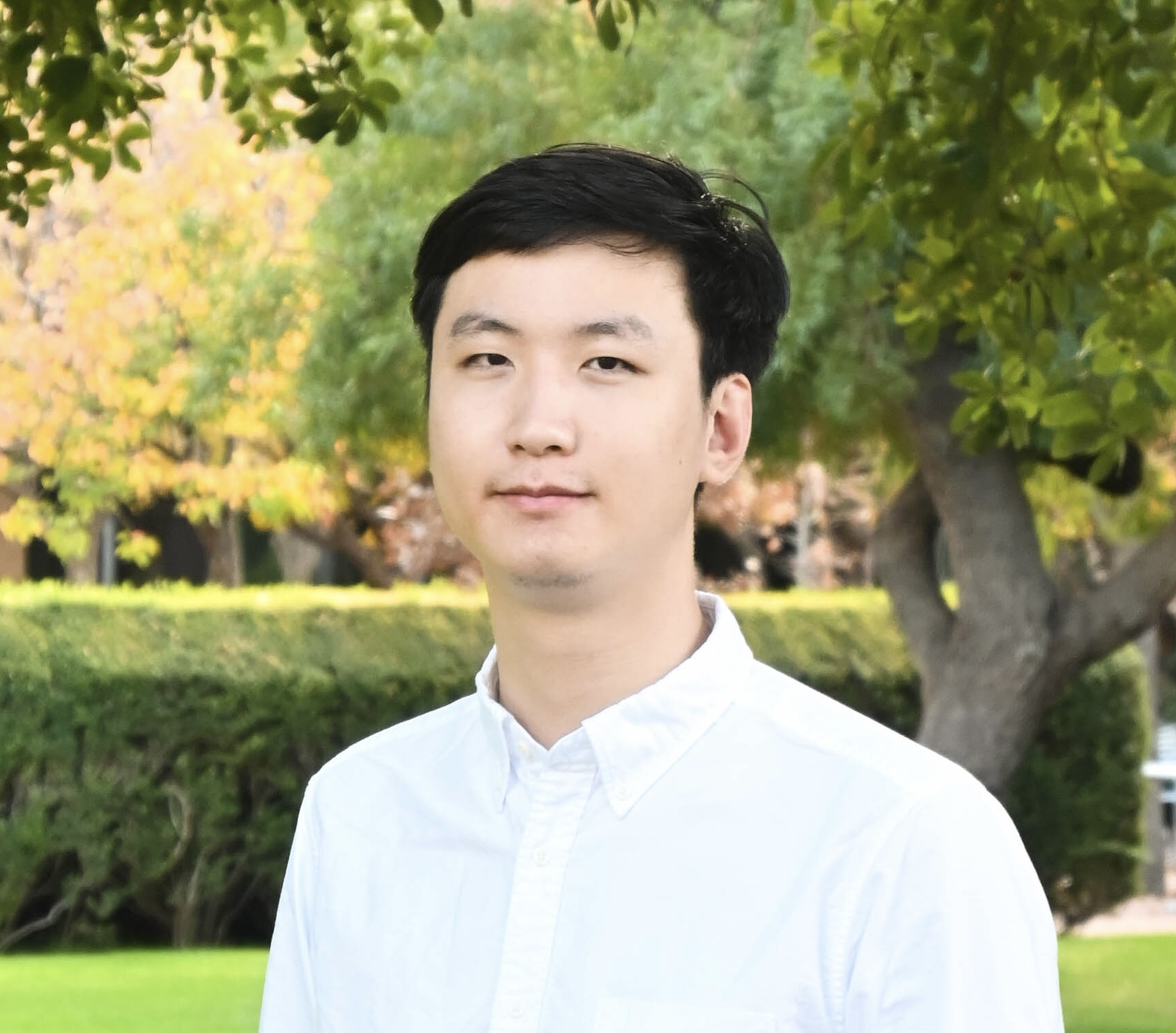
 Yang Ni
· 4 previous affiliations
- Purdue University West LafayetteSince 2025
- Assistant Professor · Since 2025
- Purdue University NorthwestCurrent
- Current
- University of California, Irvine2021–2025
- PhD student · 2021–2025
- University of California San Diego2019–2021
- MS student · 2019–2021
1 other author named Yang Ni: Yang Ni (The University of Texas at Austin · 104 papers)
Research Overview
Yang Ni focuses on hyperdimensional computing, efficient artificial intelligence, and multimodal reasoning for resource-constrained environments. His trajectory spans the development of brain-inspired algorithms for edge devices, reinforcement learning, and biosignal processing, emphasizing hardware-algorithm co-design. Recently, his work has expanded to address privacy-preserving computer vision, algorithmic fairness, and robust language-guided tracking systems.
Research Trajectory
Yang Ni's research trajectory began with a strong focus on optimizing machine learning for resource-constrained environments. In 2022, he conducted an extensive profiling study of hardware accelerators, detailing performance and power consumption patterns in Online Performance and Power Prediction for Edge TPU via Comprehensive Characterization. Recognizing the computational bottlenecks of traditional deep neural networks on edge devices, he increasingly turned to Hyperdimensional Computing (HDC)—a brain-inspired paradigm that uses high-dimensional vectors to perform lightweight, highly parallelizable learning.
He applied HDC to continuous control tasks, introducing a highly efficient alternative to deep reinforcement learning in HDPG: hyperdimensional policy-based reinforcement learning for continuous control. Simultaneously, he developed methods for processing temporal dependencies in sensor data, presenting a real-time learning framework for time-series classification in Neurally-Inspired Hyperdimensional Classification for Efficient and Robust Biosignal Processing. To maximize the practical deployment of these algorithms, he proposed an acceleration framework in Algorithm-Hardware Co-Design for Efficient Brain-Inspired Hyperdimensional Learning on Edge. This foundational work contributed significantly to the broader research direction of Resource Efficient Machine Learning for Constrained Edge Devices.
As his work in HDC matured, he addressed critical gaps in the paradigm's reliability and adaptability. In 2023, he introduced uncertainty estimation to HDC models, offering a faster and more energy-efficient alternative to Bayesian Neural Networks in Brain-Inspired Trustworthy Hyperdimensional Computing with Efficient Uncertainty Quantification. The following year, he expanded HDC into active learning with HEAL: Brain-inspired Hyperdimensional Efficient Active Learning, utilizing random prior hypervectors and a vector-based diversity metric to drastically accelerate data acquisition. He also continued refining reinforcement learning applications, leveraging model uncertainty to guide agent exploration in Efficient Exploration in Edge-Friendly Hyperdimensional Reinforcement Learning.
In 2024, his algorithmic innovations were paired with custom hardware solutions to tackle complex relational data. He developed an FPGA-based acceleration framework for knowledge graph completion in HDReason: Algorithm-Hardware Codesign for Hyperdimensional Knowledge Graph Reasoning, advancing the research area of Error Resilience in Holographic Distributed Representations. He also addressed the "black box" nature of HDC encoders by making the data-to-hyperspace mapping adaptive in Hyperdimensional computing with holographic and adaptive encoder. These efficient computing principles were subsequently applied to diverse domains, including dynamic wireless channel-sharing in Dynamic MAC Protocol for Wireless Spectrum Sharing via Hyperdimensional Self-Learning and the decoding of neural activities in Hyperdimensional Brain-Inspired Learning for Phoneme Recognition With Large-Scale Inferior Colliculus Neural Activities.
Concurrently, his research expanded into computer vision, multimodal reasoning, and data privacy. He developed a collaborative query matching strategy for referring multi-object tracking in Tell Me What to Track: Infusing Robust Language Guidance for Enhanced Referring Multi-Object Tracking. Addressing the tension between surveillance utility and personal privacy, he introduced a framework for human pose estimation in Recoverable Anonymization for Pose Estimation: A Privacy-Enhancing Approach. This contribution aligns with several privacy-focused research areas, including Utility Preserving Image Anonymization for Computer Vision, Reversible Face Anonymization via Latent Space Encryption, and Reversible Anonymization via Invertible Visual Transformations. He also collaborated on mitigating algorithmic bias introduced by privacy regulations, participating in the development of a bi-level debiasing strategy in Enabling Group Fairness in Graph Unlearning via Bi-level Debiasing.
Current Directions
The most recent papers in the evidence, extending into 2026, demonstrate a continued focus on the theoretical foundations of hyperdimensional computing and the mathematical formalization of algorithmic fairness. He recently introduced a universal encoding method that dynamically adapts hypervector correlation structures for distinct cognitive and learning tasks in Optimal hyperdimensional representation for learning and cognitive computation. Additionally, he collaborated on a novel regularization framework that leverages Cauchy-Schwarz Divergence to enforce independence between model predictions and sensitive attributes in Fairness via Independence: A General Regularization Framework for Machine Learning, contributing to the broader area of The Hyperparameter Sensitivity of Algorithmic Fairness.
Profile updated
| Title | Venue | Year |
|---|---|---|
| IndustryNav: Evaluating Spatial Reasoning and Safety of Embodied Agents in Dynamic Industrial Navigation | Openreview | 2027 |
| HEAL: Brain-Inspired Hyperdimensional Efficient Active Learning | IEEE Trans. Artif. Intell | 2026 |
| Optimal hyperdimensional representation for learning and cognitive computation | Frontiers in Artificial Intelligence | 2026 |
| Fairness via Independence: A General Regularization Framework for Machine Learning | ICLR | 2026 |
| MERIT: Multi-domain Efficient RAW Image Translation | CVPR | 2026 |
| Underestimated flash drought risks in agrciulutral lands without consideration of crop phenology | Openalex | 2026 |
| QUILL: An Algorithm-Architecture Co-Design for Cache-Local Deformable Attention | DATE | 2026 |
| LUNE: Efficient LLM Unlearning via LoRA Fine-Tuning with Negative Examples | ACL (findings) | 2026 |
| Recover-to-Forget: Gradient Reconstruction from LoRA for Efficient LLM Unlearning | ResponsibleFM @ NeurIPS | 2025 |
| DynHD: Hyperdimensional Computing Approach for Efficient Radar Spectrum Classification | IEEE Embed. Syst. Lett | 2025 |
Loading new papers…
Other researchers whose papers cluster into the same research directions — a proxy for overlapping technical interests and shared intellectual neighborhoods.
See something wrong? Report a mistake