

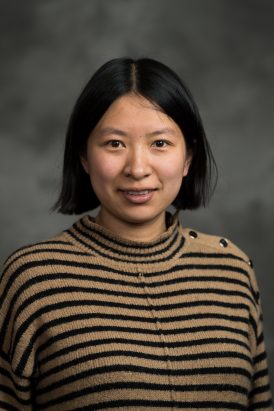
 Yang Chen
· 1 previous affiliation
- University of MichiganSince 2017
- Associate Professor · Since 2025
- Assistant Professor · 2017–2025
17 other authors named Yang Chen: Yang Chen (Shanghai Artificial Intelligence Laboratory · 41 papers), Yang Chen (Fudan University · 33 papers), Yang Chen (Southern University of Science and Technology · 18 papers), Yang Chen (Nvidia (United States) · 12 papers), Yang Chen (Jingdong (China) · hidream.ai · 9 papers), and 12 more
Research Overview
Yang Chen focuses on statistical methodology and computational algorithms, with a particular emphasis on Bayesian modeling, spatio-temporal data analysis, and uncertainty quantification for complex systems. Her work is largely motivated by applications in astronomy and space science, where she develops methods for high-dimensional imaging data and predictive modeling of solar phenomena. As an Associate Professor of Statistics at the University of Michigan, she integrates machine learning frameworks with physical constraints to improve the accuracy and reliability of space weather forecasting.
Research Trajectory
Chen’s research trajectory began with a focus on the foundational challenges of Bayesian inference and computational statistics. Following her doctoral work at Harvard University, she addressed problems in instrument calibration and the analysis of complex imaging data. Her early work on instrument calibration addressed the challenges of Disentangling Mixed Noise in Hyperspectral Data Cubes, a critical step for ensuring the fidelity of solar observations and other multi-channel imaging systems.
Starting around 2019, Chen’s work shifted significantly toward the domain of space weather, specifically the prediction of solar flares and solar energetic particles (SEPs). This period was marked by the application of deep learning architectures, such as Convolutional Neural Networks (CNNs) and Long Short-Term Memory (LSTM) networks, to high-cadence solar data. She developed pipelines to process data from the Solar Dynamics Observatory (SDO) and the Helioseismic and Magnetic Imager (HMI), utilizing Space-Weather HMI Active Region Patch (SHARP) parameters to identify precursors for solar events.
By 2020, her focus evolved from binary classification (predicting whether a flare would occur) to regression-based models capable of predicting solar flare intensity. This transition allowed for more granular forecasting, moving beyond class labels to estimate exact flare magnitudes. During this time, she also began exploring the integration of global context into local sunspot models, demonstrating that incorporating polar magnetic field data could significantly enhance prediction accuracy across different solar cycles.
In the most recent phase of her work (2023–2025), Chen has focused on the methodological refinement of high-dimensional data analysis. This includes the development of tensor-based Gaussian processes and matrix completion methods for ionospheric monitoring. A central theme in her current research is the rigorous quantification of uncertainty in these settings, employing frameworks like conformal prediction to provide reliable confidence intervals for complex model outputs.
Current Directions
Chen’s current research is concentrated on three primary areas: tensor-based machine learning, uncertainty quantification, and global space weather monitoring.
In the area of tensor methods, she is developing frameworks that combine tensor contraction with Gaussian process regression. These models are designed to handle multi-channel imaging data by compressing high-dimensional inputs while preserving essential spatial and spectral structures. This approach is particularly relevant for identifying physical features in solar images that correlate with eruptive activity.
Her work in uncertainty quantification (UQ) seeks to bridge the gap between high-performance machine learning and operational reliability. By nesting tensor completion and other estimation tasks within split conformal prediction frameworks, her group provides a way to quantify the propensity for missing data and the reliability of reconstructed signals. This is critical for applications like Total Electron Content (TEC) map reconstruction, where missing data in oceanic regions can lead to significant GPS positioning errors.
Finally, Chen continues to lead efforts in global space weather forecasting. This includes the development of probabilistic geomagnetic perturbation forecasts and the refinement of SEP prediction models. Her work increasingly emphasizes the importance of temporal consistency and spatial smoothness in video-based data imputation, ensuring that reconstructed solar and ionospheric maps are physically plausible and operationally useful.
Representative Work
Identifying Solar Flare Precursors Using Time Series of SDO/HMI Images and SHARP Parameters This early work established a data preprocessing pipeline for extracting spatial and temporal information from SDO/HMI magnetogram data. The research presented classification models that distinguished flares from quiet active regions and strong flares from weak ones, demonstrating the potential of deep learning to capture precursor signals in solar time-series data.
Solar Flare Intensity Prediction With Machine Learning Models In this study, Chen moved beyond classification to develop a mixed LSTM regression model for predicting maximum solar flare intensity. By using exact flare intensities from the GOES dataset as response variables rather than class labels, the model provided more detailed information for space weather operations, achieving predictive capabilities up to 48 hours in advance.
Incorporating polar field data for improved solar flare prediction Chen participated in this research which demonstrated that local sunspot data is insufficient for optimal flare prediction without the context of the broader solar cycle. By supplementing local magnetic parameters with global polar field strengths, the study achieved a measurable improvement in prediction accuracy, highlighting the role of global solar magnetic structures in local eruptive events.
Tensor Gaussian Process with Contraction for Multi-Channel Imaging Analysis As the senior author, Chen led the development of Tensor-GPST, a framework that integrates tensor contraction with Gaussian Process regression. This method allows for the prediction of scalar values from high-dimensional, multi-channel images while maintaining interpretability and providing robust uncertainty quantification. The model was successfully applied to identify key physical features in solar flare forecasting.
Matrix Completion Methods for the Total Electron Content Video Reconstruction Chen’s group proposed extensions to matrix completion algorithms to reconstruct TEC maps, which are vital for mitigating GPS signal delays. The method, termed video imputation with softImpute, accounts for spatial smoothness and temporal consistency, effectively addressing the problem of large-scale missingness in ionospheric data over oceanic regions.
Conformalized Tensor Completion with Riemannian Optimization Collaborating on the intersection of tensor completion and uncertainty quantification, Chen contributed to a framework that nests tensor estimation within split conformal prediction. This work addresses the lack of UQ in scalable tensor completion algorithms, establishing a connection between uncertainty intervals and the missing propensity of tensor elements, which is essential for reliable data recovery in social networks and medical imaging.
Profile updated
Loading new papers…
Other researchers whose papers cluster into the same research directions — a proxy for overlapping technical interests and shared intellectual neighborhoods.
See something wrong? Report a mistake