

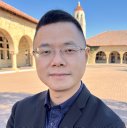
 Yanchao Yang
· 5 previous affiliations
- University of Hong KongSince 2022
- Assistant Professor · Since 2022
- Stanford UniversityCurrent
- Current
- Postdoc · 2020–2022
- Discover2014–2020
- Postdoc · 2019–2020
- PhD student · 2014–2019
- MS student · 2011–2014
- Undergrad student · 2007–2011
2 other authors named Yanchao Yang: Yanchao Yang (5 papers), Yanchao Yang (3 papers)
Research Overview
Yanchao Yang focuses on embodied artificial intelligence, self-supervised representation learning, and information-theoretic tools for physical grounding. His trajectory spans early work in dynamic shape tracking and unsupervised video segmentation to recent advances in zero-shot mutual information estimation and hypernetwork-driven robotic control. Currently, he develops algorithms that enable autonomous agents to acquire interaction skills and compositional scene representations in low-annotation regimes.
Research Trajectory
Yang's early research addressed the challenges of dynamic scene analysis and visual tracking. In Modeling Self-Occlusions in Dynamic Shape and Appearance Tracking, he and his collaborators developed joint dynamic shape and appearance models to accurately track objects through complex 3D motions and self-occlusions. This interest in motion and context evolved into unsupervised methods for video analysis. With Unsupervised Moving Object Detection via Contextual Information Separation, he contributed to an adversarial approach that isolates independently moving objects by training networks to separate motion from surrounding background patterns without manual supervision.
Expanding into domain adaptation and segmentation, Yang introduced techniques to bridge the gap between synthetic and real data. In FDA: Fourier Domain Adaptation for Semantic Segmentation, he proposed a method to align source and target distributions by swapping their low-frequency spectra. This work advanced the research direction of Structural Preservation via Fourier Phase Manipulation and the broader area of Decoupling Style and Structure with Fourier Phase and Amplitude. Returning to unsupervised video analysis, he developed DyStaB: Unsupervised Object Segmentation via Dynamic-Static Bootstrapping, which partitions motion fields to learn object models applicable to both static images and videos, contributing to the area of Learning Objectness from Motion.
His focus subsequently broadened to include human-centric intent prediction. In GIMO: Gaze-Informed Human Motion Prediction in Context, Yang explored how visual attention can disambiguate human motion, advancing the research direction of Gaze as a Leading Indicator for Intent Prediction to improve anticipation in assistive robotics and augmented reality.
A major theme in Yang's recent trajectory is the physical grounding of abstract concepts and the efficient estimation of mutual information. To address the challenge of linking high-level reasoning to low-level physical realities, he led the development of InfoCon: Concept Discovery with Generative and Discriminative Informativeness, which grounds abstract concepts for robotic task planning. Concurrently, he participated in research on automated reward design; Text2Reward: Reward Shaping with Language Models for Reinforcement Learning translates natural language goals into Python code, contributing to the area of Executable Code as Interpretable Reward Functions. In parallel, he introduced InfoNet: Neural Estimation of Mutual Information without Test-Time Optimization, a neural network architecture that estimates mutual information in a single feed-forward pass, significantly accelerating the process while maintaining differentiability for end-to-end learning.
In 2025, Yang's work heavily emphasized embodied AI, particularly through the discovery of manipulation concepts and the use of hypernetworks for robust control. He guided the creation of $\textit{HiMaCon:}$ Discovering Hierarchical Manipulation Concepts from Unlabeled Multi-Modal Data, a self-supervised framework that correlates vision with proprioception to organize tasks across multiple time horizons. This was complemented by AutoCGP: Closed-Loop Concept-Guided Policies from Unlabeled Demonstrations, which autonomously discovers fundamental motion building blocks to guide closed-loop diffusion policies.
His research also introduced hypernetwork architectures for robotic manipulation. HyPoGen: Optimization-Biased Hypernetworks for Generalizable Policy Generation generates optimal control policies from task specifications without test-time demonstrations, achieving zero-shot generalization. Similarly, $\textit{Hyper-GoalNet}$: Goal-Conditioned Manipulation Policy Learning with HyperNetworks dynamically generates policy weights based on target goals within a structured latent space. To support these policies with adaptive perception, HyperTASR: Hypernetwork-Driven Task-Aware Scene Representations for Robust Manipulation modulates scene representations based on task objectives and execution phases. Beyond control policies, Yang applied information-theoretic principles to scene representation in InfoGS: Efficient Structure-Aware 3D Gaussians via Lightweight Information Shaping, enabling consistent, object-level editing of 3D Gaussian Splatting through mutual information shaping.
The most recent papers in the evidence push toward foundation models and 3D spatial grounding. InfoAtlas: A Foundation Model for Zero-Shot Statistical Dependence Estimate scales his prior work on mutual information into a pretrained hypernetwork capable of zero-shot estimation. In robotic learning, GeoMoLa: Geometry-Aware Motion Latents for Learning Robust Manipulation Policies shifts the paradigm from predicting pixels to forecasting the evolution of 3D space, creating discrete motion primitives for complex manipulations in cluttered environments.
Current Directions
The most recent papers in the evidence indicate a strong focus on scaling embodied AI and statistical estimation through foundation models and hypernetwork architectures. Recent work investigates zero-shot mutual information estimation using pretrained hypernetworks, aiming to replace slow gradient optimization with efficient, single-pass inference. In robotic manipulation, current directions address the autonomous discovery of hierarchical manipulation concepts from unlabeled multi-modal data and the generation of robust, goal-conditioned control policies. This includes shifting from 2D pixel prediction to forecasting the evolution of 3D space, creating geometry-aware motion latents that enable autonomous agents to perform complex, long-horizon tasks in cluttered physical environments.
Profile updated
Loading new papers…
Other researchers whose papers cluster into the same research directions — a proxy for overlapping technical interests and shared intellectual neighborhoods.
See something wrong? Report a mistake