

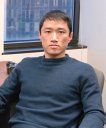
 Xinyu Huang
· 6 previous affiliations
- Robert Bosch (United States)Since 2019
- Principal Research Scientist and Global Tech Lead · Since 2019
- Baidu (China)2017–2019
- Senior Research Scientist and Project Lead · 2017–2019
- North Carolina Central University2010–2019
- Tenured Associate Professor · 2016–2019
- Tenure-track Assistant Professor · 2010–2016
- HERE Technologies2016
- Senior Research Engineer · 2016
- University of Kentucky2003–2010
- PhD student · 2003–2010
- Bachelor’s Degree
1 other author named Xinyu Huang: Xinyu Huang (ByteDance (China) · 5 papers)
Research Overview
Xinyu Huang focuses on 3D computer vision, neural rendering, and spatial perception for autonomous systems. His early work addressed fundamental problems in image processing and facial analysis before expanding into large-scale semantic segmentation and autonomous driving datasets. Recently, his research investigates advanced 3D scene representation, including Gaussian splatting and zero-shot depth estimation across diverse camera geometries.
Research Trajectory
Xinyu Huang’s early research focused on rendering techniques and computational photography. His initial work included Efficient rendering of integral images (2005) and explorations into autostereoscopic displays with Toward the Light Field Display: Autostereoscopic Rendering via a Cluster of Projectors (2008). Moving into biometrics and facial analysis, he developed methods for Illumination and Person-Insensitive Head Pose Estimation Using Distance Metric Learning (2008), utilizing non-linear dimension reduction to handle large pose and lighting variations. He subsequently introduced domain-specific deblurring techniques in Image deblurring for less intrusive iris capture (2009) to improve the robustness of biometric systems. Continuing his work on physical light transport, he participated in developing techniques for Interreflection removal for photometric stereo by using spectrum-dependent albedo (2011).
In the mid-2010s, his focus shifted toward deep learning applications in face synthesis and semantic segmentation. He contributed to the area of facial performance capture under heavy occlusion with Mask-off: Synthesizing Face Images in the Presence of Head-mounted Displays (2016), a system designed to digitally remove VR headsets from a user's face in real-time video. Addressing core challenges in scene understanding, he designed network architectures to tackle the research direction of resolving semantic confusion in visually similar categories, detailing this approach in A Network Structure to Explicitly Reduce Confusion Errors in Semantic Segmentation (2018).
A major expansion into autonomous systems and 3D perception is marked by his involvement with The ApolloScape Open Dataset for Autonomous Driving and Its Application (2020), which provided large-scale, dense annotations for self-driving research. Building on this domain, he participated in work on Part-Level Car Parsing and Reconstruction in Single Street View Images (2022), which simultaneously estimated the pose, shape, and semantic parts of vehicles. He also contributed to the broader area of Resolving Geometric Symmetry Ambiguity in 3D Pose Estimation through Symmetry and Uncertainty-Aware Object SLAM for 6DoF Object Pose Estimation (2022), a real-time framework that leverages SLAM-derived priors and uncertainty prediction to achieve globally consistent pose estimation.
Expanding perception models to handle complex camera geometries, he participated in developing OmniFusion: 360 Monocular Depth Estimation via Geometry-Aware Fusion (2022). This work mitigated spherical distortion by decomposing images into perspective patches, advancing the research direction of Distortion Aware Computer Vision for Spherical Panoramas and the area of Global Context Modeling via Non-Local Spatial Attention. Returning to the challenges of autonomous driving, he co-developed SeaBird: Segmentation in Bird's View with Dice Loss Improves Monocular 3D Detection of Large Objects (2024), investigating the sensitivity of depth regression losses to improve the detection of large vehicles.
His most recent trajectory emphasizes multi-task learning and advanced neural rendering. He contributed to NexusFlow: Unifying Disparate Tasks under Partial Supervision via Invertible Flow Networks (2025), a framework designed to align latent features across structurally different tasks when annotations are incomplete. In the realm of depth estimation, he participated in Depth Any Camera: Zero-Shot Metric Depth Estimation from Any Camera (2025), extending perspective-trained foundation models to handle fisheye and 360-degree lenses. His collaborative work on 3D Gaussian Splatting includes Online Language Splatting (2025), which integrates open-vocabulary language mapping into real-time SLAM systems. Most recently, he contributed to 3DGEER: 3D Gaussian Rendering Made Exact and Efficient for Generic Cameras (2026), a rendering framework that resolves distortion artifacts in wide-angle lenses, advancing the areas of Analytic Ray Integration for Volumetric Radiance Fields, Non-Linear Projection for Gaussian Splatting in Generic Cameras, and Mitigating the Volumetric Sampling Bottleneck in Neural Rendering.
Current Directions
The most recent work in the evidence, spanning 2025 and 2026, investigates advanced 3D scene representation and robust spatial perception. A primary focus is the evolution of neural rendering techniques, particularly adapting 3D Gaussian Splatting for generic, wide-angle, and fisheye cameras by resolving non-linear projection distortions and improving ray integration efficiency. Concurrently, recent research explores the intersection of spatial reasoning and natural language, developing real-time, open-vocabulary mapping systems that embed semantic features directly into 3D environments. Additionally, current efforts address the generalization of perception models, including zero-shot metric depth estimation across diverse camera types and the unification of disparate computer vision tasks under partial supervision using invertible flow networks.
Profile updated
Loading new papers…
Other researchers whose papers cluster into the same research directions — a proxy for overlapping technical interests and shared intellectual neighborhoods.
See something wrong? Report a mistake