

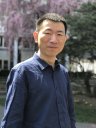
 Xifeng Gao
· 2 previous affiliations
- Tencent (China)Since 2021
- Principal Researcher · Since 2021
- LIGHTSPEED STUDIOSCurrent
- Current
Research Overview
Xifeng Gao focuses on computational geometry, computer graphics, and robotic trajectory generation. His work spans from early contributions in mesh generation and digital fabrication to robust optimization methods for multi-agent navigation and 3D asset creation. Recently, he investigates automated texture generation and advanced meshing techniques to streamline visual computing pipelines.
Research Trajectory
Gao's early work in the corpus addresses computational geometry and digital fabrication. He collaborated on Stitch meshing in 2018, exploring geometric processing for physical materials, and subsequently contributed to Field-aligned Quadrangulation for Image Vectorization in 2019.
Moving into robotics and physical interaction, he developed a novel stress-minimization metric for handling brittle materials in Grasping Fragile Objects Using A Stress-Minimization Metric. This metric calculates the maximal resistible external wrenches to prevent fractures during robotic grasping. The following year, he directed research on autonomous navigation, introducing an optimization-based approach in Robust & Asymptotically Locally Optimal UAV-Trajectory Generation Based on Spline Subdivision, which guarantees constraint satisfaction and asymptotic optimality for unmanned aerial vehicles in known environments.
In 2022, Gao's research expanded significantly across computer graphics, digital fabrication, and multi-agent robotics. In the graphics domain, he introduced specialized meshing techniques, including Low-poly Mesh Generation for Building Models and Occluder Generation for Buildings in Digital Games, aimed at optimizing rendering pipelines. He also participated in the development of robust manifold triangulations for imperfect point clouds in Restricted Delaunay Triangulation for Explicit Surface Reconstruction.
Bridging computational geometry and physical constraints, he oversaw the creation of an automatic pipeline for Wearable 3D Machine Knitting: Automatic Generation of Shaped Knit Sheets to Cover Real-World Objects, ensuring that generated knits can be applied and removed without deforming the target object—a constraint previously unaddressed in machine knitting. Similarly, he contributed to Computational Object-Wrapping Rope Nets, reformulating rope net computation into a constrained curve network optimization problem based on the observation that a single rope can construct an entire net if every knot has four adjacent curve edges. In robotics, he guided the development of Robust Multi-Robot Trajectory Optimization Using Alternating Direction Method of Multiplier, accelerating multi-robot coordination by decoupling stiff and non-stiff problem components, advancing the broader area of decentralized optimization via consensus and ADMM.
Gao continued to refine 3D asset production and physical simulation throughout 2023. He directed the development of Robust Low-Poly Meshing for General 3D Models, a feature-preserving re-meshing approach that integrates seamlessly into industry pipelines to generate visual-preserving low-poly meshes. His work on asset optimization also included overseeing Texture Atlas Compression Based on Repeated Content Removal and Learning Based 2D Irregular Shape Packing. In parallel, he contributed to complex physical and mechanical simulations, participating in High-Order Moment-Encoded Kinetic Simulation of Turbulent Flows to significantly reduce the memory footprint of lattice Boltzmann solvers on GPUs, making them more viable for commodity hardware. He also collaborated on Joint search of optimal topology and trajectory for planar linkages, utilizing mixed-integer quadratic programming to design modular mechanical systems, contributing to methods for navigating rugged landscapes for global optimization.
Recent work emphasizes advanced navigation policies and high-fidelity texture generation. In robotics, he participated in Provably Feasible Semi-Infinite Program Under Collision Constraints via Subdivision, addressing collision-free trajectories for articulated robots through adaptive subdivision, intersecting with the area of safe learning via log barrier interior point methods. He also developed environment-centric navigation models in Learning Neural Traffic Rules, coordinating large groups of unintelligent agents by learning systemic traffic rules rather than relying on individual agent-centric policies. Returning to graphics pipelines, he oversaw Joint UV Optimization and Texture Baking and contributed to AlignTex: Pixel-Precise Texture Generation from Multi-view Artwork, a framework that ensures both semantic and pixel-level consistency when generating textures from 3D meshes and multi-view concept art, addressing the limitations of prior 2D diffusion models.
Current Directions
The most recent papers in the evidence address two primary domains: automated high-fidelity 3D asset creation and scalable multi-agent navigation. In visual computing, recent work investigates pixel-precise texture generation and UV optimization, aiming to streamline the translation of multi-view concept art into fully textured 3D meshes while preserving intricate details. In robotics, current research explores environment-centric navigation policies and provably feasible trajectory generation, focusing on coordinating large groups of agents and ensuring collision-free movement for complex articulated systems.
Profile updated
Loading new papers…
Other researchers whose papers cluster into the same research directions — a proxy for overlapping technical interests and shared intellectual neighborhoods.
See something wrong? Report a mistake