

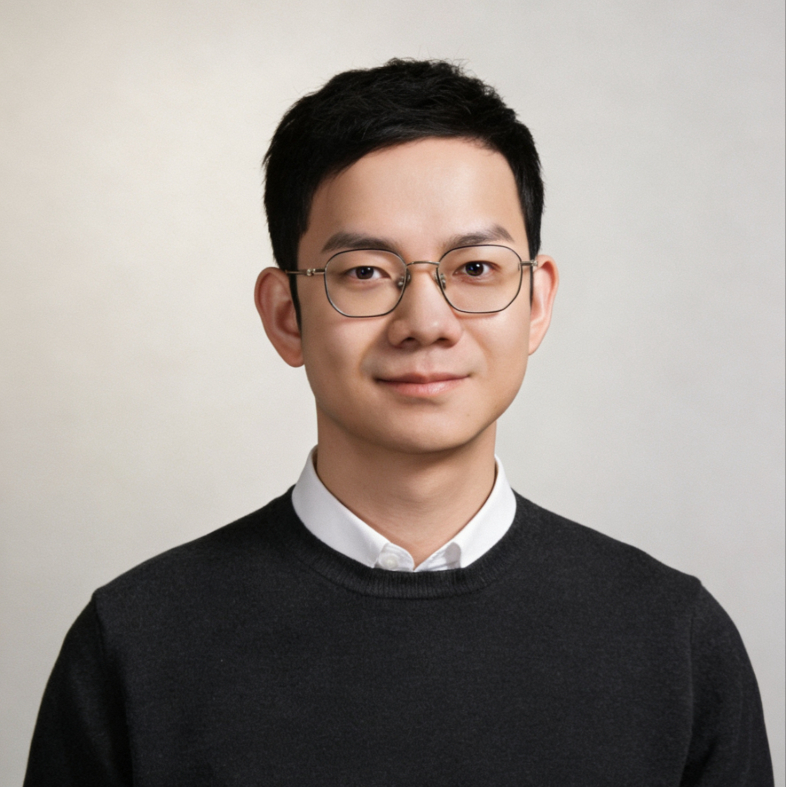
 Xiaoyu Li
· 2 previous affiliations
- Tencent (China)Since 2021
- Researcher · Since 2021
- Current
- PhD student · 2017–2021
8 other authors named Xiaoyu Li: Xiaoyu Li (UNSW Sydney · 52 papers), Xiaoyu Li (36 papers), Xiaoyu Li (2 papers), Xiaoyu Li (2 papers), xiaoyu li (Tencent (China) · 1 paper), and 3 more
Research Overview
Xiaoyu Li focuses on computer graphics, neural rendering, and computational photography. His early work addressed image and video restoration, correcting geometric distortions and removing visual artifacts. More recently, his research has shifted toward 3D generation and neural representations, developing techniques for dynamic scene reconstruction, human avatar synthesis, and generative video compositing.
Research Trajectory
His early work in computational photography focused on developing deep learning frameworks for image and video restoration. In Document rectification and illumination correction using a patch-based CNN, he introduced a method to correct geometric distortions and uneven illumination in document images by learning distortion flows on image patches and stitching the results in the gradient domain. He expanded on geometric correction in Blind Geometric Distortion Correction on Images Through Deep Learning, creating a general framework trained on synthetic datasets to predict displacement fields and automatically correct diverse geometric distortions in single images. Moving into video restoration, he addressed the challenge of physical lens artifacts. In Let's See Clearly: Contaminant Artifact Removal for Moving Cameras, he proposed a recurrent video restoration method that leverages a flow completion module to hallucinate background scenes over regions degraded by dust or moisture. This work aligns with the broader research direction of Disentangling Static Scenes from Transient Occluders in the Wild.
Around 2022, his focus expanded into neural rendering and 3D representations, bridging his expertise in image restoration with emerging techniques in novel view synthesis. He developed Deblur-NeRF: Neural Radiance Fields from Blurry Images, a method to reconstruct sharp 3D scenes directly from blurry inputs by modeling the physical blurring process with a deformable sparse kernel. This contribution advanced the area of Pose Free 3D Reconstruction from Unconstrained Images and intersected with developments in Semantic Neural Radiance Fields. Concurrently, he explored hybrid 3D representations to enable intuitive editing of dynamic scenes. In Neural Parameterization for Dynamic Human Head Editing, he combined the photorealistic rendering of implicit neural fields with the editability of explicit meshes. By disentangling geometry and appearance into a UV volume and a 2D texture space, this work facilitated highly consistent facial editing, contributing to the broader area of Scaling 3D-Aware Generative Models to High Resolutions. He also applied deep learning to 2D animation pipelines. In Deep Sketch-Guided Cartoon Video Inbetweening, he designed a framework that synthesizes intermediate cartoon frames by estimating dense cross-domain correspondence between user sketches and keyframes, which touches upon themes in the research direction of Disentangled Representations for Zero-Shot Style Transfer.
In 2023, he continued to refine dynamic scene rendering. He introduced a pipeline for creating seamless cinemagraphs from handheld camera footage in 3D Video Loops from Asynchronous Input. Utilizing a sparse Multi-Tile Video representation and a specialized looping loss, the method achieved real-time rendering on mobile devices, advancing work in Accelerating Neural Scene Representations for Real Time Rendering. By 2024, his research heavily emphasized 3D human generation from sparse inputs. He developed ConTex-Human: Free-View Rendering of Human from a Single Image with Texture-Consistent Synthesis, a framework that generates high-fidelity, 3D-consistent human models from a single photograph by employing a visibility-aware consistency loss to match unseen regions with the original image style. He further advanced this domain with HumanRef: Single Image to 3D Human Generation via Reference-Guided Diffusion, which introduced Reference-Guided Score Distillation Sampling and region-aware attention to ensure photorealistic texture consistency across all views. Reflecting on the rapid evolution of the field, he also synthesized the state of the art in Advances in 3D Generation: A Survey, providing a structured roadmap of 3D representations, generative methods, and applications.
Current Directions
The most recent papers in the evidence indicate a shift toward generative video and image compositing using advanced diffusion architectures. Recent work investigates the application of Diffusion Transformers (DiTs) to automate complex video editing tasks. For example, in GenCompositor: Generative Video Compositing with Diffusion Transformer, he and his collaborators developed a dual-branch architecture with specialized position embeddings to seamlessly inject dynamic foreground elements into videos while maintaining realistic environmental interactions like shadows and reflections.
Alongside video compositing, he is exploring unified frameworks for image customization. In IC-Custom: Diverse Image Customization via In-Context Learning, he contributed to a model that treats both position-aware and position-free object insertion as an in-context learning task, achieving high visual harmony with minimal parameter training. Additionally, he continues to innovate in 2D animation pipelines. With ToonComposer: Streamlining Cartoon Production with Generative Post-Keyframing, he participated in adapting video foundation models to unify cartoon inbetweening and colorization into a single generative process, allowing for high-quality animation from sparse sketches and a single colored reference frame.
Profile updated
Loading new papers…
Other researchers whose papers cluster into the same research directions — a proxy for overlapping technical interests and shared intellectual neighborhoods.
See something wrong? Report a mistake