

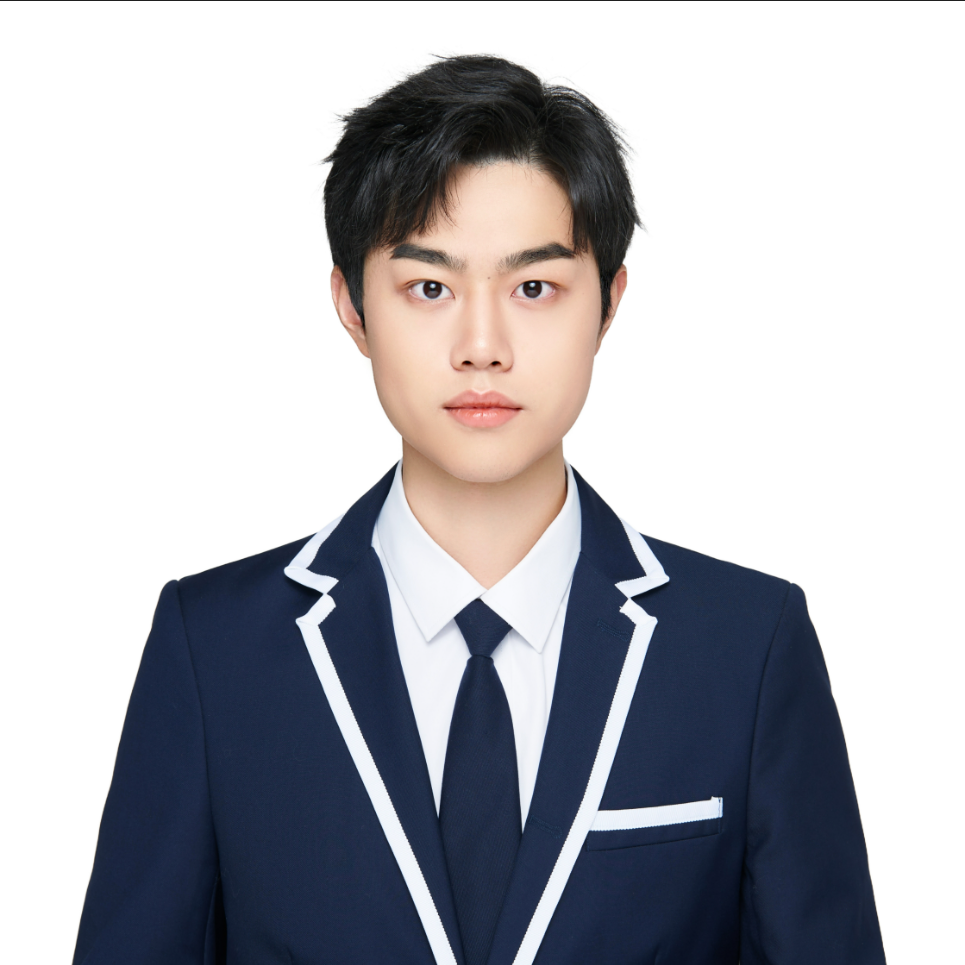
 Xiao Liang
· 2 previous affiliations
- DiscoverSince 2025
- PhD student · 2025–2030
- Tsinghua University2022–2025
- MS student · 2022–2025
2 other authors named Xiao Liang: Xiao Liang (University of California San Diego · 2 papers), Xiao Liang (1 paper)
Research Overview
Xiao Liang focuses on generative models, large language model reasoning, and reinforcement learning. His early work explored efficient contrastive learning and long-sequence processing for transformers. More recently, he investigates reinforcement learning with verifiable rewards and synthetic data generation to enhance the reasoning capabilities and test-time scalability of foundation models.
Research Trajectory
Liang’s early research addressed efficiency and representation learning in natural language and multimodal contexts. In 2023, he participated in developing SSLCL: An Efficient Model-Agnostic Supervised Contrastive Learning Framework for Emotion Recognition in Conversations, which mitigated the constraints of large batch sizes in emotion detection tasks. Continuing this focus on transformer efficiency, he contributed to Chunk, Align, Select: A Simple Long-sequence Processing Method for Transformers (2024), proposing a framework to divide inputs into chunks and align inter-chunk information to reduce the computational costs of self-attention. That same year, he introduced What You See Is What You Get: Entity-Aware Summarization for Reliable Sponsored Search, an entity-aware framework that extracts key product information to generate reliable summaries, aligning retrieval systems with language model preferences. Expanding into multimodal generation, he framed video grounding as a conditional generative task in Exploring Iterative Refinement with Diffusion Models for Video Grounding (2024), using diffusion models to iteratively refine predicted video spans from noisy inputs.
In 2025, his focus shifted toward optimizing large language models (LLMs) through knowledge distillation, efficient decoding, and architectural sparsity. He collaborated on Find Your Optimal Teacher: Personalized Data Synthesis via Router-Guided Multi-Teacher Distillation, which matched prompts to optimal teacher models based on student learnability to generate tailored synthetic data. To address factual hallucinations during generation, he helped develop Integrative Decoding: Improving Factuality via Implicit Self-consistency, a strategy that aggregates multiple sampled responses at each decoding step, effectively extending self-consistency to open-ended text. He also addressed the computational overhead of extended inference in TL;DR: Too Long, Do Re-weighting for Efficient LLM Reasoning Compression, proposing a dynamic ratio-based training pipeline that balances fast and deliberative data to eliminate redundant reasoning steps. On the architectural front, he led the development of the Sigma-MoE-Tiny Technical Report, introducing a highly sparse Mixture-of-Experts model that utilizes a progressive sparsification schedule to activate a fraction of parameters per token while maintaining strong performance. Concurrently, he participated in building Gold-Medal-Level Olympiad Geometry Solving with Efficient Heuristic Auxiliary Constructions, a framework that achieved high performance on International Mathematical Olympiad geometry problems by relying on geometric heuristics and an optimized symbolic engine rather than neural networks.
A major theme in Liang’s most recent trajectory is the application of Reinforcement Learning with Verifiable Rewards (RLVR) to enhance the reasoning capabilities of foundation models. He contributed to analyzing RLVR dynamics in Beyond the Exploration-Exploitation Trade-off: A Hidden State Approach for LLM Reasoning in RLVR (2025), using effective rank in the hidden-state space to quantify exploration and exploitation during LLM reasoning. To improve training data quality, he introduced SwS: Self-aware Weakness-driven Problem Synthesis in Reinforcement Learning for LLM Reasoning (2025), advancing the research area of Error Driven Synthetic Data for Model Remediation. He further investigated the fundamental impact of these methods in Reinforcement Learning with Verifiable Rewards Implicitly Incentivizes Correct Reasoning in Base LLMs (2026), collaborating on a rigorous evaluation metric to demonstrate that verifiable rewards extend an LLM's reasoning boundary rather than merely surfacing memorized answers. To prevent the collapse of output diversity during this training process, he developed Beyond Pass@ 1: Self-Play with Variational Problem Synthesis Sustains RLVR (2026). By generating new problem variants from correct solutions, this work addresses the broader direction of Preventing Entropy Collapse in Reinforcement Learning.
Alongside his work on individual reasoning models, Liang has investigated the structure of multi-agent systems. He participated in designing Dynamic Generation of Multi-LLM Agents Communication Topologies with Graph Diffusion Models (2025), a framework that uses graph diffusion models to dynamically structure agent interactions. This work contributes to research directions such as Sparse Communication Topologies for Multi-Agent Systems and Dynamic Communication Topologies for Multi-Agent Systems, generating task-specific communication networks that are more token-efficient and resilient than static workflows.
Current Directions
The most recent papers in the evidence address the scalability and robustness of reasoning in large language models through reinforcement learning. Recent work heavily investigates Reinforcement Learning with Verifiable Rewards (RLVR), focusing on how models can iteratively synthesize their own training data to overcome performance plateaus. By identifying model weaknesses and generating variational problems during self-play, this research aims to maintain policy entropy and incentivize logically consistent reasoning steps. Additionally, current efforts explore methods to compress extended reasoning trajectories, balancing fast and deliberative cognitive processes to make inference more computationally efficient without sacrificing accuracy.
Profile updated
Loading new papers…
Other researchers whose papers cluster into the same research directions — a proxy for overlapping technical interests and shared intellectual neighborhoods.
See something wrong? Report a mistake