

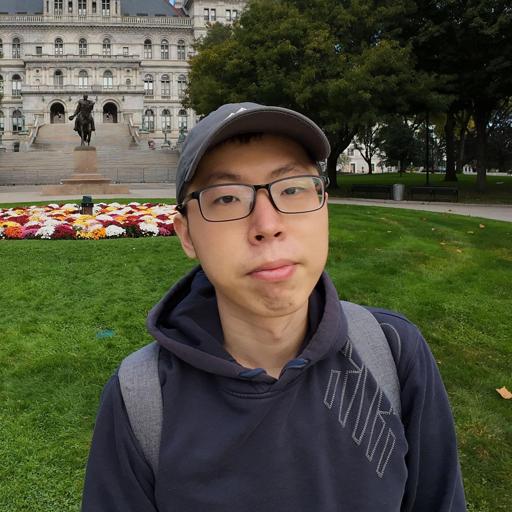
 Xiang Li
· 1 previous affiliation
- Stony Brook UniversitySince 2020
- PhD student · Since 2020
- Current
50 other authors named Xiang Li: Xiang Li (Massachusetts General Hospital · Harvard Medical School · 594 papers), Xiang Li (University of Bristol · 499 papers), Xiang Li (East China Normal University · 122 papers), Xiang Li (Nankai University · 100 papers), Xiang Li (48 papers), and 45 more
Research Overview
Xiang Li focuses on self-supervised visual representation learning, diffusion models, and vision-language models for robotic control. His early work explored foundational representation learning and neural rendering techniques to bridge simulation and reality. More recently, he investigates how large multimodal models and dense pixel tracking can be adapted into efficient, generalizable policies for embodied agents.
Research Trajectory
In 2022, his research spanned foundational representation learning, reinforcement learning (RL), and visual perception. He led the study Does Self-supervised Learning Really Improve Reinforcement Learning from Pixels?, which rigorously evaluated whether the joint optimization of self-supervised learning (SSL) and RL losses genuinely outperforms standard image augmentations. The findings suggested that existing SSL frameworks for RL often fall short of providing meaningful improvements when the amount of data and augmentations are strictly controlled. Around the same time, he contributed to sequence modeling for RL in StARformer: Transformer With State-Action-Reward Representations for Robot Learning, which proposed a Transformer architecture designed to predict future actions from sequences of past state-action-reward experiences.
During this period, he also explored visual generation and simulation. He participated in developing Peekaboo: Text to Image Diffusion Models are Zero-Shot Segmentors, an inference-time optimization technique that grounds complex natural language prompts into precise masks without additional training. This work aligns with the research direction of Promptable Foundation Models for Zero-Shot Segmentation Refinement. Additionally, he contributed to the area of Photorealistic Simulation via Neural Rendering and the broader direction of Implicit Neural Texture Fields for 3D Surface Synthesis through his involvement in TRITON: Neural Neural Textures for Better Sim2Real. This project combined differentiable rendering with neural textures to generate temporally consistent results for sim-to-real transfer tasks.
Building on his expertise in generative models and self-supervised learning, his 2024 work shifted toward improving diffusion-based policies and visual synthesis. He introduced Crossway Diffusion: Improving Diffusion-based Visuomotor Policy via Self-supervised Learning, demonstrating that augmenting the standard diffusion loss with an auxiliary state reconstruction objective enhances the visual representations used in diffusion-based behavioral cloning. He also collaborated on Diffusion Illusions: Hiding Images in Plain Sight, a pipeline utilizing frozen text-to-image diffusion models to automatically generate multi-arrangement optical illusions through specialized loss functions.
Most recently, in 2025, his focus has centered on scaling robot learning using foundation models and addressing the embodiment gap. He developed LLaRA: Supercharging Robot Learning Data for Vision-Language Policy, a framework that repurposes standard Vision-Language Models (VLMs) into robot policies by representing actions as pixel coordinates in natural language and utilizing self-supervised auxiliary tasks. He further addressed the challenge of learning from human demonstrations in Pixel Motion as Universal Representation for Robot Control. By using dense optical flow as a universal language to predict pixel movement from text commands, this system learns from diverse, action-free datasets, contributing directly to the research direction of Bridging the Embodiment Gap in Robot Learning. Finally, he collaborated on Understanding Long Videos with Multimodal Language Models, a framework that extracts concise object-centric data to fuse into Large Language Models via natural language. This approach addresses challenges in the area of The Perception Bottleneck in Modular Visual Reasoning, enabling efficient long-video understanding without relying solely on internal common sense.
Current Directions
The most recent papers in the evidence address the integration of large multimodal models into robotic control and efficient video understanding. Recent work investigates how standard Vision-Language Models can be repurposed as efficient robot policies by translating actions into conversational formats and pixel coordinates. Additionally, there is a strong focus on utilizing dense pixel motion as a universal representation to learn from human demonstrations without requiring explicit action labels. This approach aims to overcome the embodiment gap between human videos and robotic execution. Finally, ongoing research explores efficient long-video understanding by extracting object-centric data—such as identity, location, and motion—and fusing it into language models via natural language, bypassing the computational bottlenecks of traditional video processing.
Profile updated
Loading new papers…
Other researchers whose papers cluster into the same research directions — a proxy for overlapping technical interests and shared intellectual neighborhoods.
See something wrong? Report a mistake