

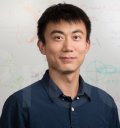
 Wenzhao Lian
· 8 previous affiliations
- Shanghai Jiao Tong UniversitySince 2024
- Professor · Since 2024
- 2007–2011
- Google (United States)Current
- Current
- Staff research scientist · 2022–2023
- Figure AI2023
- Director of Robot Manipulation · 2023
- Figure2023
- Director of Robot Manipulation · 2023
- X, the moonshot factory2019–2023
- Staff Research Scientist · 2022–2023
- Senior Research Scientist · 2019–2022
- Vicarious AI2016–2019
- Senior Researcher and Team Lead · 2017–2019
- Senior Researcher · 2016–2017
- Vicarious Inc.2016–2017
- Senior Researcher · 2016–2017
- Duke University2011–2015
- Research Assistant · 2011–2015
Research Overview
Wenzhao Lian focuses on robotic manipulation, reinforcement learning, and probabilistic modeling for time-series data. His early work centered on developing Bayesian methods and latent variable models for complex event streams and biomedical signals. More recently, his research addresses contact-rich robotic assembly, category-level manipulation, and learning from demonstrations to enable robust automation in unstructured environments.
Research Trajectory
Lian’s early research focused on probabilistic modeling and multivariate time-series analysis. In 2014, he developed latent semi-Markov processes to model correlated arrival events, contributing to the area of The Discretization Dilemma in Continuous Time Modeling with Modeling Correlated Arrival Events with Latent Semi-Markov Processes. During this period, he also participated in applying infinite hidden Markov models to electrophysiological data to capture evolving cognitive patterns in Analysis of Brain States from Multi-Region LFP Time-Series. Expanding on these Bayesian approaches, he introduced methods for learning the evolving statistics of time series using diffusion maps in Multivariate time-series analysis and diffusion maps. To handle scarce data environments, he subsequently proposed a hierarchical multitask Gaussian Process model for predicting future events across related streams in A Multitask Point Process Predictive Model. Continuing his work in machine learning optimization, he explored convex optimization techniques for predictive modeling in bioinformatics with Convex Factorization Machine for Toxicogenomics Prediction.
By 2021, Lian’s focus had shifted entirely toward robotics, specifically addressing the physical and algorithmic challenges of contact-rich manipulation and industrial assembly. He investigated methods to algorithmically extract dense reward functions from high-dimensional observations, such as images and tactile feedback, in Learning Dense Rewards for Contact-Rich Manipulation Tasks. This interest in tactile sensing extended to collaborative work on hierarchical control systems that leverage data from failed assembly attempts to refine environmental understanding, as detailed in Interpreting Contact Interactions to Overcome Failure in Robot Assembly Tasks. He also contributed to large-scale studies on multi-modal policies for assembly tasks in Robust Multi-Modal Policies for Industrial Assembly via Reinforcement Learning and Demonstrations: A Large-Scale Study. This body of work intersects with several broader research areas, including Versatile Automation for High-Mix Manufacturing, Relative Representations for Spatially Invariant Robot Learning, and Visuotactile Fusion for Dexterous Robotic Manipulation.
In 2022, his research expanded into category-level manipulation and learning from demonstrations. He helped develop frameworks that allow robots to learn manipulation tasks from a single video demonstration by utilizing category-level object representations, as presented in You Only Demonstrate Once: Category-Level Manipulation from Single Visual Demonstration. Similarly, he explored category-level, object-centric representations for grasping in cluttered simulated environments in CaTGrasp: Learning Category-Level Task-Relevant Grasping in Clutter from Simulation. To improve data efficiency in learning insertion skills, he co-developed optimization frameworks guided by human demonstrations in Prim-LAfD: A Framework to Learn and Adapt Primitive-Based Skills from Demonstrations for Insertion Tasks.
Alongside learning from demonstrations, Lian addressed the physical and symbolic complexities of robotic execution. He investigated symbolic state estimation to help robots adjust sensorimotor skills during contact-rich tasks in Symbolic State Estimation with Predicates for Contact-Rich Manipulation Tasks. He also tackled the specific challenge of modeling deformable objects in Robotic Cable Routing with Spatial Representation, proposing spatial representations for high-level path planning and low-level manipulation. Furthermore, he advocated for generating compliance reference signals to allow safe contact between robot bodies and their environments during goal-reaching tasks in Allowing Safe Contact in Robotic Goal-Reaching: Planning and Tracking in Operational and Null Spaces.
The trajectory culminates in his recent collaborative work on meta-reinforcement learning. In Zero-Shot Policy Transfer with Disentangled Task Representation of Meta-Reinforcement Learning, he participated in developing algorithms that explicitly encode different aspects of tasks into disentangled representations, enabling zero-shot policy generalization across novel compositional settings.
Current Directions
The most recent papers in the evidence indicate a focus on improving the generalization, data efficiency, and safety of robotic manipulation policies. Recent work investigates zero-shot policy transfer in meta-reinforcement learning by leveraging disentangled task representations, allowing agents to adapt to novel compositional settings without additional training. Additionally, ongoing themes include the development of category-level object representations to facilitate task-relevant grasping and manipulation from minimal visual demonstrations, as well as the integration of safe, compliant contact into robotic motion planning for complex, unstructured environments.
Profile updated
Loading new papers…
Other researchers whose papers cluster into the same research directions — a proxy for overlapping technical interests and shared intellectual neighborhoods.
See something wrong? Report a mistake