

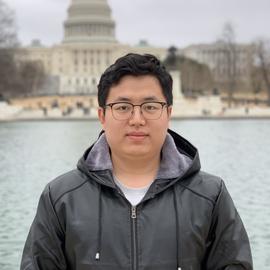
 Wentao Guo
· 4 previous affiliations
- Princeton UniversitySince 2024
- PhD student · 2024–2029
- Current
- Nvidia (United States)Since 2026
- PhD intern · Since 2026
- Carnegie Mellon University2023–2024
- Research Assistant · 2023–2024
- Cornell University2018–2023
- Research Assistant · 2022–2023
- Undergrad student · 2018–2022
2 other authors named Wentao Guo: Wentao Guo (Atombeat Inc. · University of California, Davis · 161 papers), Wentao Guo (ByteDance (China) · 1 paper)
Research Overview
Wentao Guo focuses on machine learning systems, hardware-efficient model architectures, and large language model optimization. His early research investigated optimal data ordering strategies to accelerate stochastic gradient descent. More recently, his work addresses the memory and computational bottlenecks of massive neural networks, developing zeroth-order optimization methods and hardware-aware designs for efficient fine-tuning and training.
Research Trajectory
Early in his academic trajectory, Guo investigated the theoretical and practical benefits of data ordering in machine learning training, contributing to the research direction of Optimal Data Ordering for Stochastic Gradient Descent. While random reshuffling of datasets is standard practice, greedy data orderings can empirically speed up convergence, though historically at the cost of significant memory and computation overhead. With collaborators, he addressed this in GraB: Finding Provably Better Data Permutations than Random Reshuffling. This work formulated an example-ordering framework called herding, demonstrating that stochastic gradient descent with herding achieves a faster convergence rate on smooth, non-convex objectives. This research also intersected with the broader areas of Efficient Per-Example Gradients for Optimization and Analysis and Scaling Data Attribution with Compressed Gradient Sketches.
The following year, Guo and his co-authors extended these theoretical benefits to distributed machine learning environments. In Coordinating Distributed Example Orders for Provably Accelerated Training, they developed Coordinated Distributed Gradient Balancing (CD-GraB). By using insights from kernel thinning to coordinate how parallel workers sequence their data, the algorithm achieves a provable linear speedup in convergence and outperforms standard random reshuffling in distributed settings.
As large language models (LLMs) grew in scale, Guo’s focus shifted toward the intersection of hardware efficiency and model architecture design, specifically targeting the severe memory constraints of LLM fine-tuning. He led the development of SensZOQ, detailed in Zeroth-Order Fine-Tuning of LLMs with Transferable Static Sparsity. This method enables the fine-tuning of 7-billion parameter models on consumer-grade hardware with less than 8GB of VRAM. By identifying a highly sensitive subset of parameters—just 0.1% of the total—that transfers effectively from pre-training to downstream tasks, the approach successfully combines aggressive 4-bit quantization with memory-efficient zeroth-order optimization. This contribution advanced the research direction of Zeroth Order Optimization for Memory Efficient Large Model Fine-Tuning, as well as the areas of Scaling Zeroth-Order Optimization for Large Models and The Transferability of Sparse Subnetworks.
Building on these efficiency paradigms, Guo’s subsequent work tackled the bottlenecks of highly sparse, fine-grained architectures. In SonicMoE: Accelerating MoE with IO and Tile-aware Optimizations, he introduced a hardware-software co-design for Mixture of Experts (MoE) models. By reordering backward-pass mathematics, overlapping GPU memory IO with computation, and implementing a hardware-aware token routing strategy, the system significantly reduces activation memory and boosts training throughput on modern accelerators.
Simultaneously, Guo applied his expertise in transferable sparsity to decentralized AI systems. In Mitigating Non-IID Drift in Zeroth-Order Federated LLM Fine-Tuning with Transferable Sparsity, he and his collaborators addressed the challenge of fine-tuning massive LLMs on resource-constrained edge devices. The research provides a mechanism to prevent global model degradation caused by non-IID data drift across distributed nodes, leveraging zeroth-order methods to make federated LLM training viable under strict hardware limitations.
Current Directions
The most recent papers in the evidence indicate a sustained focus on democratizing the training and fine-tuning of massive neural networks through hardware-software co-design. Guo’s current work investigates how to overcome the memory wall in complex architectures like Mixture of Experts, utilizing low-level optimizations such as IO overlapping and tile-aware computation to maximize accelerator throughput.
Additionally, his research explores the limits of zeroth-order optimization and static sparsity. By identifying transferable parameter subsets that require minimal memory to update, recent projects aim to make both localized fine-tuning and decentralized federated learning feasible on consumer-grade and edge hardware. This dual approach—optimizing the underlying systems for high-performance clusters while simultaneously compressing the optimization process for edge devices—defines his ongoing efforts in machine learning systems.
Profile updated
Loading new papers…
Other researchers whose papers cluster into the same research directions — a proxy for overlapping technical interests and shared intellectual neighborhoods.
See something wrong? Report a mistake