

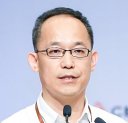
 Wenqiang Zhang
· 4 previous affiliations
- Fudan UniversitySince 2004
- Full Professor · Since 2004
- Shanghai Jiao Tong University2001–2004
- PhD student · 2001–2004
- Shandong University1998–2001
- MS student · 1998–2001
- Undergrad student · 1988–1992
Research Overview
Wenqiang Zhang focuses on computer vision, affective computing, and the adversarial robustness of foundation models. His trajectory spans from early developmental robotics and object detection to large-scale facial expression recognition and unified visual tracking frameworks. Recently, his group investigates multimodal reasoning agents, active 3D reconstruction, and security vulnerabilities in large vision-language models.
Research Trajectory
He began his research in embodied intelligence, exploring autonomous sensorimotor development in The architecture and body of FUWA developmental humanoid. Moving into core computer vision, he participated in developing dynamic anchor mechanisms for object detection frameworks in MetaAnchor: Learning to Detect Objects with Customized Anchors.
By 2021, his focus expanded to semantic segmentation, addressing visual inconsistency through interactive source and target pipelines in Dual Path Learning for Domain Adaptation of Semantic Segmentation. This work contributed to the broader area of Semantic Consistency for Domain Adaptation. Around this time, he established a significant research thrust in affective computing. He led a comprehensive survey of the field in A systematic review on affective computing: emotion models, databases, and recent advances, which synthesized unimodal and multimodal approaches and advanced the direction of Multimodal Fusion for Robust Affective Computing. Recognizing the limitations of static image benchmarks, his group introduced FERV39k: A Large-Scale Multi-Scene Dataset for Facial Expression Recognition in Videos. This dataset provided a critical resource for evaluating application-oriented scenes, supporting research in Spatio-Temporal Modeling for Facial Affective Computing and Contextualized Affective Computing for Emotion Recognition.
Building on temporal modeling, he developed unified frameworks for visual object tracking. In OneTracker: Unifying Visual Object Tracking with Foundation Models and Efficient Tuning, he introduced a general architecture that leverages large-scale pre-training to handle various input modalities through a shared temporal matching mechanism. He continued to refine dynamic facial expression recognition in the wild with Observe finer to select better: Learning key frame extraction via semantic coherence for dynamic facial expression recognition in the wild, proposing a coarse-to-fine spatial-temporal approach to extract key expression peaks. Concurrently, his tracking research extended to specialized domains; Dynamic Semantic-Aware Correlation Modeling for UAV Tracking addressed tracking drift caused by sudden camera motion, contributing to the area of Global Re-acquisition Mechanisms for Long-term Visual Tracking.
A major theme in his recent trajectory involves the security and robustness of machine learning models, particularly concerning adversarial attacks. He explored the transferability of black-box attacks across different model architectures in Boosting Adversarial Transferability with Spatial Adversarial Alignment, advancing the direction of Enhancing Adversarial Transferability for Black Box Attacks. He also reframed unrestricted adversarial generation as a preference alignment problem in Enhancing Diffusion-based Unrestricted Adversarial Attacks via Adversary Preferences Alignment, decoupling the goals of visual realism and attack success. This focus on vulnerabilities culminated in LingoLoop Attack: Trapping MLLMs via Linguistic Context and State Entrapment into Endless Loops, where he demonstrated how adversarial images could force Multimodal Large Language Models into infinite generative loops, highlighting critical risks in the area of Adversarial Overthinking and Computational Denial of Service.
In 2026, his work diversified into active perception, agentic reasoning, and out-of-distribution detection. He introduced GO-PRE: Goal-Oriented Next-Best-View Selection via Predictive Rendering Entropy for Active 3D Reconstruction, which minimizes rendering uncertainty to improve visual fidelity, contributing to research in Active Vision for Uncertainty Driven 3D Reconstruction. To address complex reasoning in vision tasks, he developed RSAgent: Learning to Reason and Act via Multi-Turn Tool Invocations for Text-Guided Segmentation, transforming segmentation into an iterative process that interleaves reasoning with tool use, aligning with the direction of Decoupling Perception and Reasoning in Multimodal Models. His group also tackled out-of-distribution detection by leveraging foundation models to generate challenging synthetic data in Synthesizing Near-Boundary OOD Samples for Out-of-Distribution Detection, advancing work in Distinguishing Near Distribution Semantic Shifts. Finally, he expanded his unified tracking research with Unified Multimodal Visual Tracking with Dual Mixture-of-Experts, utilizing a Dual Mixture-of-Experts architecture to decouple motion cues from sensor-specific features, further developing the area of Modality Specific Experts for Multimodal Fusion.
Current Directions
The most recent papers in the evidence indicate a strong focus on the intersection of multimodal foundation models, agentic reasoning, and system robustness. Recent work investigates how to transform static vision tasks into iterative, tool-using processes, enabling models to self-correct during text-guided segmentation. Concurrently, there is an emphasis on the security of these large multimodal systems, specifically identifying and mitigating energy-latency attacks that exploit generative loops. Other active areas include advancing active 3D reconstruction through predictive rendering entropy and improving out-of-distribution detection by synthesizing near-boundary adversarial examples.
Profile updated
Loading new papers…
Other researchers whose papers cluster into the same research directions — a proxy for overlapping technical interests and shared intellectual neighborhoods.
See something wrong? Report a mistake