

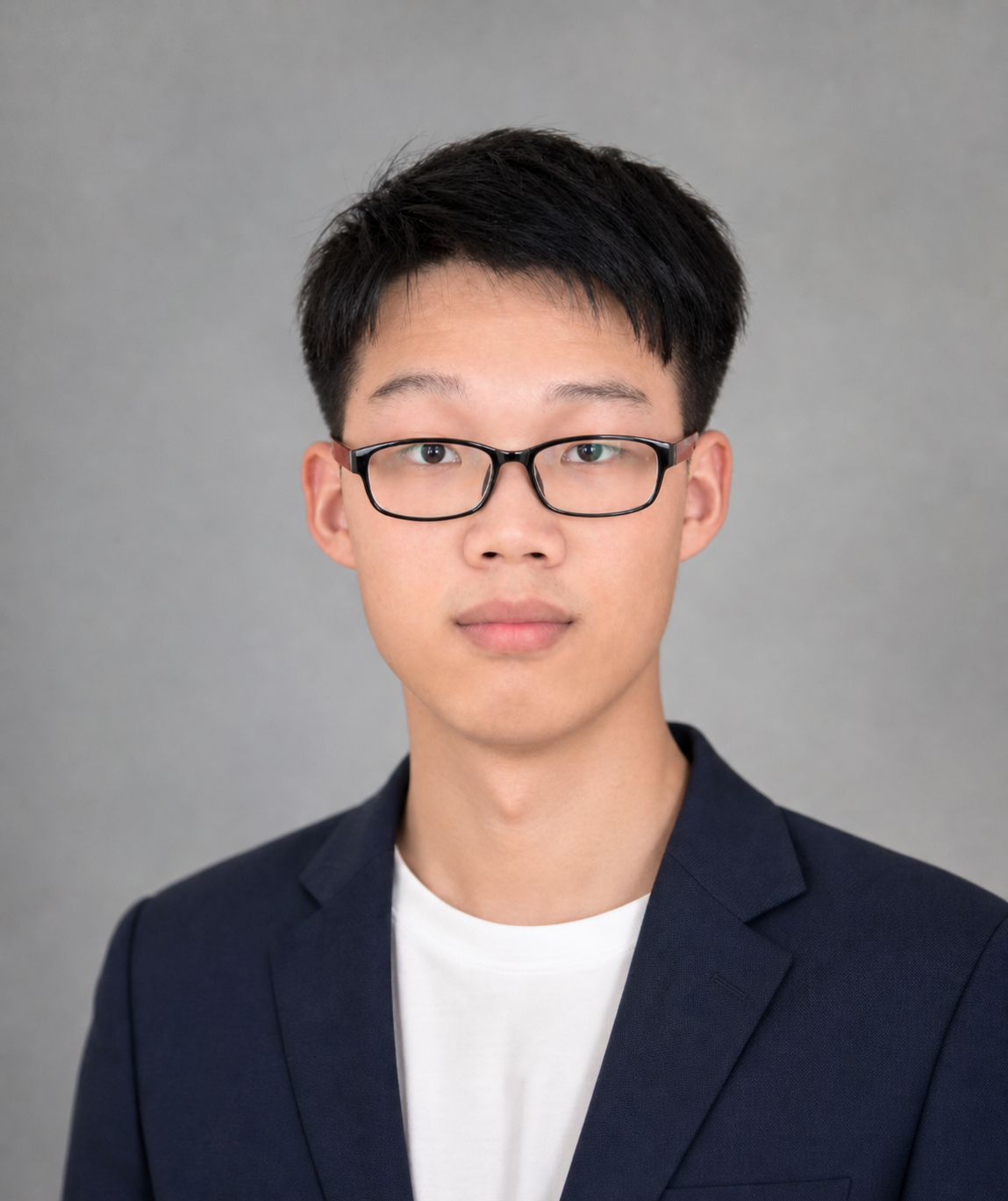
 Wei Chen
· 2 previous affiliations
- South China University of TechnologySince 2022
- PhD student · Since 2022
- Wuhan University of Technology2017–2021
- Undergrad student · 2017–2021
33 other authors named Wei Chen: Wei Chen (Microsoft (United States) · 539 papers), Wei Chen (Zhejiang University · 406 papers), Wei Chen (Guangdong University of Technology · 124 papers), Wei Chen (Chinese Academy of Sciences · 117 papers), Wei Chen (Huazhong University of Science and Technology · 102 papers), and 28 more
Research Overview
Wei Chen focuses on probabilistic inference and deep generative modeling, with a particular emphasis on diffusion models, normalizing flows, and density ratio estimation. His trajectory spans from accelerating continuous normalizing flows to developing mathematically grounded methods for score-based generative models and time-series forecasting. Recently, his work addresses the application of density ratio estimation to large language model alignment and safety.
Research Trajectory
Chen's early research addressed the computational bottlenecks of deep generative models, particularly continuous normalizing flows (CNFs). He contributed to TO-FLOW: Efficient Continuous Normalizing Flows with Temporal Optimization adjoint with Moving Speed, which treats the integration time horizon as a learnable parameter rather than a fixed hyperparameter. By alternately optimizing network weights and integration time via coordinate descent, this approach significantly reduces training time without sacrificing sample quality. This work aligns with the broader area of Joint Spatiotemporal Optimization for Trajectory Planning.
Building on this interest in generative efficiency, his focus expanded to diffusion models. He participated in developing SciRE-Solver: Accelerating Diffusion Models Sampling by Score-integrand Solver with Recursive Difference. This work introduced a recursive difference method to calculate the derivative of the score function, facilitating faster iterative processes. This contribution intersects with several research directions, including Few Step Inference for Diffusion and Flow Models, Optimizing Discretization Schedules for Fast Diffusion Sampling, and High Order Numerical Solvers for Fast Diffusion Sampling.
Chen continued to refine generative architectures and their applications. He introduced Entropy-informed weighting channel normalizing flow for deep generative models, a novel normalizing flow architecture that adaptively shuffles channels based on entropy to preserve important features and improve density estimation. He also collaborated on EVODiff: Entropy-aware Variance Optimized Diffusion Inference, an information-theoretic framework that optimizes denoising variance on the fly to reduce reconstruction errors without requiring a reference trajectory. Concurrently, he explored the utility of diffusion processes in specialized domains, contributing to ReciprocalLA-LLIE: Low-light image enhancement with luminance-aware reciprocal diffusion process for low-level computer vision, as well as time-series modeling through Generative Self-Supervised Time-Series Forecasting Leveraging Wavelet Diffusion and Diffinformer: Diffusion informer model for long sequence time-series forecasting.
A major, ongoing theme in Chen's trajectory is Density Ratio Estimation (DRE)—a foundational task for mutual information estimation, domain adaptation, and generative modeling. He developed Dequantified Diffusion-Schrödinger Bridge for Density Ratio Estimation to address the instability that occurs when comparing distributions with non-overlapping supports, advancing the research direction of Direct Density Ratio Estimation. To further stabilize training and reduce the variance of learning objectives in score-based DRE, he proposed Any-Step Density Ratio Estimation via Interval-Annealed Secant Alignment, a framework that replaces instantaneous tangents with interval integrals. This line of inquiry culminated in A Minimum Variance Path Principle for Accurate and Stable Score-Based Density Ratio Estimation. Together, these works represent significant progress in the area of Path-Based Density Ratio Estimation for High-Dimensional Distributions.
Recently, Chen has applied these probabilistic insights to the alignment of Large Language Models (LLMs). He introduced Towards Disentangled Preference Optimization Dynamics: Suppress the Loser, Preserve the Winner, which diagnoses and corrects a common flaw in LLM alignment where penalizing bad responses inadvertently degrades the model's preference for good responses. By implementing a reward calibration method, this work ensures balanced training updates that disentangle the optimization dynamics.
Current Directions
The most recent papers in the evidence indicate a dual focus on advancing the mathematical foundations of probabilistic inference and applying these frameworks to modern machine learning challenges. A primary current direction is the refinement of score-based and path-based density ratio estimation, seeking to minimize variance and improve stability when comparing complex, high-dimensional distributions. Concurrently, Chen is investigating the dynamics of preference optimization in large language models. His recent work addresses the unintended consequences of alignment training, developing calibrated methods to disentangle reward signals and ensure models reliably suppress undesirable outputs while preserving high-quality responses.
Profile updated
Loading new papers…
Other researchers whose papers cluster into the same research directions — a proxy for overlapping technical interests and shared intellectual neighborhoods.
See something wrong? Report a mistake