

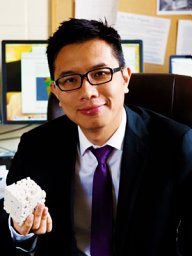
 WaiChing Sun
· 7 previous affiliations
- John Wiley & Sons (United States)Since 2025
- Editor of International Journal for Numerical Methods in Engineering · Since 2025
- Columbia UniversitySince 2014
- Full Professor · Since 2026
- Associate Professor · 2020–2026
- Assistant Professor · 2014–2020
- Visko PlatformSince 2025
- Technical Advisor · Since 2025
- Stanford University2022–2023
- UPS Foundation Visiting Professor · 2022–2023
- Sandia National Laboratories2011–2013
- Senior Member of Technical Staff · 2013
- Postdoctoral Fellow · 2011–2012
- Northwestern University2008–2011
- PhD, Theoretical and Applied Mechanics · 2008–2011
- Princeton University2007–2008
- M.A, Civil Engineering · 2007–2008
Research Overview
WaiChing Sun focuses on computational mechanics, multiscale modeling, and the integration of artificial intelligence with physical sciences. His trajectory spans from geometric deep learning for material microstructures to the development of data-driven constitutive laws for complex solids. His current work emphasizes physics-informed generative models and reinforcement learning techniques to ensure scientific consistency in material modeling and experimental design.
Research Trajectory
Sun's early work explored the intersection of topological material representations and computational mechanics, focusing on how machine learning can capture the complex reality of material microstructures. In 2020, his group published Geometric deep learning for computational mechanics Part I: Anisotropic Hyperelasticity, which bridged the gap between non-Euclidean microstructural data and the rigorous mathematical requirements of hyperelasticity. By leveraging geometric deep learning, this research contributed to the broader area of Graph Neural Networks for Molecular and Materials Representation, demonstrating how physics-informed architectures could be applied to solid mechanics to predict anisotropic behaviors.
As the field of computational mechanics increasingly adopted artificial intelligence, Sun participated in synthesizing these rapid advancements. He co-authored A review on data-driven constitutive laws for solids in 2024, which provided a comprehensive taxonomy of the shift away from traditional, phenomenological material equations. This collaborative effort explored model-free approaches capable of discovering and encoding complex material behaviors directly from experimental or simulation data. The review touched upon the research direction of Learning History Dependent Constitutive Laws with Recurrent Architectures and the area of Discovering Governing Equations via Sparse Symbolic Regression, highlighting the ongoing transition toward interpretable and data-efficient constitutive modeling.
Building on the need for robust data acquisition and model calibration, Sun's group developed novel frameworks for experimental design. In Design of experiments for the calibration of history-dependent models via deep reinforcement learning and an enhanced Kalman filter, published in 2025, he introduced an approach that intelligently selects experimental actions to maximize information gain. By combining deep reinforcement learning with an enhanced Kalman filter, the method significantly reduces the cost and time required to accurately calibrate complex, history-dependent material models.
Most recently, Sun has investigated the integration of fundamental physical laws into generative AI architectures. With collaborators, he developed Physics-Informed Diffusion Models, addressing the tendency of standard diffusion models to generate solutions that fit data distributions but violate physical constraints. By embedding partial differential equations directly into the training process, this framework reduces physical residual errors by up to two orders of magnitude and acts as a natural safeguard against overfitting. This work advances the area of Physics Informed Generative Models for Scientific Consistency and contributes to the research direction of Noise Aware Loss Weighting for Diffusion Models.
Current Directions
The most recent papers in the evidence indicate a strong focus on embedding physical constraints into advanced machine learning architectures. Recent work investigates how generative AI, particularly diffusion models, can be constrained by partial differential equations to ensure that generated solutions remain physically valid and scientifically consistent. Additionally, Sun is exploring the use of deep reinforcement learning to optimize the design of experiments, aiming to efficiently calibrate complex, history-dependent constitutive models. Together, these directions highlight an ongoing effort to create robust, interpretable, and physically grounded artificial intelligence tools for computational mechanics and materials science.
Profile updated
| Paper | Venue | Year |
|---|---|---|
| Physics-Informed Diffusion ModelsGitHubjhbastek/ | ICLR | 2025 |
Loading new papers…
Other researchers whose papers cluster into the same research directions — a proxy for overlapping technical interests and shared intellectual neighborhoods.
See something wrong? Report a mistake