

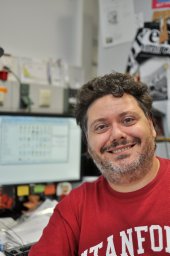
 Vito De Feo
· 7 previous affiliations
- University of TurinSince 2004
- Adjunct Professor · Since 2008
- Master's degree, Neuroscience · 2004–2020
- Professor · 2011–2013
- Caserta Hub Lab Fondazione NeuroneSince 2019
- Director · Since 2019
- University of EssexSince 2019
- Lecturer · Since 2019
- Italian Institute of Technology2015–2019
- Postdoc · 2015–2019
- Universität Hamburg2013–2015
- Researcher · 2013–2015
- Postdoc · 2013–2015
- Stanford University2002–2004
- Doctor of Philosophy - PhD, Electrical, Electronics and Communications Engineering · 2002–2004
Research Overview
Vito De Feo focuses on the development of embedded neuromorphic control systems and bidirectional closed-loop Brain-Machine Interfaces (BMIs). His research integrates machine learning, statistical signal processing, and information theory to improve the encoding and decoding of neural signals. Currently, his work emphasizes the creation of state-dependent neural decoders and the implementation of neuromorphic hardware to facilitate low-power, real-time communication between the brain and external assistive technologies.
Research Trajectory
The trajectory of De Feo’s research reflects a transition from high-speed digital communications infrastructure to the specialized domain of neural engineering. Between 2001 and 2008, his work was primarily situated within the field of telecommunications, specifically focusing on the architecture and implementation of optical packet networks. During this period at Politecnico di Torino, he contributed to the development of Wavelength Division Multiplexing (WDM) ring networks. This research involved designing high-capacity node controllers using Field-Programmable Gate Arrays (FPGAs) to manage Medium Access Control (MAC) protocols and real-time queuing processes. These early projects, such as RINGO and WONDER, sought to optimize the balance between electronic and optical technologies in metropolitan area networks, establishing a foundation in hardware-level signal management and real-time system control.
Following this period, De Feo shifted his focus toward the intersection of intelligent systems and neuroscience. This transition applied his expertise in hardware architecture and signal processing to the challenges of neural decoding. By the mid-2010s, his research began addressing the limitations of existing BMIs, which often struggled with the inherent variability of neural activity. He moved toward a framework that accounts for the "internal state" of the brain—ongoing spontaneous activity that precedes stimulus-driven responses—to improve the accuracy of motor intention decoding.
In recent years, his work has converged on two primary fronts: the development of novel information-theoretic measures to quantify communication between brain regions and the design of neuromorphic hardware for clinical BMI applications. This current phase is characterized by an effort to move BMI decoders from bulky, external computing platforms to compact, low-power embedded systems suitable for long-term implantation and rehabilitation.
Current Directions
De Feo’s current research is centered on the refinement of bidirectional BMIs, which establish a two-way link by decoding motor commands and encoding sensory feedback. A significant portion of this work involves addressing the "state-dependency" of neural signals. By identifying how the background state of a neural network influences its response to stimuli or its generation of motor commands, De Feo aims to create decoders that are more robust to trial-to-trial variability.
Another major area of focus is the development of Feature-specific Information Transfer (FIT). This framework utilizes Partial Information Decomposition (PID) and the Wiener-Granger causality principle to isolate the flow of specific information (such as sensory features) from general neural background noise. This allows for a more granular understanding of how different brain regions communicate specific types of data, rather than merely detecting that communication is occurring.
Furthermore, De Feo is actively working on neuromorphic hardware decoders. These systems mimic the architecture of biological neural networks to achieve high efficiency. By implementing decoding algorithms directly onto neuromorphic chips, his research seeks to overcome the power and size constraints that currently limit the clinical utility of fully implantable BMIs.
Representative Work
De Feo’s early contributions to optical networking are exemplified by his work on the RINGO and WONDER projects. In An FPGA-based Node Controller for a High Capacity WDM Optical Packet Network, he served as a key contributor to the design of a high-speed digital node controller. The research demonstrated how FPGA-based architectures could handle concurrent real-time processes, such as input queuing and multicast capabilities, within a WDM fiber ring. This was followed by Experimentation of single-hop WDM rings for metro and distributed switching applications, which detailed the architecture of the WONDER network. This work focused on assessing the effectiveness of optical versus electronic devices, identifying an optimal technological mix for metropolitan networking environments.
In the domain of neural engineering, De Feo led research into improving BMI performance through state-aware algorithms. In State-Dependent Decoding Algorithms Improve the Performance of a Bidirectional BMI in Anesthetized Rats, he demonstrated that accounting for the brain's internal state—the neural activity present immediately before a command—can significantly enhance decoding accuracy. By discounting background variability, the study achieved a 22% increase in extracted information, suggesting that state-dependent models can provide more stable control of external systems without requiring a higher density of electrodes.
His work on information theory led to the development of the FIT framework. In A Non-negative Measure Of Feature-Related Information Transfer Between Neural Signals, De Feo introduced a mathematical approach to quantify not just the presence of communication, but the specific content being exchanged between neural populations. By leveraging Partial Information Decomposition, this metric provides a noise-robust way to track the flow of individual sensory features with high temporal precision. This methodology was further refined in collaborative work, such as An information-theoretic quantification of the content of communication between brain regions, which applied the FIT measure to isolate stimulus-specific information flow from general neural activity.
De Feo’s recent efforts to miniaturize BMI technology are represented in A bidirectional brain-machine interface featuring a neuromorphic hardware decoder. In this study, he developed a modular BMI setup that utilizes a compact neuromorphic hardware decoder. This work serves as a proof-of-concept for low-power, fully implantable systems capable of real-time neural signal decoding, representing a critical step toward the clinical application of BMIs for patients with severe motor and sensory deficits.
Profile updated
Loading new papers…
Other researchers whose papers cluster into the same research directions — a proxy for overlapping technical interests and shared intellectual neighborhoods.
See something wrong? Report a mistake