

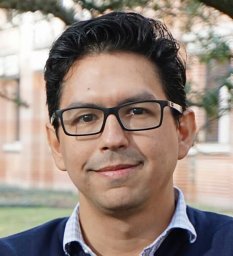
 Vicente Ordonez
· 7 previous affiliations
- Rice UniversitySince 2021
- Full Professor · Since 2026
- Associate Professor · 2021–2026
- Amazon (United States)2021–2025
- Visiting Academic · 2021–2025
- University of Virginia2016–2021
- Assistant Professor · 2016–2021
- Visiting Professor · 2019
- Visiting Research Fellow · 2015–2016
- Doctor of Philosophy (PhD), Computer Science · 2013–2015
- Stony Brook University2009–2013
- Master of Science (MS), Computer Science · 2009–2013
Research Overview
Vicente Ordonez focuses on computer vision, natural language processing, and the intersection of multimodal representation learning. His early work pioneered large-scale image captioning and visual grounding, while his subsequent research has heavily investigated bias mitigation and model interpretability. Most recently, his focus has shifted toward test-time reasoning and efficient multimodal retrieval architectures.
Research Trajectory
Ordonez's early research established foundational methods for connecting visual data with natural language. He introduced Im2Text: Describing Images Using 1 Million Captioned Photographs, a non-parametric approach to automatic image description that leveraged a massive, web-mined dataset of Flickr images. This work contributed to the broader research direction of Saliency-Driven Content Selection for Multimodal Generation and advanced the area of Quality-Centric Alignment for Vision-Language Models. Building on this intersection of vision and text, he developed models to predict human-centric object labels in From Large Scale Image Categorization to Entry-Level Categories, mapping standard visual recognition outputs to the "entry-level" words people naturally use. He also collaborated on ReferItGame: Referring to Objects in Photographs of Natural Scenes, designing a two-player crowdsourcing game to collect and verify a large-scale dataset of natural language referring expressions, which facilitated new optimization-based models for spatial disambiguation.
In the mid-2010s, his work expanded to include efficient neural architectures and the critical examination of model behavior. He participated in the development of XNOR-Net: ImageNet Classification Using Binary Convolutional Neural Networks, which approximated convolutions with binary operations to drastically reduce memory and computation requirements. Concurrently, he began investigating the societal implications of vision-language datasets, contributing to Men Also Like Shopping: Reducing Gender Bias Amplification using Corpus-level Constraints. This study revealed how structured prediction models amplify existing gender biases found in web corpora during multilabel object classification. Returning to architectural innovations, his lab proposed Feedback-Prop: Convolutional Neural Network Inference Under Partial Evidence, an inference procedure that boosts prediction accuracy by propagating known target labels backward. This contributed to the research direction of Bidirectional Feedback Loops for Deep Neural Architectures.
The analysis and mitigation of bias became a central theme of his lab's subsequent work. In Balanced Datasets Are Not Enough: Estimating and Mitigating Gender Bias in Deep Image Representations, his team demonstrated that models amplify gender associations even when trained on perfectly balanced datasets, proposing an adversarial approach to remove protected features from intermediate representations. Alongside bias mitigation, his group focused heavily on model interpretability and visual grounding. He collaborated on Black-Box Explanation of Object Detectors via Saliency Maps (D-RISE), a method for generating visual explanations for object detectors without requiring internal model access. His lab further aligned interpretability with performance in Improving Visual Grounding by Encouraging Consistent Gradient-based Explanations, introducing an Attention Mask Consistency objective that optimizes internal gradient heatmaps to match human annotations. During this period, his team also released Visual News: Benchmark and Challenges in News Image Captioning, expanding multimodal evaluation to complex, entity-rich domains.
Exploring the limits of representation learning and data environments, his lab investigated feature transferability in On the Transferability of Visual Features in Generalized Zero-Shot Learning. To overcome the constraints of static datasets, they utilized 3D physics engines in Sim VQA: Exploring Simulated Environments for Visual Question Answering, generating synthetic data to expand visual and language spaces for VQA tasks. Returning to the theme of fairness, his lab published Variation of Gender Biases in Visual Recognition Models Before and After Finetuning in 2023, introducing a framework to measure how biases shift when large-scale pretrained models are adapted for downstream tasks. This interest in robust representations also extended to video domains. His group developed ViC-MAE, detailed across Visual Representation Learning from Unlabeled Video using Contrastive Masked Autoencoders and ViC-MAE: Self-supervised Representation Learning from Images and Video with Contrastive Masked Autoencoders. By unifying masked autoencoders with contrastive learning across image and video frames, this architecture achieved state-of-the-art video-to-image transfer learning, advancing the research direction of Bridging the Domain Gap in Video Understanding.
Most recently, his research has leveraged synthetic data generation and test-time optimization to enhance multimodal models. His lab introduced SynGround in Learning from Synthetic Data for Visual Grounding, a pipeline that uses text-to-image generation and large language models to create scalable synthetic training data. In the realm of inference efficiency, his group proposed ProxyThinker: Test-Time Guidance through Small Visual Reasoners, which equips large vision-language models with deliberative reasoning capabilities without the computational burden of full retraining. He also collaborated on MetaEmbed: Scaling Multimodal Retrieval at Test-Time with Flexible Late Interaction, a framework utilizing learnable "Meta Tokens" and Matryoshka training to allow dynamic trade-offs between retrieval accuracy and speed during inference.
Current Directions
The most recent papers in the evidence address the scalability and efficiency of vision-language models during both training and inference. Recent work investigates the use of generative models to create high-quality synthetic data, providing a scalable alternative to expensive real-world annotations for visual grounding tasks. Additionally, current research focuses on test-time compute and dynamic inference, exploring methods to grant large multimodal models deliberative reasoning capabilities and flexible retrieval mechanisms without incurring the massive computational costs of full model retraining.
Profile updated
Loading new papers…
Other researchers whose papers cluster into the same research directions — a proxy for overlapping technical interests and shared intellectual neighborhoods.
See something wrong? Report a mistake