

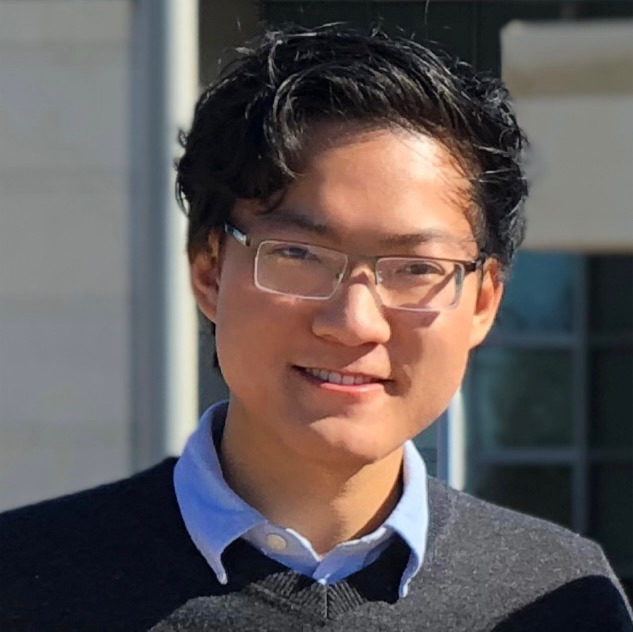
 Trung Le
· 10 previous affiliations
- Emory UniversitySince 2026
- Postdoctoral Researcher · Since 2026
- Georgia Institute of TechnologySince 2026
- Postdoctoral Researcher · Since 2026
- University of Washington2020–2025
- Graduate Research Assistant · 2020–2025
- Allen Institute2024–2025
- Visiting Researcher · 2024–2025
- Meta (United States)2024–2025
- Intern · 2024–2025
- Intern · 2023
- Master's degree, Electrical and Computer Engineering · 2018–2020
- HRL Laboratories (United States)2019–2020
- Intern · 2019–2020
- Discover2018–2020
- MS student · 2018–2020
- Texas A&M University2015–2017
- Undergrad student · 2015–2017
3 other authors named Trung Le: Trung Le (Monash University · 230 papers), Trung Le (University of South Florida · 7 papers), Trung Le (1 paper)
Research Overview
Trung Le focuses on computational neuroscience, deep learning, and signal processing, specifically developing interpretable models to analyze large-scale neural recordings. His early work introduced spatiotemporal architectures for modeling single-trial neural population dynamics and identifying biological entities. Recently, his research has shifted toward dynamic connectivity inference and the development of robust, cross-species foundation models for brain-computer interfaces and speech decoding.
Research Trajectory
The early phase of Le's research focused on capturing the complex dynamics of neural populations without relying on explicit dynamical models. In 2022, he introduced STNDT: Modeling Neural Population Activity with Spatiotemporal Transformers, an architecture designed to explicitly model the responses of individual neurons across both time and space. This work addressed the rich covariation between neurons that previous non-recurrent methods often neglected, contributing to the research direction of Modeling Single Trial Dynamics in Neural Populations and the broader area of Noise Invariant Representation Learning with Contrastive Objectives.
In 2023, Le expanded his focus to include the structural and genetic identities of neural circuits. He collaborated on AMAG: Additive, Multiplicative and Adaptive Graph Neural Network For Forecasting Neuron Activity, which utilized message-passing operations to forecast neural signals and recover the spatial connectivity of neural circuits. Concurrently, he contributed to Learning Time-Invariant Representations for Individual Neurons from Population Dynamics (NeuPRINT). This self-supervised framework modeled individual neuronal dynamics based on local network interactions to predict a neuron's molecular subclass, advancing work in the area of Neighborhood Context for Biological Entity Identification.
By 2024, Le's work began addressing the nonstationary aspects of biological neural systems, such as ongoing synaptic plasticity. He participated in the development of NetFormer: An interpretable model for recovering identity and structure in neural population dynamics, which employed a query and key mechanism to generate state-dependent attention matrices for extracting underlying network structures. During this period, he also engaged with the challenges of speech brain-computer interfaces (BCIs), co-authoring Brain-to-Text Benchmark '24: Lessons Learned. This empirical study evaluated the efficacy of ensembling recurrent neural network decoders with large language models, aligning with the research direction of Joint Optimization of Neural Speech Pipelines.
In 2025, Le developed solutions for the practical deployment of BCIs, specifically addressing the nonstationarity problem where recorded neurons shift over time. He introduced SPINT: Spatial Permutation-Invariant Neural Transformer for Consistent Intracortical Motor Decoding, a framework that treats neurons as an unordered set and dynamically learns their identities from unlabeled data to enable robust, real-time movement decoding. He also continued his work on interpretable architectures with NetFormer: An interpretable model for recovering dynamical connectivity in neuronal population dynamics. By utilizing a linearized attention mechanism, this model successfully tracked dynamic connectivity patterns, contributing to the research direction of Integrating Dynamic Synaptic Plasticity into Network Models and the area of Neural Architectures as Discrete Differential Equations. Additionally, he collaborated on hardware-efficient implementations of these models, as detailed in BAQET: BRAM-aware Quantization for Efficient Transformer Inference via Stream-based Architecture on an FPGA.
Most recently, in 2026, Le contributed to A cross-species neural foundation model for end-to-end speech decoding. This research transitioned speech BCIs from multi-step pipelines to differentiable end-to-end systems, leveraging cross-species pretraining and audio-based large language models to improve decoding performance for both attempted and imagined speech.
Current Directions
The most recent papers in the evidence indicate a strong focus on the robustness and scalability of neural decoding systems. A primary theme is overcoming the nonstationarity of neural recordings—whether by tracking dynamic synaptic plasticity over time or by designing permutation-invariant architectures that can maintain consistent decoding performance even as the set of recorded neurons changes. Furthermore, recent work investigates the development of end-to-end foundation models for brain-computer interfaces. By integrating cross-species pretraining and large language models, this direction aims to replace rigid, multi-step BCI pipelines with unified, differentiable systems capable of high-performance speech and motor decoding.
Profile updated
Loading new papers…
Other researchers whose papers cluster into the same research directions — a proxy for overlapping technical interests and shared intellectual neighborhoods.
See something wrong? Report a mistake