

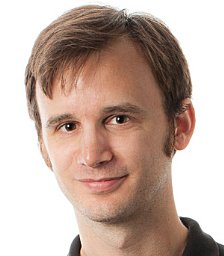
 Tristan Glatard
· 8 previous affiliations
- University of TorontoSince 2024
- Professor · Since 2024
- Concordia UniversitySince 2019
- Full Professor · Since 2024
- Co-Director, Applied AI Institute · 2022–2024
- Associate Professor · 2019–2024
- Centre for Addiction and Mental HealthSince 2024
- Scientific Director, Krembil Centre for Neuroinformatics · Since 2024
- Researcher (CR1) · 2013–2016
- Researcher (CR2) · 2008–2013
- McGill University2013–2016
- Visiting Scholar · 2013–2016
- University of Amsterdam2007–2008
- Postdoctoral Fellow · 2007–2008
- Université Nice Sophia Antipolis2004–2007
- PhD, Computer Science · 2004–2007
- École Centrale de Lyon2001–2004
- Engineering degree & Master · 2001–2004
Research Overview
Tristan Glatard focuses on distributed systems monitoring, fault prediction, and medical image analysis. Early work addressed probe selection in large-scale grid environments using collaborative prediction and active learning techniques to improve system reliability. More recently, his collaborative efforts have extended into the evaluation of segmentation algorithms for positron emission tomography.
Research Trajectory
The available evidence outlines two distinct phases of research activity, beginning with a focus on the reliability of large-scale distributed computing environments and later shifting toward collaborative efforts in medical image analysis.
In the early 2010s, Glatard served as a senior researcher investigating fault prediction and monitoring in distributed systems. Isolating users from inevitable hardware and software faults in massive grid infrastructures is a persistent challenge in distributed computing. To address this, Glatard and colleagues formulated the problem of probe selection for fault prediction as a Collaborative Prediction (CP) task. In Distributed Monitoring with Collaborative Prediction (2012), the research team applied a Maximum Margin Matrix Factorization approach combined with active learning to an extensive experimental dataset from the EGI grid. This methodology demonstrated that the number of required probes could be reduced by 80% to 90% while maintaining excellent fault prediction performance. This line of inquiry was further solidified in the journal article Efficient distributed monitoring with active Collaborative Prediction (2013), which emphasized that active probing is a necessary component for coping with the high data variability inherent in real-world distributed systems.
By 2018, the evidence indicates a transition toward biomedical computing and participation in large-scale community benchmarking. Glatard was a contributing middle author to The first MICCAI challenge on PET tumor segmentation (2018). Rather than driving the core algorithmic development, his participation in this highly collaborative, multi-author project reflects an engagement with the rigorous evaluation and standardization of medical imaging algorithms, specifically focusing on positron emission tomography (PET) tumor segmentation.
Current Directions
The most recent paper in the provided evidence is from 2018, making the current trajectory difficult to characterize definitively. Based on this latest available work, recent efforts involve participation in community-driven challenges for medical image analysis. This direction focuses on establishing standardized benchmarks and evaluating the efficacy of various algorithmic approaches to tumor segmentation in PET imaging. Given the sparse recent evidence, it remains an open question whether this represents a permanent domain shift toward medical imaging or a specific application of broader computational and distributed systems expertise to the biomedical domain.
Profile updated
| Title | Venue | Year |
|---|---|---|
| The first MICCAI challenge on PET tumor segmentation | Medical Image Analysis | 2018 |
| Efficient distributed monitoring with active Collaborative Prediction | Future Generation Computer Systems | 2013 |
| Distributed Monitoring with Collaborative Prediction | Ccgrid | 2012 |
Loading new papers…
Loading research neighbors…
See something wrong? Report a mistake