

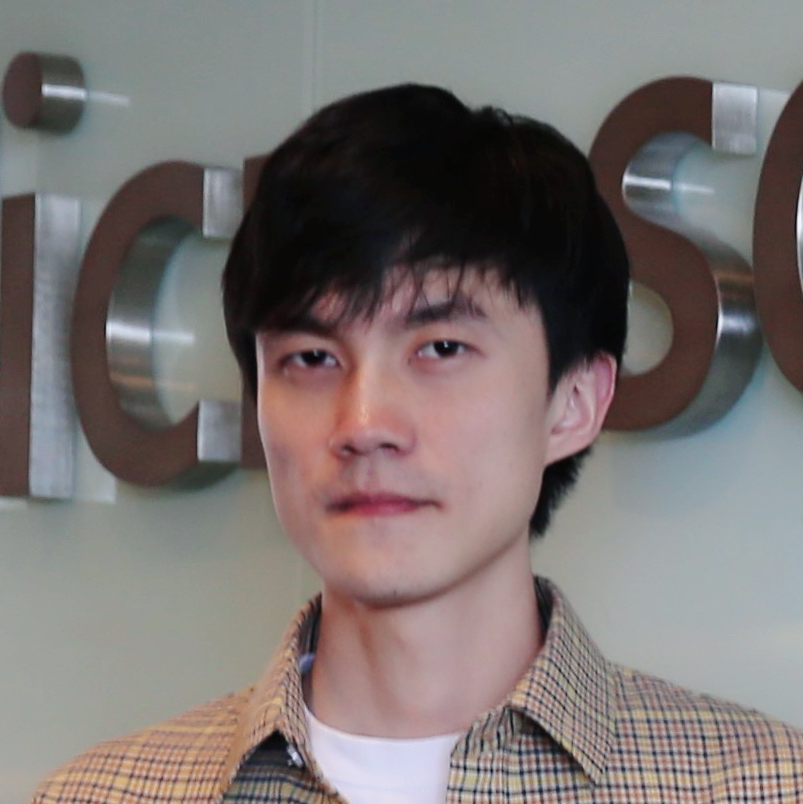
 Tianyu He
· 2 previous affiliations
- Microsoft (United States)Since 2022
- Researcher · Since 2022
- Current
- Alibaba Group (China)2019–2022
- Researcher · 2019–2022
1 other author named Tianyu He: Tianyu He (StepFun AI (China) · University of Maryland, College Park · 9 papers)
Research Overview
Tianyu He focuses on generative modeling, neural media compression, and 3D vision. Their trajectory spans early work in neural machine translation and video compression to advanced frameworks for talking avatar generation and novel view synthesis. Recently, He investigates interactive video world models and 3D-aware multimodal systems.
Research Trajectory
The early phase of Tianyu He's research explored architectural improvements in sequence modeling and translation. In 2018, they introduced Layer-Wise Coordination between Encoder and Decoder for Neural Machine Translation, which explicitly coordinated the learning of hidden representations across layers to improve translation accuracy. This was followed by Tied Transformers: Neural Machine Translation with Shared Encoder and Decoder (2019), demonstrating that sharing parameters between representation and generation stages yields a more compact model with superior generalization. During this period, He also applied sequence-to-sequence refinement concepts to computer vision, developing Deliberation Learning for Image-to-Image Translation (2019), a two-stage polishing approach that contributed to the broader area of Learning Image Transformations Without Paired Data.
Subsequent research shifted toward neural media compression. Addressing the research direction of Image Compression for Machine Perception, He proposed Beyond Coding: Detection-driven Image Compression with Semantically Structured Bit-stream (2019), a framework that organizes bit-streams around detected objects to enable direct semantic analysis without full decompression. Extending these principles to temporal data, Learning for Video Compression (2020) introduced PixelMotionCNN, a fully learning-based framework that models spatiotemporal coherence directly, advancing the area of Overcoming Computational Overhead in Neural Video Codecs.
Between 2021 and 2022, He extensively investigated person re-identification (re-ID) under challenging observational conditions. This work began with Partial Person Re-Identification With Part-Part Correspondence Learning (2021), which utilized self-supervised patch correspondence to handle flawed or occluded inputs. To better capture spatiotemporal dynamics, Dense Interaction Learning for Video-based Person Re-identification (2021) combined convolutional encoders with dense interaction decoders. Tackling the specific challenge of clothing variations, Cloth-Changing Person Re-identification from A Single Image with Gait Prediction and Regularization (2022) used synthetic gait sequences as a biometric regulator during training. This approach allowed the model to learn cloth-invariant features from static images, aligning with the research direction of Training-Time Auxiliary Supervision for Zero-Overhead Inference.
By 2024, He's focus expanded into generative video editing, neural rendering, and digital avatars. UniEdit: A Unified Tuning-Free Framework for Video Motion and Appearance Editing enabled simultaneous text-driven editing of video style and motion without per-video fine-tuning. In the domain of Neural Radiance Fields (NeRF), He addressed sparse-view reconstruction challenges with Is Vanilla MLP in Neural Radiance Field Enough for Few-Shot View Synthesis?, introducing a multi-input architecture to prevent overfitting, and CMC: Few-shot Novel View Synthesis via Cross-view Multiplane Consistency, which enforced depth-aware consistency across input views. Concurrently, He made significant contributions to the area of Stochastic Generation for Audio Driven Motion Synthesis. This included Make Your Actor Talk: Generalizable and High-Fidelity Lip Sync with Motion and Appearance Disentanglement, a diffusion-based framework for speech-driven facial animation, and GAIA: Zero-shot Talking Avatar Generation, a scalable approach that eliminated domain-specific heuristics by disentangling motion and appearance representations.
Most recently, He has focused on 3D generation, multimodal reasoning, and video world models. In 2025, they developed AR4D: Autoregressive 4D Generation from Monocular Videos, shifting from score distillation to an autoregressive paradigm for dynamic 3D content. They also introduced 3D-LLaVA: Towards Generalist 3D LMMs with Omni Superpoint Transformer, a minimalist 3D large multimodal model that processes point clouds directly, contributing to the broader area of Overcoming the Static Scene Assumption. To improve the instruction-following capabilities of generative environments, He proposed Reinforcement Learning with Inverse Rewards for World Model Post-training (2025). In 2026, their collaborative work explored geometric constraints in generative AI, including Quotient-Space Diffusion Models for systems with continuous symmetries, LIVE: Long-horizon Interactive Video World Modeling to enforce bounded error accumulation via cycle-consistency, and Geometry Forcing: Marrying Video Diffusion and 3D Representation for Consistent World Modeling, which aligns video diffusion representations with pretrained geometric foundation models.
Current Directions
The most recent papers in the evidence indicate a strong focus on interactive video world models and 3D-grounded generative systems. A primary theme is mitigating error accumulation and temporal drift in long-horizon video generation, utilizing techniques like cycle-consistency objectives and inverse dynamics models to provide verifiable reward signals for reinforcement learning. Additionally, recent work investigates the integration of explicit 3D geometric priors into diffusion models and large multimodal systems. This includes developing unified architectures that process point clouds for fine-grained 3D scene understanding, as well as forcing 2D video diffusion models to internalize latent 3D representations to ensure physical and spatial consistency in generated environments.
Profile updated
Loading new papers…
Other researchers whose papers cluster into the same research directions — a proxy for overlapping technical interests and shared intellectual neighborhoods.
See something wrong? Report a mistake