

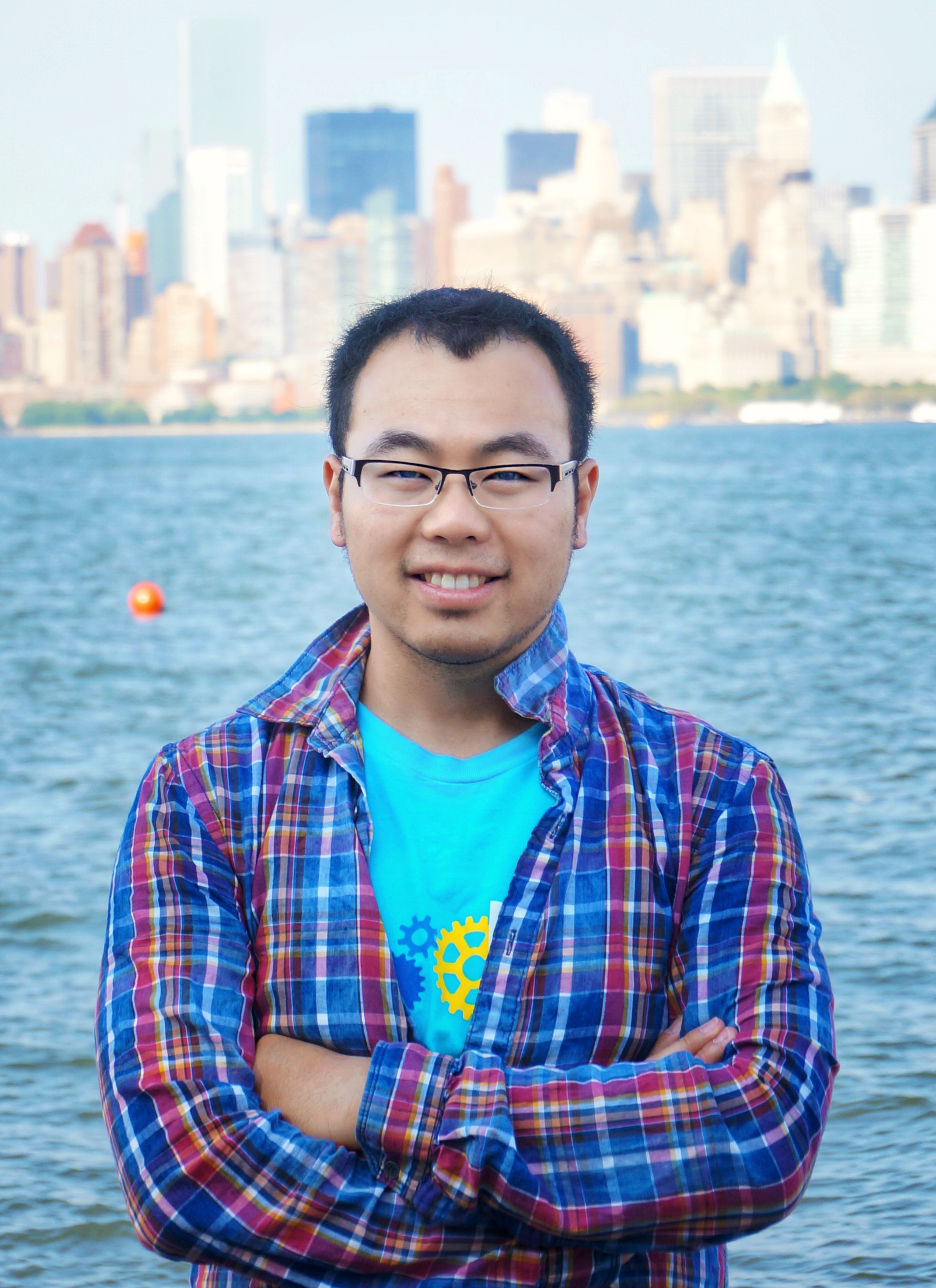
 Tianyi Zhou
· 7 previous affiliations
- Visiting Assistant Professor · Since 2026
- University of Maryland, College Park2022–2024
- Assistant Professor · 2022–2024
- University of Washington2013–2022
- Research/Teaching Assistant · 2013–2022
- Google (United States)2021–2022
- Visiting Research Scientist · 2021–2022
- Summer Research Intern · 2015
- University of Technology Sydney2011–2013
- Research Assistant · 2011–2013
- Nanyang Technological University2009–2011
- Research Assistant · 2009–2011
5 other authors named Tianyi Zhou: Tianyi Zhou (University of Southern California · 20 papers), Tianyi Zhou (6 papers), Tianyi Zhou (1 paper), Tianyi Zhou (Shanghai Artificial Intelligence Laboratory · 1 paper), Tianyi Zhou (1 paper)
Research Overview
Tianyi Zhou focuses on machine learning optimization, natural language processing, and the development of efficient generalist AI systems. His early work advanced matrix decomposition and self-attention mechanisms for sequence modeling. Currently, his research addresses the alignment, reasoning capabilities, and training dynamics of large language models, emphasizing mixture-of-experts architectures and neuro-symbolic hybrid intelligence.
Research Trajectory
Zhou's early research addressed fundamental challenges in matrix optimization and high-dimensional data scaling. The publication of GoDec: Randomized Lowrank & Sparse Matrix Decomposition in Noisy Case (2011) introduced a method for efficiently separating noisy data matrices into low-rank and sparse components using randomized subspace projections.
Transitioning into natural language processing, he developed highly efficient sequence modeling architectures that bypassed the need for recurrent or convolutional layers. In DiSAN: Directional Self-Attention Network for RNN/CNN-Free Language Understanding (2018), he combined feature-wise attention with directional masks to capture temporal order. This work advanced the broader research area of Directional Masking for Parallel Sequence Modeling as well as the field of Multi-dimensional Attention for Fine-grained Feature Selection. Building on these attention mechanisms, he subsequently proposed Tensorized Self-Attention: Efficiently Modeling Pairwise and Global Dependencies Together (2019), which utilized tensorized alignment scores to simultaneously capture token-to-token and source-to-token dependencies while maintaining the computational efficiency of a CNN.
In subsequent years, his focus expanded to training dynamics and distributed learning. Adaptive training schedules were the focus of Curriculum Learning by Dynamic Instance Hardness (2020). In the context of collaborative learning, he participated in developing FedProto: Federated Prototype Learning across Heterogeneous Clients (2022). This framework addressed the challenge of client heterogeneity by exchanging class prototypes rather than model weights or gradients, making a key contribution to the domain of Prototype Based Federated Learning.
Exploring the intersection of generative and discriminative models, Zhou contributed to Do Text-Free Diffusion Models Learn Discriminative Visual Representations? (2024). This research demonstrated that unconditional diffusion models contain powerful discriminative features within their U-Net architectures, advancing the area of Generative Models as Visual Perception Backbones. In reinforcement learning and optimization, his group developed Many-Objective Multi-Solution Transport (2025), utilizing optimal transport to match competing objectives to expert models without suffering from task collapse. Concurrently, he formalized new theoretical objectives for unsupervised reinforcement learning in Task Adaptation from Skills: Information Geometry, Disentanglement, and New Objectives for Unsupervised Reinforcement Learning (2025), leveraging Wasserstein distances to discover diverse skills that adapt rapidly to unseen downstream tasks.
A major recent theme in Zhou's trajectory is the optimization and analysis of large language models, particularly Mixture-of-Experts (MoE) architectures and reasoning behaviors. Research into the failure modes of reasoning models led to Missing Premise exacerbates Overthinking: Are Reasoning Models losing Critical Thinking Skill? (2025), identifying how models trained for deep reasoning often generate excessively redundant responses to ill-posed questions. To improve MoE efficiency at inference, his lab introduced C3PO: Critical-Layer, Core-Expert, Collaborative Pathway Optimization for Test-Time Expert Re-Mixing (2025), a technique that dynamically adjusts expert pathways for individual test samples. MoE routing was further refined through Routing Manifold Alignment Improves Generalization of Mixture-of-Experts LLMs (2026), a post-training method that aligns semantically similar tasks to the same experts, allowing smaller active-parameter models to outperform much larger dense networks.
Pushing beyond rigid transformer architectures, he developed Skip a Layer or Loop It? Learning Program-of-Layers in LLMs (2026), a framework that treats network layers as a function library that can be dynamically skipped or looped based on the input. He also explored fundamental training phenomena in Grokking in LLM Pretraining? Monitor Memorization-to-Generalization without Test (2026), demonstrating that delayed generalization occurs in large-scale pretraining and proposing zero-cost metrics based on MoE routing pathways to monitor this transition in real time.
His most recent work evaluates and enhances generalist multimodal models. To evaluate these systems, Quantifying the Gap between Understanding and Generation within Unified Multimodal Models (2026) introduced a bidirectional benchmark revealing significant performance disparities between cognitive integration and superficial unification. To probe reasoning over complex temporal data, his team constructed TSRBench: A Comprehensive Multi-task Multi-modal Time Series Reasoning Benchmark for Generalist Models (2026). Finally, bridging neural and symbolic approaches, he introduced FaSTA*: Fast-Slow Toolpath Agent with Subroutine Mining for Efficient Multi-turn Image Editing (2026), an agent that mimics human cognition by mining successful tool sequences into reusable symbolic subroutines for efficient execution, reserving expensive search algorithms for novel challenges.
Current Directions
The most recent papers in the evidence indicate a strong focus on the efficiency, reasoning capabilities, and architectural flexibility of large-scale foundation models. Recent work investigates dynamic inference techniques, such as test-time expert re-mixing and input-dependent layer execution, to optimize compute allocation in Mixture-of-Experts and dense language models. Additionally, current research addresses the evaluation and enhancement of multimodal generalist agents. This includes developing neuro-symbolic frameworks that combine language models with symbolic subroutines for complex tasks like image editing, as well as constructing comprehensive benchmarks to probe the true reasoning capacities of unified models across temporal and visual domains. Finally, ongoing studies explore fundamental training dynamics, particularly the real-time monitoring of grokking and generalization during large-scale pretraining.
Profile updated
Loading new papers…
Other researchers whose papers cluster into the same research directions — a proxy for overlapping technical interests and shared intellectual neighborhoods.
See something wrong? Report a mistake