

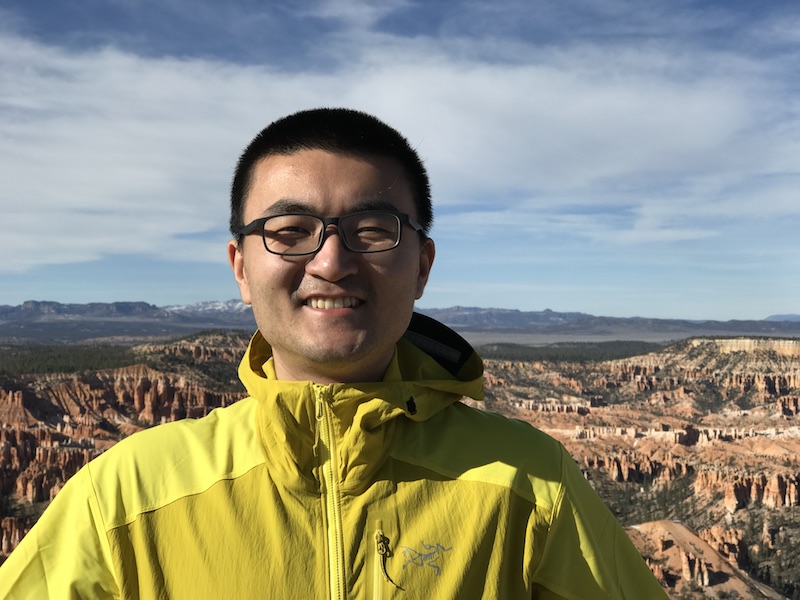
 Tianhao Wang
· 4 previous affiliations
- University of VirginiaSince 2022
- Assistant Professor · Since 2022
- Carnegie Mellon University2021–2022
- Postdoc · 2021–2022
- Purdue University West Lafayette2015–2021
- PhD student · 2015–2021
- Fudan University2011–2015
- Undergrad student · 2011–2015
3 other authors named Tianhao Wang: Tianhao Wang (University of California San Diego · 28 papers), Tianhao Wang (3 papers), Tianhao Wang (1 paper)
Research Overview
Tianhao Wang focuses on differential privacy, private machine learning, and the generation of synthetic data. His work spans foundational algorithms for local differential privacy to the evaluation of privacy risks in generative models and machine unlearning. Currently, he investigates deployable privacy-preserving systems, emphasizing rigorous empirical evaluation and differentially private adaptations for large language models.
Research Trajectory
Wang's early research concentrated heavily on the area of Local Differential Privacy for Decentralized Data Collection. In 2017, he presented Locally Differentially Private Protocols for Frequency Estimation, establishing foundational methods for aggregating user data without exposing individual records. He expanded on this by addressing the inherent noise in LDP systems; his 2020 paper, Locally Differentially Private Frequency Estimation with Consistency, introduced post-processing techniques that leverage the non-negative and sum-to-one properties of frequency distributions to significantly improve estimation accuracy. That same year, he and his collaborators developed frameworks for the Continuous Release of Data Streams under both Centralized and Local Differential Privacy, utilizing a privately estimated threshold and hierarchical aggregation to achieve substantial performance gains over prior methods. This focus on efficient LDP aggregation culminated in Locally Differentially Private Heavy Hitter Identification (2021), which introduced the Prefix Extending Method to strategically group users and identify the most frequent items in large datasets with high utility.
Around 2021, Wang's focus broadened to include the emerging field of Machine Unlearning for Regulatory Data Deletion Requirements. He investigated the unintended consequences of the "right to be forgotten" in When Machine Unlearning Jeopardizes Privacy. This work demonstrated that the unlearning process itself could leave imprints of the erased data, creating new vulnerabilities to membership inference attacks. This research contributed to critical sub-areas, including Sharded Model Isolation for Exact Machine Unlearning and the Robust Verification of Data Erasure in Machine Unlearning. He subsequently extended these erasure concepts to complex relational data structures in Graph Unlearning (2022).
As an Assistant Professor at the University of Virginia, Wang increasingly explored privacy within complex machine learning pipelines and generative AI. In the federated setting, he addressed the challenge of clustering shared entities across organizations with strict data silos in Differentially Private Vertical Federated Clustering (2022). Turning to generative models, his group developed PrivImage: Differentially Private Synthetic Image Generation using Diffusion Models with Semantic-Aware Pretraining (2023). By semantically selecting a highly relevant subset of public data for pre-training, this framework enabled the use of smaller, more stable diffusion models to generate high-quality synthetic images under strict privacy guarantees.
Concurrently, Wang audited the security and privacy risks inherent to modern generative architectures. He explored vulnerabilities in diffusion models in White-box Membership Inference Attacks against Diffusion Models (2023), advancing the broader study of Overfitting as a Privacy Side Channel in Machine Learning. To protect intellectual property against the destructive capabilities of diffusion-based editing tools, he introduced a latent-space optimization approach in A Somewhat Robust Image Watermark against Diffusion-based Editing Models. He also conducted a comprehensive audit of large language model adaptation techniques in Last One Standing: A Comparative Analysis of Security and Privacy of Soft Prompt Tuning, LoRA, and In-Context Learning (2023), revealing a stark trade-off where methods resistant to backdoors often proved highly vulnerable to membership inference.
Most recently, Wang has focused on bridging the gap between theoretical privacy guarantees and deployable systems. In 2025, he contributed to the growing area of Differentially Private In-Context Learning with Data-adaptive Differentially Private Prompt Synthesis for In-Context Learning. This work introduced AdaDPSyn, an algorithm that adaptively calibrates noise based on token prediction consensus, allowing LLMs to perform in-context learning on private data with high accuracy. He also addressed the practical challenges of synthetic data evaluation in Benchmarking Differentially Private Tabular Data Synthesis Algorithms (2025), proposing a unified framework to standardize the comparison of diverse synthesis methods. Finally, he expanded the scope of privacy research to infrastructure with Network-Aware Differential Privacy (2025), arguing that decentralized DP mechanisms must be co-designed with network routing and caching protocols to withstand real-world vulnerabilities.
Current Directions
The most recent papers in the evidence indicate a strong focus on making differential privacy practical and robust for modern AI deployments. A primary direction involves securing large language models, specifically designing adaptive noise mechanisms that allow LLMs to utilize private data for in-context learning without sacrificing utility. Additionally, Wang is working to standardize the evaluation of privacy-preserving systems, developing comprehensive benchmarks for tabular data synthesis to help practitioners navigate an increasingly crowded algorithmic landscape. Finally, his recent work investigates the intersection of privacy and networking, exploring how network-centric innovations can reinforce decentralized differential privacy mechanisms against infrastructure-level attacks.
Profile updated
Loading new papers…
Other researchers whose papers cluster into the same research directions — a proxy for overlapping technical interests and shared intellectual neighborhoods.
See something wrong? Report a mistake