

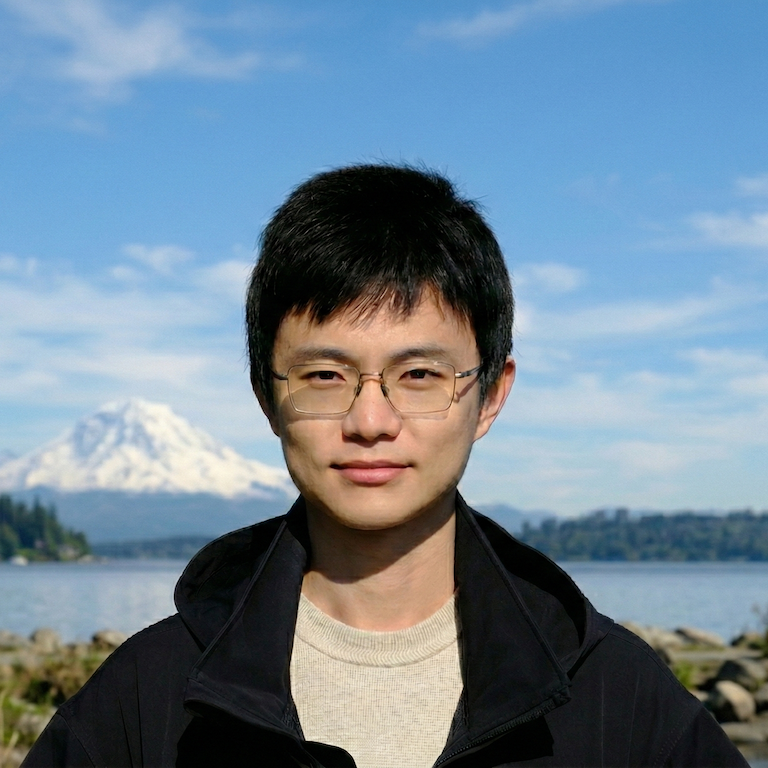
 Tiancheng Sun
· 3 previous affiliations
- Google (United States)Since 2021
- Researcher · Since 2021
- University of California San Diego2017–2021
- PhD student · 2017–2021
- Tsinghua University2013–2017
- Undergrad student · 2013–2017
Research Overview
Tiancheng Sun focuses on computer vision and graphics, with a particular emphasis on novel view synthesis, 3D reconstruction, and computational illumination. His early work addressed image restoration and the modeling of complex material reflectances, eventually leading to neural rendering techniques for portrait relighting. Recently, his research investigates 3D continuous learning in time and efficient feed-forward scene representations.
Research Trajectory
Sun's early research addressed fundamental challenges in computational photography and material modeling. In 2017, he investigated the pixel-wise similarity between color channels to correct optical degradations in consumer cameras. This work, detailed in Revisiting Cross-Channel Information Transfer for Chromatic Aberration Correction, contributed to the broader research direction of Algorithmic Compensation for Imperfect Optical Hardware and advanced techniques in the area of Cross-Channel Structural Guidance for Image Restoration, as well as the direction of Spatially Variant Kernel Prediction for Image Restoration. Concurrently, he explored the representation of real-world materials, developing methods to manipulate and compress bidirectional reflectance distribution functions (BRDFs). He introduced Attribute-preserving gamut mapping of measured BRDFs and subsequently proposed a robust data-driven framework for separating diffuse and specular components in Connecting measured BRDFs to analytic BRDFs by data-driven diffuse-specular separation.
Transitioning toward neural rendering and computational illumination, Sun focused heavily on portrait relighting and novel view synthesis. He developed Single image portrait relighting, a system that utilizes neural networks to manipulate the illumination of a subject from a single unconstrained photograph. Building on this, he addressed the ghosting artifacts common in sparse light stage captures with Light stage super-resolution: continuous high-frequency relighting, enabling the realistic rendering of continuous shadows and specularities. This trajectory naturally extended into 3D space with NeLF: Neural Light-transport Field for Portrait View Synthesis and Relighting, which predicts light-transport fields to synthesize portraits from new camera views under novel environmental lighting. Alongside facial relighting, he tackled the complex geometry of hair, proposing a line-based multi-view stereo solution in Human Hair Inverse Rendering using Multi-View Photometric data to reconstruct high-fidelity 3D hair strands and reflectance.
In 2022, Sun explored variance reduction in Monte Carlo rendering, contributing to Photon-Driven Neural Reconstruction for Path Guiding, which reconstructs high-quality sampling distributions from sparse photon samples. As the field of 3D generation evolved, he collaborated on Text2Immersion: Generative Immersive Scene with 3D Gaussians, a pipeline combining 2D diffusion models with 3D Gaussian Splatting to generate photorealistic environments from text. This work aligns with the broader research direction of Error Propagation in Monocular Depth Priors. He also contributed to real-time rendering architectures, participating in the development of Quark: Real-time, High-resolution, and General Neural View Synthesis.
More recently, Sun has guided research into efficient, feed-forward 3D scene representations, particularly focusing on dynamic scenes and primitive redundancy. His group introduced SplatVoxel: History-Aware Novel View Streaming without Temporal Training, which leverages a hybrid Splat-Voxel representation to resolve redundant and newly appearing content across frames. This was complemented by Learning Efficient Fuse-and-Refine for Feed-Forward 3D Gaussian Splatting, which merges and refines 3D primitives in a canonical space. Together, these projects significantly advance the research direction of Scaling 3D Representations Beyond the Memory Wall. Continuing this focus on geometric consistency, he collaborated on Selfi: Self Improving Reconstruction Engine via 3D Geometric Feature Alignment, a pipeline that improves multi-view feature alignment in vision foundation models for uncalibrated novel view synthesis.
Current Directions
Recent work investigates the efficiency and geometric consistency of feed-forward 3D scene representations. The most recent papers in the evidence address the limitations of pixel-aligned 3D Gaussian Splatting, particularly in dynamic environments where redundant primitives accumulate. To solve this, current research explores hybrid point-voxel architectures and "fuse-and-refine" mechanisms that merge overlapping primitives in a canonical 3D space, enabling high-quality, real-time reconstruction from sparse views. Additionally, ongoing work focuses on self-improving reconstruction engines that enforce explicit multi-view geometric consistency within vision foundation models, allowing for accurate novel view synthesis and pose estimation directly from uncalibrated image sets.
Profile updated
Loading new papers…
Other researchers whose papers cluster into the same research directions — a proxy for overlapping technical interests and shared intellectual neighborhoods.
See something wrong? Report a mistake