

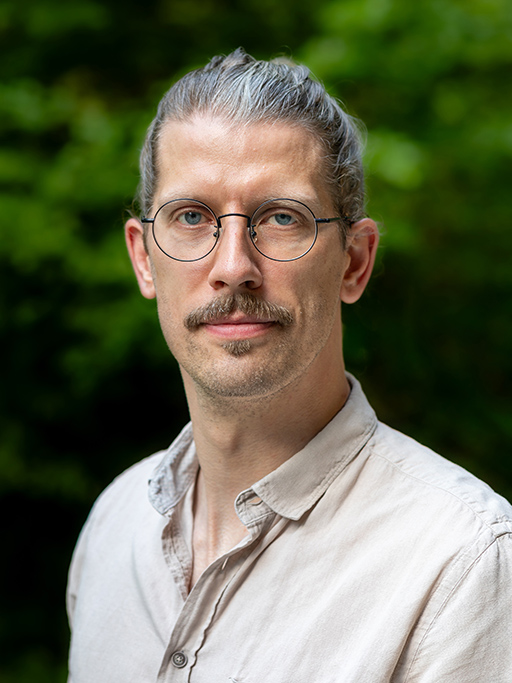
 Thomas Leimkuehler
· 2 previous affiliations
- Max Planck Institute for InformaticsSince 2021
- Principal Researcher · Since 2021
- Current
- PhD student · 2015–2019
- Postdoc · 2019–2021
Research Overview
Thomas Leimkuehler focuses on machine learning for visual computing, neural signal representations, and data-driven rendering. His trajectory spans early work in visual perception and novel-view synthesis to recent advances in neural fields and generative models for high dynamic range imaging. Currently, he investigates efficient neural rendering and physically-based inverse rendering techniques.
Research Trajectory
His early research centered on the intersection of visual perception, geometry, and rendering. This work began with investigations into human visual processing, such as What makes 2D-to-3D stereo conversion perceptually plausible? (2015). He subsequently explored geometric inference and view synthesis in Minimal Warping: Planning Incremental Novel-view Synthesis (2017), which addressed the challenges of generating new viewpoints from sparse data. Expanding on efficient rendering techniques, he developed Laplacian kernel splatting for efficient depth-of-field and motion blur synthesis or reconstruction (2018). By 2019, his focus increasingly incorporated learned statistics and neural reconstruction, evidenced by his work on DeepFovea: neural reconstruction for foveated rendering and video compression using learned statistics of natural videos and the introduction of Deep point correlation design.
In 2023, his research expanded significantly into generative models and continuous neural representations. He contributed to interactive image manipulation techniques with Drag Your GAN: Interactive Point-based Manipulation on the Generative Image Manifold. Concurrently, he became active in the research direction of Accelerating Neural Scene Representations for Real Time Rendering. With collaborators, he participated in the development of 3D Gaussian Splatting for Real-Time Radiance Field Rendering, a method that represents scenes as collections of 3D Gaussians paired with a visibility-aware rasterizer to achieve high-fidelity, real-time rendering.
During this period, his group also advanced the mathematical foundations of neural fields. He led the development of Neural Field Convolutions by Repeated Differentiation, which demonstrated that piecewise polynomial kernels become sparse after repeated differentiation, enabling efficient, spatially-varying convolutions directly on continuous visual data. Addressing complex optical phenomena, he introduced Neural Point Catacaustics for Novel-View Synthesis of Reflections. This Lagrangian approach explicitly models the movement of reflection points through space using a neural warp field, contributing to the broader area of High-Frequency Specular Reflections in Neural Radiance Fields. He also explored the area of Resolving the Material-Lighting Ambiguity in Inverse Rendering alongside collaborators in Diffusion Posterior Illumination for Ambiguity-aware Inverse Rendering, which integrated a denoising diffusion probabilistic model into a differentiable path tracer to handle the multi-modal distribution of possible scene decompositions.
A major, sustained theme in his recent trajectory is the research direction of Learning High Dynamic Range Reconstruction from Limited Data. He led the work on GlowGAN: Unsupervised Learning of HDR Images from LDR Images in the Wild (2023), which trains a generative adversarial network to synthesize high dynamic range (HDR) images from uncalibrated, low dynamic range (LDR) image collections. He further unified multi-focus and multi-exposure image stack reconstruction in An Implicit Neural Representation for the Image Stack: Depth, All in Focus, and High Dynamic Range. Continuing this focus into the area of Overcoming Sensor Saturation and Dynamic Range Clipping, he developed Exposure Diffusion: HDR Image Generation by Consistent LDR denoising (2024). This framework orchestrates multiple pre-trained LDR diffusion models to enforce consistency across exposure brackets, bypassing the need for massive HDR training datasets.
Most recently, his work has pushed the boundaries of continuous representations for fundamental graphics operations. With collaborators, he explored Learning Neural Antiderivatives (2025), training neural fields to represent repeated integrals of a function as a continuous analogue to summed-area tables. He also continues to advance the research direction of Mitigating the Volumetric Sampling Bottleneck in Neural Rendering, participating in the development of Splat the Net: Radiance Fields with Splattable Neural Primitives (2026).
Current Directions
The most recent papers in the evidence indicate a strong ongoing focus on refining neural representations for complex visual computing tasks. Current work investigates continuous mathematical formulations—such as neural antiderivatives—that allow traditional discrete graphics operations like filtering and integration to be performed efficiently on neural fields. Additionally, ongoing research addresses the optimization and structural consistency of radiance fields, utilizing splattable neural primitives to improve the compactness, queryability, and rendering speed of 3D scene representations.
Profile updated
| Title | Venue | Year |
|---|---|---|
| Faster 3D Gaussian Splatting Convergence via Structure-Aware Densification | Siggraph (conference Paper Track) | 2026 |
| Splat the Net: Radiance Fields with Splattable Neural Primitives | ICLR | 2026 |
| Volumetric Inverse Rendering via Neural Radiative Transfer | Computer Graphics Forum | 2026 |
| AlbedoEdit: Unified Instance-Level Video Editing with Albedo Guidance | arXiv | 2026 |
| Hybrid Image-based Rendering for Free-view Synthesis | Proceedings of the ACM on Computer Graphics and Interactive Techniques | 2025 |
| LEDiff: Latent Exposure Diffusion for HDR Generation | CVPR | 2025 |
| Physically-Based Lighting for 3D Generative Models of Cars | Computer Graphics Forum | 2024 |
| Who did it? How User Agency is influenced by Visual Properties of Generated Images | UIST | 2024 |
| Drag Your GAN: Interactive Point-based Manipulation on the Generative Image Manifold | arXiv | 2023 |
| Neural Field Convolutions by Repeated Differentiation | Openreview | 2023 |
Loading new papers…
Other researchers whose papers cluster into the same research directions — a proxy for overlapping technical interests and shared intellectual neighborhoods.
See something wrong? Report a mistake