

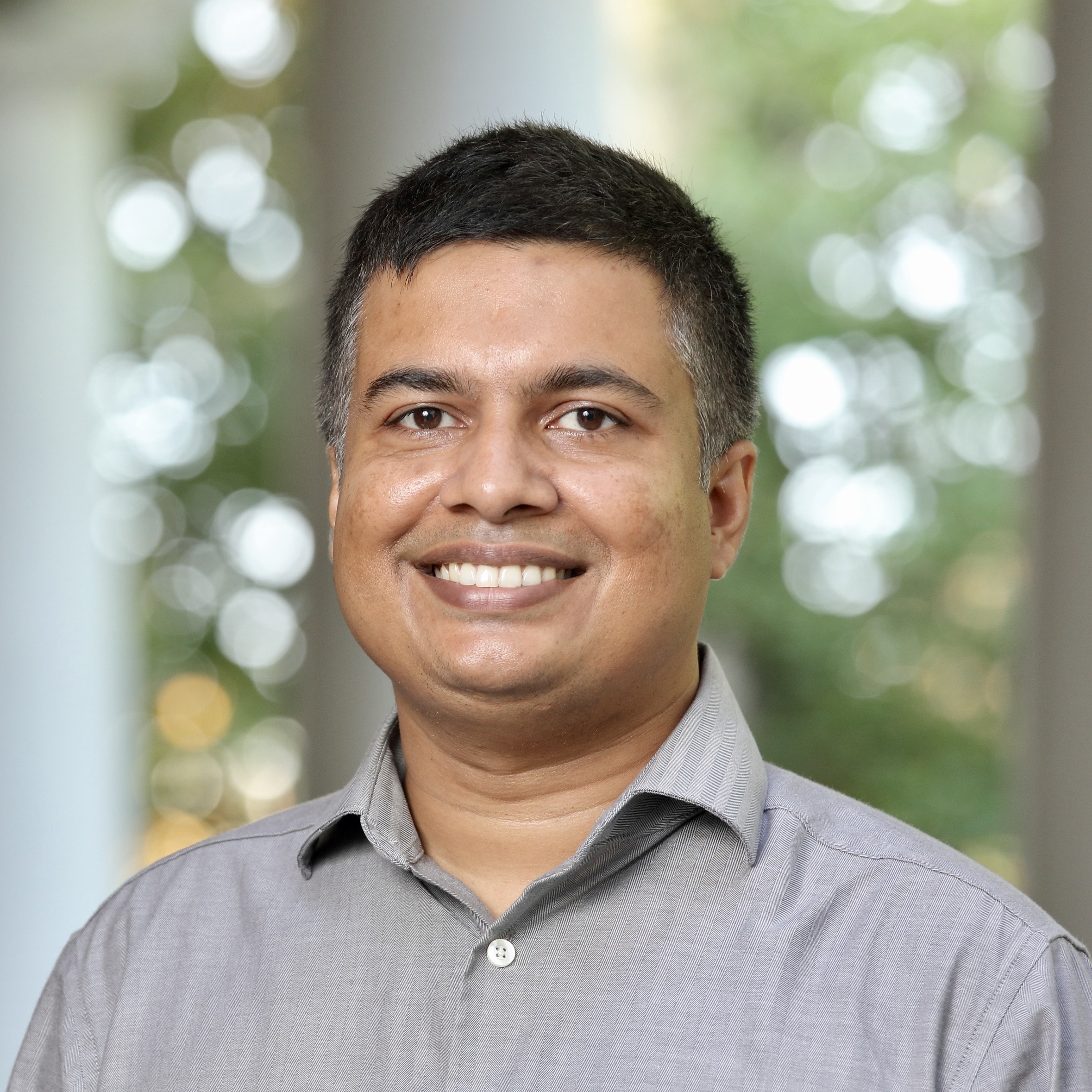
 Tariq Iqbal
· 3 previous affiliations
- University of VirginiaSince 2019
- Assistant Professor · Since 2019
- Postdoctoral Associate · 2017–2019
- University of California San Diego2014–2017
- PhD student · 2014–2017
Research Overview
Tariq Iqbal focuses on human-robot interaction, multimodal fusion, and embodied spatial reasoning in complex environments. His early work developed dynamical systems to detect and synthesize synchronous joint action between humans and robots. More recently, his research addresses perspective-aware multimodal referring expressions and the application of energy-based models to scale reasoning capabilities in artificial intelligence.
Research Trajectory
Iqbal’s early research investigated how robots can fluently coordinate with human teams by understanding and adapting to group motion in real time. He introduced methods to measure and model synchronous joint action, beginning with Mobile Robots and Marching Humans: Measuring Synchronous Joint Action While in Motion. Building on this foundation, he developed nonlinear dynamical approaches to automatically detect these interactions in Detecting and Synthesizing Synchronous Joint Action in Human-Robot Teams. This work culminated in a real-time anticipation framework that allowed an autonomous mobile robot to observe and successfully synchronize its movements with a team of human dancers, detailed in Movement Coordination in Human-Robot Teams: A Dynamical Systems Approach.
He later expanded on these foundations by developing neurobiologically-inspired algorithms for temporal anticipation and adaptation. In Temporal Anticipation and Adaptation Methods for Fluent Human-Robot Teaming, he demonstrated how robots can leverage a humanlike understanding of external and internal temporal changes to coordinate with humans during tempo-changing rhythmic tasks.
As his focus broadened to include complex communication modalities, Iqbal began addressing the challenges of embodied referring expressions—situations where humans use both verbal utterances and nonverbal gestures to refer to objects. His group developed CAESAR: An Embodied Simulator for Generating Multimodal Referring Expression Datasets to overcome the limitations of synthetic datasets that typically neglect nonverbal cues or capture them only from an exocentric perspective. This work contributes to the research direction of Perspective Taking in Multimodal Large Language Models. To handle the disparate characteristics of heterogeneous modalities like visual, skeletal, and physical sensor data, he introduced a memory-augmented recurrent approach in MAVEN: A Memory Augmented Recurrent Approach for Multimodal Fusion, which generates unimodal memory banks comprised of spatial-temporal features.
Recognizing that referring expressions depend heavily on the speaker's or observer's viewpoint, he subsequently developed a perspective-aware multitask model in PATRON: Perspective-Aware Multitask Model for Referring Expression Grounding Using Embodied Multimodal Cues. This research explicitly learns perspective grounding, advancing the broader area of Perspective Alignment for Embodied Spatial Reasoning. During this period, he also participated in collaborative work on self-supervised reinforcement learning, exploring the area of Task-Relevant Abstractions for Robust Visual Control through discrete information bottlenecks in Representation Learning in Deep RL via Discrete Information Bottleneck.
Returning to embodied communication, his lab introduced a novel fusion method to align visual and verbal data for agents interpreting speech alongside pointing and eye gaze in EQA-MX: Embodied Question Answering using Multimodal Expression. To facilitate broader studies of complex team dynamics—such as fairness, trust, and workload distribution—he directed the creation of an open-source framework for multi-human, single-robot collaboration, presented in CoHRT: A Collaboration System for Human-Robot Teamwork.
In parallel, Iqbal's research expanded into foundational model architectures and robust machine learning methodologies. He contributed to the design of frameworks that evaluate the compatibility between context and potential futures, rather than relying solely on next-token prediction. This work, detailed in Cognitively Inspired Energy-Based World Models, intersects with the research direction of Amortized Neural Samplers for Energy Based Models and enables dynamic computation allocation for complex reasoning. He also contributed to robust adaptation techniques, addressing source-free continual test-time adaptation via a dual-teacher framework in SloMo-Fast: Slow-Momentum and Fast-Adaptive Teachers for Source-Free Continual Test-Time Adaptation.
Continuing his focus on embodied interaction, his lab released a large-scale dataset capturing human-robot interactions across diverse settings and viewpoints, alongside a lightweight guided residual module for fusing speech and visual cues, in Embodied Referring Expression Comprehension in Human-Robot Interaction. Most recently, he advanced the area of Inference as Gradient Descent on Learned Energy Landscapes by framing prediction as an energy-minimization optimization problem. In Energy-Based Transformers are Scalable Learners and Thinkers, he demonstrated how these architectures can bridge the gap between fast, intuitive pattern matching and slow, deliberate reasoning, improving performance on out-of-distribution tasks.
Current Directions
The most recent papers in the evidence address the intersection of advanced reasoning architectures and embodied multimodal comprehension. Recent work investigates how energy-based models can scale reasoning capabilities by framing prediction as an energy-minimization problem, allowing models to dynamically allocate computation for complex tasks and out-of-distribution generalization. Concurrently, ongoing research in human-robot interaction focuses on bridging the view gap in egocentric vision and improving how agents process referring expressions that combine speech with nonverbal gestures in diverse, real-world environments.
Profile updated
Loading new papers…
Other researchers whose papers cluster into the same research directions — a proxy for overlapping technical interests and shared intellectual neighborhoods.
See something wrong? Report a mistake