

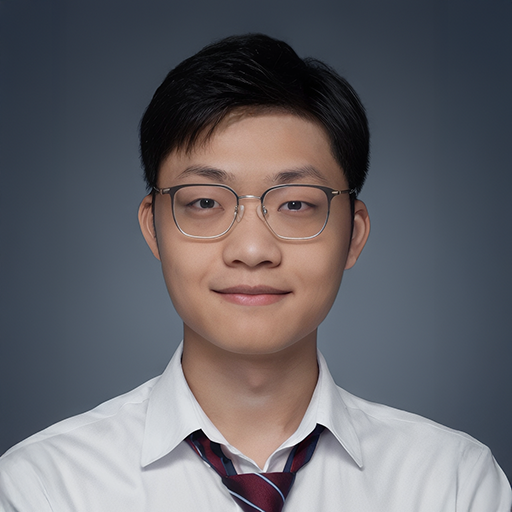
 Tao Huang
· 3 previous affiliations
- Shanghai Jiao Tong UniversitySince 2025
- Assistant Professor · Since 2025
- Current
- The University of Sydney2022–2025
- PhD student · 2022–2025
- Sensetime (China)2020–2022
- Researcher · 2020–2022
7 other authors named Tao Huang: Tao Huang (James Cook University · 25 papers), Tao Huang (Shanghai Jiao Tong University · 13 papers), Tao Huang (Beijing Jiaotong University · 3 papers), Tao Huang (Minjiang University · 1 paper), Tao Huang (CiaoAI · 1 paper), and 2 more
Research Overview
Tao Huang focuses on efficient deep learning algorithms, large vision-language models, and embodied artificial intelligence. His early trajectory centered on optimizing neural architecture search and knowledge distillation for computer vision. More recently, his research investigates video generative world models and the structural adaptation of state space models and transformers for resource-constrained environments.
Research Trajectory
During his early trajectory, Huang's research primarily addressed the computational bottlenecks of neural network design, contributing significantly to the area of Scaling Neural Architecture Search to Global Macro Topologies. He introduced GreedyNAS: Towards Fast One-Shot NAS with Greedy Supernet, which mitigates the massive compute waste of training supernets by filtering out weak architectures using an exploration-exploitation candidate pool. He expanded on this by decoupling topology learning from operation selection in Explicit Learning Topology for Differentiable Neural Architecture Search, enabling the discovery of more diverse cell structures while reducing parameter counts. With collaborators, he also integrated Monte Carlo tree search to capture layer dependencies in Prioritized Architecture Sampling With Monto-Carlo Tree Search, and further refined search efficiency in GreedyNASv2: Greedier Search with a Greedy Path Filter.
Building on his interest in compact models, Huang explored knowledge distillation to transfer capabilities from massive networks to smaller, more efficient ones. He developed a correlation-based loss framework in Knowledge Distillation from A Stronger Teacher to handle the severe prediction discrepancies that arise when teacher models are significantly stronger than their students. This work naturally led to contributions in the broader area of Selective Feature Distillation for Task-Relevant Learning. In Masked Distillation with Receptive Tokens, he introduced learnable embeddings to locate pixels of interest, ensuring student models focus on task-critical features rather than background noise. He later shifted this distillation process from the spatial to the frequency domain in FreeKD: Knowledge Distillation via Semantic Frequency Prompt, utilizing learnable prompts to filter noise and advance the research direction of Preserving Tiny Features Against Spatial Resolution Degradation. Concurrently, he investigated pure transformer architectures for edge devices, proposing a local-global broadcast attention mechanism in LightViT: Towards Light-Weight Convolution-Free Vision Transformers.
As large-scale generative and multimodal models gained prominence, Huang's focus expanded to include efficient synthesis and representation learning. He utilized diffusion models to generate challenging synthetic samples for active learning in Active Generation for Image Classification, drastically reducing the volume of synthetic data required to train robust classifiers. In layout-to-image synthesis, he developed Training-Free Composite Scene Generation for Layout-to-Image Synthesis, which constrains internal attention mechanisms to prevent overlapping objects from bleeding into one another. Addressing the memory footprint of long-context vision-language conversations, he introduced a training-free compression method in Cross-Self KV Cache Pruning for Efficient Vision-Language Inference. Returning to foundational architectures, he adapted state space models for mobile environments in EfficientVMamba: Atrous Selective Scan for Light Weight Visual Mamba. This architecture employs a skip-sampling scanning strategy, contributing to the research areas of Hybrid Convolutional State Space Models for Vision and Integrating Local Inductive Biases with Global Visual Context. He also applied information bottleneck principles to masked autoencoders in Learning Mask Invariant Mutual Information for Masked Image Modeling, maximizing relevant semantic information in the latent space to improve downstream detection and segmentation.
Most recently, Huang has addressed the reasoning bottlenecks of large vision-language models (VLMs) and their application to embodied AI. In the domain of robotic manipulation, he guided research into the spatial memory failures of Vision-Language-Action models, proposing solutions to help robots retain object permanence in Affordance Field Intervention: Enabling VLAs to Escape Memory Traps in Robotic Manipulation. Finally, he contributed to the research direction of Overcoming the Causality Curse in Visual Sequence Modeling by co-authoring Rethinking Causal Mask Attention for Vision-Language Inference, which demonstrates that relaxing text-based causal masks allows visual tokens to preview future context, significantly improving reasoning without additional training.
Current Directions
The most recent papers in the evidence indicate a strong focus on the efficiency and spatial reasoning capabilities of large vision-language models and embodied artificial intelligence. Current work investigates how foundational VLM architectures can be adapted for physical world interactions, particularly addressing spatial memory deficits and affordance tracking in robotic manipulation. Additionally, ongoing research explores fundamental modifications to transformer attention mechanisms—such as relaxing causal masks for visual tokens—to improve complex reasoning in multimodal sequences without the need for extensive retraining or expanded memory budgets.
Profile updated
Loading new papers…
Other researchers whose papers cluster into the same research directions — a proxy for overlapping technical interests and shared intellectual neighborhoods.
See something wrong? Report a mistake