

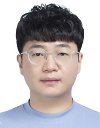
 Tackgeun You
· 2 previous affiliations
- Researcher · Since 2024
- Current
- PhD student · 2014–2024
Research Overview
Tackgeun You focuses on spatial intelligence, generative methods, and transfer learning within computer vision. His trajectory spans early work in visual tracking and domain adaptation to recent advancements in autoregressive image generation and implicit neural representations. Currently, he investigates 3D multi-person interaction geometry and scalable architectures for visual synthesis.
Research Trajectory
Early in his career, his research addressed fundamental challenges in computer vision and network optimization. He developed techniques for visual tracking, introducing Online Tracking by Learning Discriminative Saliency Map with Convolutional Neural Network, which utilized pre-trained convolutional neural networks to generate saliency maps that highlight discriminative target regions for accurate localization. Shifting toward the fundamental properties of deep learning models, he investigated network generalization in Regularizing Deep Neural Networks by Noise: Its Interpretation and Optimization. This work reinterpreted noise injection techniques, such as dropout, as optimizing a lower bound of the true objective function, contributing to the broader research direction of Regularizing Over-parameterized Neural Networks for Better Generalization.
Expanding into transfer learning, he explored methods to align models across different data distributions. In Domain-Specific Batch Normalization for Unsupervised Domain Adaptation, he proposed a two-stage framework that specializes batch normalization layers for source and target domains while sharing other model parameters. This approach advanced the area of Domain Specific Normalization for Multi Source Learning. Concurrently, he addressed video understanding and reasoning by introducing the Traffic Accident Benchmark for Causality Recognition. This dataset decomposed traffic accidents into cause and effect events, providing temporal intervals and semantic labels to facilitate complex environmental reasoning.
His work has also touched upon efficient search algorithms. With collaborators, he developed Bayesian optimization with approximate set kernels, a framework designed for functions that take sets as inputs rather than fixed-length vectors. By integrating a computationally efficient kernel with a symmetry-aware acquisition function, this research improved convergence on complex tasks, intersecting with the research directions of Nyström Subsampling for Scalable Kernel Methods and Breaking Symmetry to Prune Combinatorial Search Spaces.
In recent years, a significant portion of his trajectory has focused on generative modeling and implicit neural representations. He designed Locally Hierarchical Auto-Regressive Modeling for Image Generation, which utilized a pyramid of discrete codes to disentangle multi-level information, capturing high-level coarse structures while preserving fine details. Building on the flexibility of implicit functions, he subsequently introduced Generative Neural Fields by Mixtures of Neural Implicit Functions. This approach learned generative neural fields as linear combinations of implicit basis networks, enlarging model capacity while maintaining a small inference footprint.
Most recently, his research has bridged generative methods with spatial intelligence. He contributed to ContactField: Implicit Field Representation for Multi-Person Interaction Geometry, a novel implicit representation that simultaneously reconstructs body geometry and contact points without requiring explicit contact labels during training. This work addresses challenges in the area of Multi-Person Pose Estimation Under Heavy Occlusion. In parallel, he participated in the development of Spanning Tree Autoregressive Visual Generation, which utilizes traversal orders of uniform spanning trees to incorporate structural priors into image synthesis, advancing the broader area of Scaling From Class Conditional to Text to Image Generation.
Current Directions
The most recent papers in the evidence indicate a dual focus on spatial intelligence and scalable visual generation. In the 3D domain, recent work investigates implicit field representations capable of modeling complex multi-person interaction geometry. This involves reconstructing individual identities, body geometries, and precise contact points in environments with heavy occlusion, relying on global scene context rather than explicit contact annotations.
Concurrently, in the domain of visual synthesis, recent efforts address the structural limitations of conventional autoregressive models. By exploring novel sequence orderings—such as spanning tree traversals defined over image patches—this research aims to balance the inherent structural priors of images (like locality and center bias) with the flexible sequence generation required for downstream applications such as interactive image editing.
Profile updated
Loading new papers…
Other researchers whose papers cluster into the same research directions — a proxy for overlapping technical interests and shared intellectual neighborhoods.
See something wrong? Report a mistake