

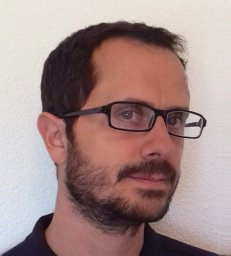
 Sylvain Calinon
· 3 previous affiliations
- École Polytechnique Fédérale de LausanneSince 2014
- Lecturer · Since 2014
- Postdoctoral Fellow · 2003–2007
- 1998–2007
- Master Student in Microengineering · 2001–2003
- Bachelor Student in Microengineering · 1998–2001
- Idiap Research InstituteSince 2014
- Senior Research Scientist · Since 2018
- Principal Researcher · 2014–2017
- Italian Institute of Technology2009–2014
- Principal Researcher · 2009–2014
Research Overview
Sylvain Calinon focuses on robot learning, optimal control, and human-robot collaboration. His research trajectory spans from early work on teaching humanoid robots through kinesthetic demonstrations to developing sophisticated geometric and probabilistic models for task representation. Currently, he investigates contact-rich manipulation and real-time trajectory optimization using tensor factorization and diffusion-based models.
Research Trajectory
Calinon’s early research established foundational methods for teaching robots through demonstration, enabling machines to acquire complex skills from human guidance. He introduced techniques for On Learning, Representing, and Generalizing a Task in a Humanoid Robot (2007), which allowed robots to model and reproduce human movements. This progressed into Dynamical System Modulation for Robot Learning via Kinesthetic Demonstrations (2008), formalizing how physical interactions could shape robotic control policies. He later synthesized these approaches in A tutorial on task-parameterized movement learning and retrieval (2016) and expanded them to human-robot interaction in Learning Physical Collaborative Robot Behaviors From Human Demonstrations (2016).
Moving toward complex geometric and priority-based control, he developed methods for Learning Task Priorities from Demonstrations in 2019. This work extended Gaussian Mixture Models to automatically resolve conflicts between operational space goals, such as hand positions, and configuration space constraints, like body posture. Recognizing that robotic data often resides on curved spaces rather than flat Euclidean planes, he explored the broader area of Geometric Control on the Special Euclidean Group. He co-authored Gaussians on Riemannian Manifolds: Applications for Robot Learning and Adaptive Control (2020), providing a unified probabilistic framework for handling rotations, joint limits, and stiffness ellipsoids naturally within robot learning algorithms.
By 2024, his focus expanded significantly to address the computational bottlenecks of contact-rich manipulation, contributing to work in the area of Scaling Robotic Control to High Dimensional Action Spaces. Because under-actuated dynamics and hybrid contact modes complicate planning, he introduced Learning Contact-rich Abstractions using Tensor Factorization (2024) to facilitate motion-level planning. This tensor-based approach was further expanded in Unifying Robot Optimization: Monte Carlo Tree Search with Tensor Factorization (2025), which reduces computational complexity from exponential to linear, enabling real-time global optimization. He also addressed contact dynamics analytically in A Smooth Analytical Formulation of Collision Detection and Rigid Body Dynamics With Contact (2025). To manage long-horizon tasks, he addressed sequential skill planning in Logic-Skill Programming: An Optimization-based Approach to Sequential Skill Planning (2024), advancing the broader area of Scaling Robotic Control to Long-Horizon Multi-Stage Tasks.
In parallel, Calinon investigated high-speed, dynamic environments, contributing to the research direction of Breaking the Quasi-Static Assumption for Agile Robotic Manipulation. This is evident in his work on robot air hockey: Energy-based Contact Planning under Uncertainty for Robot Air Hockey (2024) and Distilling Contact Planning for Fast Trajectory Optimization in Robot Air Hockey (2025). In these systems, complex contact reasoning was distilled into Energy-Based Models to achieve real-time execution that outperforms traditional control baselines.
Continuing into 2025 and 2026, he further integrated geometric principles into perception and planning, contributing to the research direction of Differentiable Distance Fields for Real Time Robot Control. In Configuration Space Distance Fields for Manipulation Planning (2024), he shifted obstacle distance representation into the robot's joint space to accelerate motion planning. He applied similar geometric reasoning to object-centric tasks in Object-centric Manipulation in Dynamic Environments using Diffused Orientation Fields (2025), enabling shape-invariant task descriptions. He also explored tactile perception in Diffusion-based Inverse Observation Model for Artificial Skin (2025), using generative models to estimate object poses from artificial skin data.
His recent collaborative work includes participating in the development of an ergonomic framework for human-robot interaction in Interactive Motion Planning for Human-Robot Collaboration Based on Human-Centric Configuration Space Ergonomic Field (2025), which intersects with the area of Null Space Projection for Redundant Robotic Systems. Most recently, he introduced Geometry-aware Policy Imitation (2026), treating demonstrations as continuous geometric curves to create highly efficient, non-parametric policies, and explored implicit adaptation in Robust contact-rich manipulation through implicit motor adaptation (2026) to handle uncertain physical properties during contact.
Current Directions
Recent work investigates highly dynamic and contact-rich robotic manipulation, emphasizing real-time adaptation and geometric representations. The most recent papers in the evidence address the use of continuous geometric curves for policy imitation, offering faster and more memory-efficient alternatives to standard diffusion-based models. Additionally, current research focuses on implicit motor adaptation to handle uncertain physical properties during contact, as well as integrating generative models with artificial skin for tactile pose estimation. This work collectively advances the ability of robots to operate robustly in unstructured, high-speed, and physically interactive environments.
Profile updated
Loading new papers…
Other researchers whose papers cluster into the same research directions — a proxy for overlapping technical interests and shared intellectual neighborhoods.
See something wrong? Report a mistake