

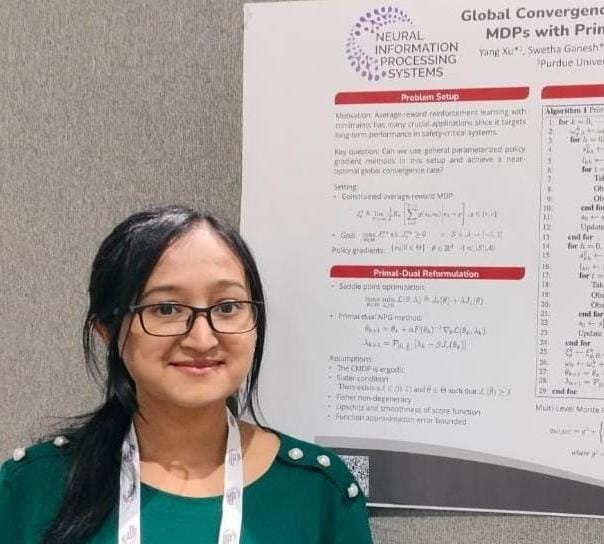
 Swetha Ganesh
· 2 previous affiliations
- Purdue University West LafayetteSince 2025
- Postdoc · Since 2025
- Indian Institute of Science BangaloreSince 2020
- PhD student · Since 2020
Research Overview
Swetha Ganesh focuses on reinforcement learning and stochastic optimization, with a particular emphasis on average-reward Markov decision processes and federated learning. Her trajectory spans from analyzing the sample complexity of momentum methods to developing variance-reduced policy gradient algorithms. Her current work investigates provable convergence guarantees for actor-critic methods in complex, infinite-horizon environments.
Research Trajectory
Ganesh's early work examined the theoretical foundations of stochastic optimization, specifically investigating the efficacy of momentum methods. In Does Momentum Help in Stochastic Optimization? A Sample Complexity Analysis (2023), she and her collaborators analyzed Stochastic Heavy Ball and Nesterov’s Accelerated Stochastic Gradient methods. This work demonstrated that when accounting for both bias and variance, these acceleration techniques do not universally improve performance. This analysis contributed to the research direction of The Tradeoff Between Acceleration and Variance in Stochastic Momentum and the broader area of The Equivalence of Momentum and Learning Rate Scaling. Concurrently, she explored robust distributed systems, introducing an asynchronous federated learning algorithm guaranteed to converge in the presence of malicious clients in Online Learning with Adversaries: A Differential-Inclusion Analysis.
Building on these foundations in distributed and robust learning, Ganesh expanded her focus to policy gradient methods in adversarial settings. In Global Convergence Guarantees for Federated Policy Gradient Methods with Adversaries (2024), she proposed a robust approach for federated reinforcement learning that maintains resilience against adversarial agents while achieving optimal sample complexity. This advanced the area of Federated Reinforcement Learning across Heterogeneous Environments.
During this period, her research heavily pivoted toward infinite-horizon average-reward Markov Decision Processes (MDPs). A central challenge in this domain is achieving optimal regret bounds without relying on prior knowledge of environment mixing times. In Variance-Reduced Policy Gradient Approaches for Infinite Horizon Average Reward Markov Decision Processes, she utilized variance-reduction and Hessian-aided techniques to bridge the gap to theoretical lower bounds. This work is central to the research direction of Reinforcement Learning Beyond the Ergodicity Assumption. She further addressed these challenges in An Accelerated Multi-level Monte Carlo Approach for Average Reward Reinforcement Learning with General Policy Parametrization, introducing a Randomized Accelerated Natural Actor Critic method. By integrating Multi-level Monte-Carlo sampling, this approach achieved a global convergence rate without requiring mixing time knowledge, advancing the area of Reinforcement Learning Without Mixing Time Oracles.
In 2025, Ganesh's work continued to refine actor-critic methods and policy gradient approaches for complex RL environments. In A Sharper Global Convergence Analysis for Average Reward Reinforcement Learning via an Actor-Critic Approach, she introduced MLMC-NAC, an algorithm that leverages Multi-level Monte Carlo sampling to provide convergence guarantees independent of state-space size, contributing to the field of Reinforcement Learning via Linear Function Approximation. She extended theoretical guarantees for neural network critics in Order-Optimal Global Convergence for Actor-Critic with General Policy and Neural Critic Parametrization, which presented the Natural Actor-Critic with Data Drop algorithm to improve sample efficiency over prior methods.
Her theoretical contributions to average-reward settings culminated in several key publications addressing regret and constraints. In Order-Optimal Regret with Novel Policy Gradient Approaches in Infinite-Horizon Average Reward MDPs, the research established that the average-reward function is approximately smooth and presented algorithms achieving theoretical lower bounds for expected regret. She also provided a rigorous regret analysis for unichain MDPs in Regret Analysis of Average-Reward Unichain MDPs via an Actor-Critic Approach, bridging the gap between practical actor-critic methods and long-term average-reward environments. Finally, with collaborators, she addressed constrained environments in Global Convergence for Average Reward Constrained MDPs with Primal-Dual Actor Critic Algorithm, introducing a Primal-Dual Natural Actor-Critic algorithm that achieves optimal convergence rates for large-scale constrained MDPs without requiring mixing time priors.
Current Directions
The most recent papers in the evidence address the theoretical limits of actor-critic algorithms in infinite-horizon average-reward settings. Current work investigates how to achieve order-optimal global convergence and regret bounds using general policy parameterizations, including neural network critics. A major ongoing theme is the elimination of restrictive assumptions—such as the need for mixing time oracles or finite state spaces—by employing advanced sampling techniques like Multi-level Monte Carlo estimation. Additionally, recent research extends these optimal convergence guarantees to constrained Markov Decision Processes, ensuring that reinforcement learning agents can safely and efficiently optimize long-term average rewards in complex, large-scale environments.
Profile updated
Loading new papers…
Other researchers whose papers cluster into the same research directions — a proxy for overlapping technical interests and shared intellectual neighborhoods.
See something wrong? Report a mistake