

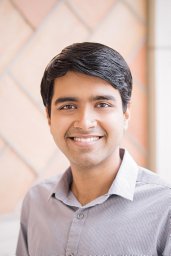
 Swarun Kumar
· 3 previous affiliations
- Carnegie Mellon UniversitySince 2016
- Sathaye Family Foundation Professor · Since 2024
- Associate Professor · 2021–2024
- Full Professor · 2016–2021
- Research Assistant · 2010–2015
- Teaching Assistant · 2013
- Bachelor's Degree, Computer Science and Engineering · 2006–2010
Research Overview
Swarun Kumar focuses on wireless networking, low-power sensing, and radio-frequency (RF) systems. His trajectory spans from optimizing LTE video streaming and passive RFID tracking to leading the development of batteryless assistive technologies and low-cost satellite receivers. Most recently, his work investigates machine learning techniques for enhancing millimeter-wave radar perception.
Research Trajectory
Swarun Kumar’s research trajectory began with contributions to mobile networking and wireless sensing systems. In his early collaborative work, he participated in optimizing cellular network performance, such as in piStream: Physical Layer Informed Adaptive Video Streaming over LTE, which proposed using physical-layer resource allocation data to estimate available bandwidth and improve adaptive HTTP video streaming.
By 2017, Kumar’s collaborative efforts expanded into passive radio-frequency identification (RFID) systems for human-computer interaction and ubiquitous sensing. He was a co-author on Towards Wearable Everyday Body-Frame Tracking using Passive RFIDs, a project that utilized wireless signals reflected off passive tags embedded in clothing to track a user's body movements without relying on external infrastructure. Building on these RFID sensing techniques, he also contributed to WiSh: Towards a Wireless Shape-aware World using Passive RFIDs, which demonstrated how battery-free tags could be used to infer the real-time geometry of ordinary surfaces, enabling applications ranging from posture-aware clothing to structural health monitoring.
In subsequent years, Kumar transitioned to a senior leadership role, directing research that applied RF systems to novel domains such as assistive technology and satellite networking. As the principal investigator on RFID Tattoo: A Wireless Platform for Speech Recognition, he led the development of a batteryless, flexible RFID system designed to assist individuals with voice impairments. The system recognized speech by capturing facial and lip gestures without requiring battery-powered sensors or manual input devices. Expanding his focus to global-scale networking, he also served as the senior author on SelfieStick: Towards Earth Imaging from a Low-Cost Ground Module Using LEO Satellites. This work addressed the high cost and sparse deployment of Low-Earth Orbit (LEO) satellite receivers by proposing a low-cost ground module to facilitate real-time access to overhead satellite imagery for applications like disaster tracking.
Most recently, Kumar has participated in research intersecting wireless sensing and machine learning for robotics. He contributed to High Resolution Point Clouds from mmWave Radar, which introduced an end-to-end neural network pipeline to generate lidar-quality point clouds from low-resolution millimeter-wave radar data, enabling robust perception in visually occluded environments.
Current Directions
The most recent work in the evidence indicates a dual focus on enhancing the perception capabilities of radio-frequency sensors and democratizing access to satellite networks. In the domain of wireless sensing, recent collaborative efforts investigate the application of machine learning to millimeter-wave radar, aiming to synthesize high-resolution, lidar-like point clouds that can operate reliably in visually degraded environments such as smoke or fog. Concurrently, Kumar's senior-authored work explores low-cost hardware and networking architectures to improve real-time access to Low-Earth Orbit satellite imagery, addressing critical infrastructure gaps in remote environmental monitoring and disaster response.
Profile updated
Loading new papers…
Other researchers whose papers cluster into the same research directions — a proxy for overlapping technical interests and shared intellectual neighborhoods.
See something wrong? Report a mistake